

That nagging ache above your heel isn't something to just push through. Here's what Achilles pain usually means, what tends to cause it, and what actually helps.
Right above your heel, there's a thick rope of tissue connecting your calf muscles to your heel bone. That's your Achilles tendon, and when it starts complaining, you feel it on almost every step. Walking up stairs, pushing off to start a jog, even just standing up after sitting too long: all of it routes through this one tendon.
Achilles pain is one of the most common lower-leg complaints out there, and for good reason. The tendon takes a beating. Weekend warriors who ramp up their mileage too fast, nurses who are on concrete floors for twelve-hour shifts, people who switch from sneakers to flat dress shoes for work; all of it can aggravate the area. Runners and court-sport athletes (think basketball, tennis, pickleball) tend to be the poster children for Achilles pain, but you don't have to be an athlete to end up with it. Plenty of people develop it just from daily life and the wrong shoes.
Here's the thing: "Achilles pain" describes a location, not a diagnosis. The same ache above your heel can come from a handful of different underlying issues, and they don't all respond to the same fix. Stretching helps some causes and aggravates others. That's why understanding what's actually going on matters more than just icing it and hoping it goes away.
This guide walks through what the pain typically feels like, what's commonly behind it, how footwear plays into the picture, and when it's time to stop self-managing and get it looked at.
Quick Answer: Achilles pain is discomfort, stiffness, or tenderness along the tendon connecting your calf muscles to your heel bone. It's most often related to overuse, tightness, or footwear issues affecting the tendon's mid-portion or its attachment at the heel. Most cases improve with activity changes, stretching, and supportive footwear, but persistent or sudden severe pain should be evaluated by a healthcare professional.
Featured Snippet: What Is Achilles Pain?Achilles pain refers to discomfort anywhere along the Achilles tendon, the band of tissue running from the calf muscles down to the back of the heel bone. It can show up as stiffness, aching, burning, or sharp pain, and it may be associated with overuse, tightness, or structural foot issues like flat feet.
Quick Symptom Checklist
If two or more of these sound familiar, the sections below will help you connect the dots.

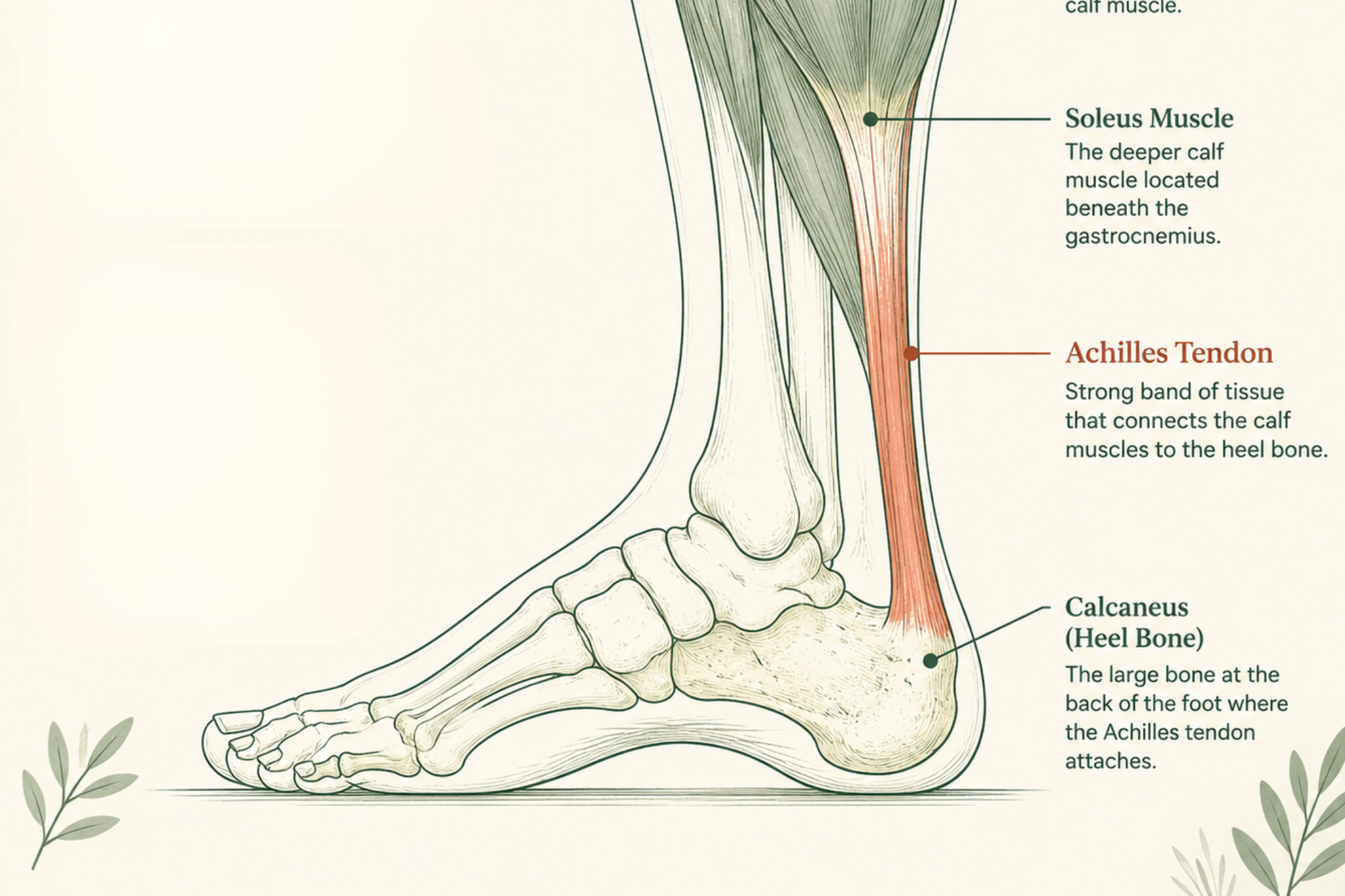
The Achilles tendon is the largest and strongest tendon in your body, and it has a pretty simple job: connect your calf muscles (the gastrocnemius and soleus, if you want the technical names) to your heel bone, called the calcaneus. A tendon, in plain terms, is just a tough cord of tissue that transmits force from a muscle to a bone. When your calf muscles contract, that pull travels down the tendon and lifts your heel, which is what lets you walk, run, climb stairs, and push up onto your toes.
Because it's doing that job thousands of times a day, the Achilles tendon absorbs an enormous amount of repetitive load. Estimates suggest it can handle forces several times your body weight during running and jumping. It's built for that kind of work, but "built for it" doesn't mean immune to it.
One distinction worth making early: Achilles pain is a symptom, not a diagnosis. Saying "my Achilles hurts" is like saying "my stomach hurts." It tells you where the problem is, but several different conditions can produce that same feeling. A healthcare professional's job is to figure out which one you're dealing with. This article's job is to help you understand the possibilities so that conversation is more productive.
Location is one of the more useful clues your body gives you, even though it's not the whole story.
Mid-portion pain. This shows up about two to four inches above where the tendon meets the heel bone. It's the most common spot for pain related to overuse and tendinopathy (more on that term shortly), partly because blood flow to this section of the tendon is naturally a bit more limited than the rest.
Pain near the heel insertion. This is right where the tendon attaches to the back of the heel bone. Pain here can feel sharper and is often associated with the tendon's attachment point itself, sometimes alongside a bony bump that we'll cover later.
Pain higher into the calf. Less common, but some people feel discomfort higher up, closer to where the tendon blends into the calf muscle. This can sometimes indicate a strain higher in the muscle-tendon unit rather than the tendon itself.
One-sided versus both-sided. Pain in just one Achilles is more typical of overuse or a specific footwear or training issue. Pain in both tendons at once is less common from simple overuse and may be associated with broader factors like inflammatory conditions, which we'll touch on further down.

Tightness in the back of the ankle, especially during the first few steps after getting out of bed or standing up after a period of rest.
Soreness or sensitivity when pressing directly on the Achilles tendon, particularly along the mid-portion or where it attaches to the heel.
A puffy or thickened appearance along the tendon that may sometimes feel warm or irritated after activity.
A hot, irritated feeling in the back of the ankle that may develop during exercise or become more noticeable afterward.
Discomfort and stiffness that tend to be worse immediately after waking up but often improve as the tendon warms up with movement.
A feeling of reduced strength or confidence when pushing off your toes while walking, climbing stairs, or running.
The Achilles tendon may feel wider, lumpier, or more rope-like than usual when touched.
Difficulty fully flexing the foot upward, often accompanied by a sensation of tightness in the calf muscles or back of the ankle.
Self-Check: Stand with your injured-side foot flat on the ground and try to rise onto your toes, holding onto something stable for balance. Mild discomfort can happen with several causes of Achilles pain. A sudden inability to push off at all, or a feeling that something "gave way," is different and should be evaluated promptly. We'll cover this distinction in the warning signs section below.
There's a wide range of potential causes here, from simple overuse to structural foot issues to, in rare cases, medication side effects. The most common culprits get the deepest explanation below; the less common ones are still worth knowing about, just in a tighter format.
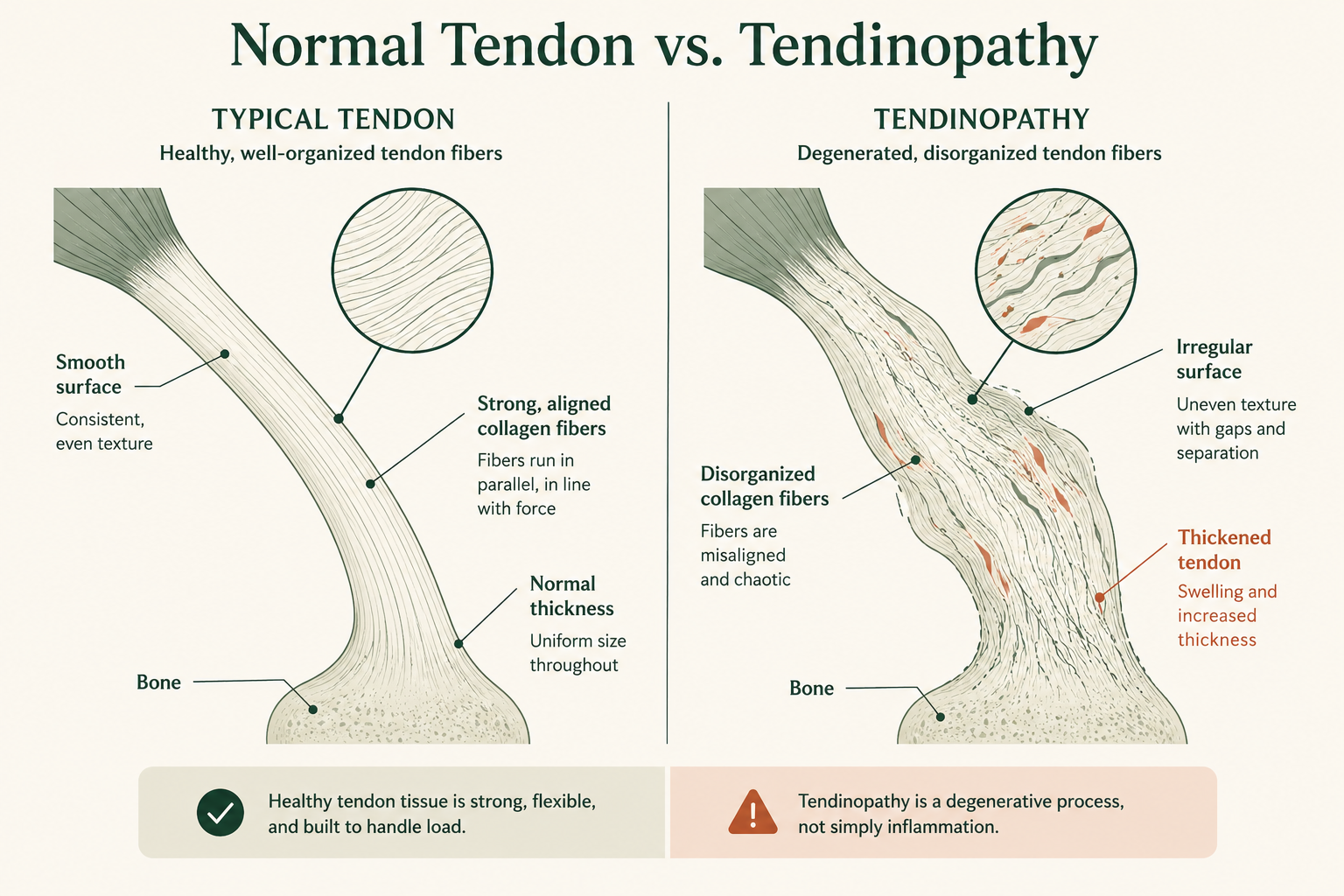
Tendinopathy is the general, current medical term for a tendon that's become painful and changed in structure from repetitive stress, without necessarily being "inflamed" in the classic sense. Research over the past couple of decades has shown that what used to get lumped in as inflammation is often actually a breakdown and disorganization of the collagen fibers that make up the tendon, plus some new blood vessel growth into areas that don't normally have much blood supply.
Why it causes pain: As the tendon's fiber structure becomes disorganized, the tendon loses some of its normal strength and elasticity, making it more sensitive to load and movement.
Common symptoms: Gradual onset of stiffness and aching, usually in the mid-portion, that's often worse at the start of activity and after periods of rest, and may ease somewhat once you're warmed up.
Typical risk factors: Repetitive loading over weeks or months, sudden increases in activity, tight calf muscles, and footwear that doesn't support the tendon's natural mechanics.
You'll see "tendonitis" and "tendinopathy" used interchangeably a lot, including in older medical literature, but they technically describe different things. Tendonitis specifically implies active inflammation, which tends to be more relevant in the earlier, acute stages of an Achilles injury, often after a specific incident or a sharp increase in activity.
Why it causes pain: True inflammation brings swelling, heat, and chemical irritation to the area, which directly triggers pain signals.
Common symptoms: More noticeable swelling and warmth compared to chronic tendinopathy, often appearing relatively quickly after a specific activity or event.
Typical risk factors: A sudden spike in activity, a new exercise routine, or a single overload event like a hard sprint or an unaccustomed hike.
This is less a single diagnosis and more a description of how a lot of Achilles problems start. Doing too much, too soon, too often, without adequate recovery between sessions, is one of the most common paths to Achilles pain, whether it ends up being classified as tendonitis or tendinopathy.
Why it causes pain: Tendons adapt to load, but they adapt more slowly than muscles do. Ramping up mileage, intensity, or standing time faster than the tendon can keep up with leaves it under-recovered and increasingly irritated.
Common symptoms: A pattern of pain that builds over days or weeks rather than appearing suddenly, often tracking closely with a specific change in activity level.
Typical risk factors: New training programs, returning to activity after time off, occupational standing or walking that increased recently, and inconsistent rest days.
Your calf muscles and Achilles tendon function as one continuous unit, so tightness upstream in the calf directly changes the load the tendon has to absorb.
Why it causes pain: Tight calf muscles reduce ankle flexibility, which can force the Achilles tendon to stretch and work harder during normal movement than it would with more flexible calves.
Common symptoms: Morning stiffness, a pulling sensation when flexing the foot upward, and discomfort that sometimes improves temporarily after stretching.
Typical risk factors: Sedentary periods, high heel use, prolonged sitting, and skipping mobility work, especially in people who also run or play court sports.
Closely related to general overuse, but specific enough to call out on its own: a rapid jump in training volume or intensity is one of the most reliably documented triggers for Achilles injuries.
Why it causes pain: The tendon hasn't had time to adapt its collagen structure to the new demand, so it experiences microscopic strain faster than it can repair.
Common symptoms: Pain that appears within days of starting a new program, increasing race distance, adding hill or speed work, or significantly increasing standing hours at work.
Typical risk factors: Couch-to-running programs, returning athletes, new jobs requiring more time on feet, and seasonal activity changes (think the first warm weekend of spring).
Shoes interact with the Achilles tendon more than most people realize, mostly through heel height and how much support the shoe offers around the back of the ankle.
Why it causes pain: Shoes with minimal cushioning, an unstable heel, or a sudden drop in heel height compared to what you're used to wearing can change the angle and load on the tendon with every step.
Common symptoms: Pain that correlates with specific footwear, such as new shoes, going barefoot or in flat sandals after wearing supportive shoes, or switching workout shoes.
Typical risk factors: Frequent shoe rotation without an adjustment period, worn-out shoes that have lost cushioning, and footwear with little to no heel-to-toe drop introduced too quickly.
Flat feet, where the arch sits lower than typical, often go hand in hand with overpronation, which is when the foot rolls inward more than usual during walking or running.
Why it causes pain: Overpronation changes the angle at which the Achilles tendon pulls on the heel bone, introducing a twisting or "whipping" type of stress that a neutral foot strike doesn't create to the same degree.
Common symptoms: Pain that may be felt more on the inner side of the tendon, sometimes alongside arch fatigue or inner ankle discomfort.
Typical risk factors: Naturally low or flexible arches, worn-out shoes that no longer offer arch support, and increased time on feet without supportive footwear. If this sounds like your situation, our flat feet guide covers the condition itself in more depth.
The opposite foot structure can create problems too, just through a different mechanism.
Why it causes pain: High, rigid arches tend to reduce the foot's natural shock absorption, transmitting more force directly up through the tendon with each step.
Common symptoms: Pain that may be felt more centrally in the tendon, sometimes paired with general foot stiffness.
Typical risk factors: Naturally high arches, minimal cushioning footwear, and high-impact activities like running on hard surfaces.
This one's a bony bump, not a soft tissue issue on its own, though it frequently irritates soft tissue nearby. It's a bony enlargement on the back of the heel bone, sometimes nicknamed "pump bump" because rigid-backed shoes can aggravate it.
Why it causes pain: The bony prominence can rub against the back of shoes and create friction against the Achilles tendon and the bursa (a small fluid-filled cushion) that sits near it, leading to irritation in both the tendon and surrounding tissue.
Common symptoms: A noticeable hard bump on the back of the heel, with pain and redness that's often worse with stiff-backed shoes.
Typical risk factors: A naturally high-arched foot structure, tight Achilles tendons, and footwear with rigid heel counters worn consistently.
A step beyond tendinopathy, a partial tear means some of the tendon's fibers have actually torn rather than just becoming irritated or disorganized.
Why it causes pain: Torn fibers create a more acute injury response, and the remaining intact fibers have to handle more relative load, which can perpetuate pain and weakness.
Common symptoms: A sudden increase in pain, often after a specific movement, along with new or worsening weakness during push-off.
Typical risk factors: Pre-existing tendinopathy that's gone unaddressed, sudden forceful movements, and a history of recurring Achilles pain.
Certain inflammatory conditions, like reactive arthritis or ankylosing spondylitis, can affect tendon attachment points, including the Achilles, as part of a broader pattern in the body.
Why it causes pain: These conditions can cause inflammation specifically at the spot where tendons attach to bone, a site that's somewhat differently structured from the rest of the tendon.
Common symptoms: Pain that may affect both Achilles tendons at once, sometimes alongside other joint symptoms elsewhere in the body.
Typical risk factors: A personal or family history of inflammatory arthritis conditions, and age ranges where these conditions more commonly first appear (often younger adults).
A specific class of antibiotics, fluoroquinolones (common brand names include Cipro and Levaquin), carries a recognized association with tendon problems, including the Achilles.
Why it causes pain: The exact mechanism isn't fully settled, but these medications are thought to affect tendon collagen structure directly in some people.
Common symptoms: Achilles pain that develops during or shortly after a course of fluoroquinolone antibiotics, sometimes with little or no preceding activity change.
Typical risk factors: Current or recent fluoroquinolone use, older age, and concurrent corticosteroid use. Anyone noticing Achilles pain that started during one of these prescriptions should mention it to their prescriber.
Pain in the middle portion of the Achilles tendon is most commonly associated with Achilles tendinopathy, tendonitis, or repetitive overuse injuries. This area is particularly vulnerable because it naturally receives less blood flow than other portions of the tendon.
Pain where the Achilles tendon attaches to the heel bone may be associated with insertional Achilles tendinopathy or irritation related to Haglund's deformity. Symptoms are often more noticeable during walking, climbing stairs, or after prolonged standing.
A painful bump on the back of the heel may be associated with Haglund's deformity or irritation of the nearby bursa, a small fluid-filled sac that helps reduce friction between tissues.
Discomfort that extends higher into the lower leg may sometimes be associated with calf muscle tightness or a strain where the calf muscles transition into the Achilles tendon.
A sudden sharp pain accompanied by a popping sensation may indicate a partial or complete Achilles tendon tear. This type of injury should be evaluated promptly by a healthcare professional, especially if walking or pushing off the affected foot becomes difficult.
Pain location is a helpful clue, not a diagnosis. The same spot can hurt for different reasons in different people, and several causes can overlap. This table is meant to help you describe your symptoms more precisely, not to replace an evaluation.
People describe it in a lot of different ways, and the description itself can be informative:
Aching is the most common description, usually a dull, persistent discomfort that's there throughout activity.
Burning often shows up during or right after exercise, especially with tendinopathy.
Tightness is frequently a morning symptom, tied to calf and tendon stiffness after rest.
Pulling is sometimes described when stretching or flexing the foot, particularly with calf tightness as a contributing factor.
Sharp pain is more concerning, especially if it appears suddenly during a specific movement, and is worth paying closer attention to.
Morning stiffness that eases within the first several minutes of moving around is a classic tendinopathy pattern.
Pain after exercise that wasn't present during the activity itself can sometimes indicate a tendon that's reacting to load after the fact.
Pain during activity that's present from the first step is a different pattern and may point toward a more acute issue.
A handful of factors show up again and again in people dealing with Achilles pain:
Footwear is one of the few Achilles pain factors you have direct, daily control over, and it's often underestimated. A handful of specific shoe features can meaningfully change the load and angle your Achilles tendon deals with.
Heel-to-toe drop refers to the height difference between the heel and forefoot of a shoe. A moderate drop (generally in the 8-12mm range) can reduce the amount of stretch the Achilles experiences with each step compared to a zero-drop shoe, which may be worth considering during a flare-up, even if you eventually want to work toward a lower-drop shoe long term.
Cushioning in the heel area helps absorb impact before it travels up through the tendon, which can reduce the cumulative load over a long day of walking or standing.
Heel counter stability (the structured part of the shoe wrapping around your heel) helps control excess foot motion, including the overpronation that can twist the Achilles tendon with each step.
Rocker soles are built with a curved sole profile that helps roll your foot through each step, which can reduce the amount of ankle flexion required and ease strain on the tendon during push-off.
Flexibility in the right zones matters too. Too rigid through the forefoot can force extra ankle motion to compensate, while too flexible offers little support during push-off.
Arch support that matches your foot type (flat, neutral, or high arch) helps keep the whole lower leg's mechanics more consistent, indirectly supporting the tendon.
Fit around the heel collar matters more for the Achilles than almost any other shoe-fit factor. A heel collar that rubs or sits too low can directly irritate the tendon and the Haglund's-prone area discussed earlier, while one that's too loose won't offer the stability you need.
Moderate Heel-to-Toe Drop
May reduce strain on the Achilles tendon by slightly decreasing the amount of tendon stretch that occurs with each step during a flare-up.
Heel Cushioning
Helps absorb impact forces before they reach the Achilles tendon, potentially improving comfort during walking and standing.
Stable Heel Counter
Provides rearfoot stability and may help control excessive pronation that can increase stress on the tendon.
Rocker Sole Design
Reduces the amount of ankle flexion required during push-off, decreasing demand on the Achilles tendon during gait.
Appropriate Flexibility
A shoe should balance support with natural foot movement. Excessively rigid or overly flexible shoes may not be ideal for every individual.
Arch Support Matched to Foot Type
Proper support can help promote more consistent lower-leg mechanics and reduce unnecessary strain on the tendon.
Well-Fitted Heel Collar
Helps minimize rubbing and pressure around the back of the heel, reducing irritation near the tendon and heel bone.
Quick Footwear Checklist for Achilles Pain
✅ Moderate Heel-to-Toe Drop (8–12mm)
May help reduce strain on the Achilles tendon by limiting excessive stretch during walking and running.
✅ Cushioned Heel
Helps absorb impact forces before they reach the tendon.
✅ Stable Heel Counter
Provides rearfoot stability and may reduce excessive motion that places stress on the Achilles.
✅ Rocker Sole Design
Reduces ankle flexion demand during push-off, decreasing workload on the tendon.
✅ Secure Heel Fit
Keeps the foot stable within the shoe and minimizes unnecessary movement.
❌ Extremely Worn-Out Shoes
Compressed cushioning and reduced stability can increase stress on the Achilles tendon.
❌ Sudden Transition to Minimalist Footwear
A rapid change may increase Achilles loading before the tendon has adapted.
❌ Loose Heel Collars That Rub the Tendon
Can cause irritation and discomfort around the back of the heel and tendon insertion.
If you're trying to figure out which specific shoes check these boxes, that's exactly the kind of side-by-side comparison we're building out next. Keep an eye out for our upcoming Best Shoes for Achilles Pain roundup, where we'll break down drop, stability, and heel-collar fit across the models most commonly recommended for this exact issue.
The following are general educational strategies, not personalized medical advice. What works varies by underlying cause, so consider discussing any new routine with a healthcare professional, especially if symptoms are more than mild.
Activity modification is usually the first and most important step: temporarily reducing the activities that clearly aggravate the tendon, without necessarily stopping movement altogether.
Calf stretching is commonly recommended, though it's worth noting that stretching can help some causes of Achilles pain and may aggravate others (particularly some insertional issues near the heel bone), so it's worth getting personalized guidance rather than assuming more stretching is always better.
Eccentric strengthening, which involves slowly lengthening the calf muscle under control (like slowly lowering your heel off a step edge), has a meaningful amount of research support for certain types of tendinopathy, though it's typically introduced gradually and under guidance.
Ice can help take the edge off acute discomfort and swelling, particularly after activity.
Temporary heel lifts, whether built into a shoe or added as an insert, can reduce tendon stretch in the short term while symptoms settle.
Footwear changes, as discussed above, are often one of the more immediately actionable steps available.
Physical therapy is frequently the most effective long-term path for persistent Achilles issues, since a physical therapist can identify the specific contributing factors at play and build a program around them rather than a generic one-size-fits-all approach.
Most Achilles discomfort is manageable, but certain signs mean it's time to stop self-treating and get evaluated:
These signs of a possible Achilles tendon rupture should be evaluated promptly. This isn't the kind of injury where waiting it out is a reasonable strategy.
Can Achilles pain go away on its own?
Mild, recent-onset Achilles pain related to a temporary increase in activity sometimes improves with rest and activity modification alone. However, ongoing tendinopathy often needs more active management, like targeted strengthening, to fully resolve, since the underlying tendon changes don't necessarily reverse with rest alone.
What is the difference between Achilles tendonitis and tendinopathy?
Tendonitis specifically refers to active inflammation, typically in the earlier stages after a specific overload event. Tendinopathy is the broader, currently preferred term for ongoing tendon pain and structural changes that may not involve significant inflammation, especially once the issue has been present for a while. In casual conversation, people often use the terms interchangeably.
Can shoes cause Achilles pain?
Footwear can be one possible cause, particularly when shoes have an unstable heel, minimal cushioning, or a heel-to-toe drop that changes significantly from what your tendon is used to. Sudden footwear changes, like switching to minimalist shoes too quickly, are a commonly cited contributing factor.
Does walking help Achilles pain?
This depends heavily on the cause and severity. Gentle walking is often fine and sometimes even helpful for circulation, but walking through sharp pain, or walking in footwear that aggravates the area, can slow things down. This is a good question to bring to a healthcare professional for guidance specific to your situation.
Can Achilles pain be caused by walking too much?
Yes. Long periods of walking, especially on hard surfaces or in unsupportive footwear, can overload the Achilles tendon. This is particularly common when walking volume increases suddenly or when calf tightness and foot mechanics place additional stress on the tendon.
Should I stretch my Achilles tendon?
Stretching can be helpful for some causes, like general calf tightness, but may not be appropriate for every type of Achilles pain, particularly some insertional issues near the heel. A healthcare professional or physical therapist can help determine whether stretching is right for your specific situation.
How long does Achilles pain last?
This varies widely depending on the underlying cause and how it's managed. Mild, activity-related irritation may ease within a couple of weeks. More established tendinopathy can take several weeks to a few months of consistent management to meaningfully improve. Persistent pain beyond a few weeks is a reasonable signal to seek evaluation rather than continuing to self-manage indefinitely.
Can flat feet cause Achilles pain?
Yes, flat feet and the overpronation that often comes with them can change the angle at which the Achilles tendon pulls on the heel bone, which may be associated with increased strain over time. Supportive footwear and, in some cases, orthotics are commonly discussed options for this contributing factor.
❌ Myth: Achilles pain only affects runners.
✅ Fact: Runners are commonly affected, but nurses, retail workers, teachers, and anyone else spending long hours on their feet can develop Achilles pain too. Occupational standing and unsupportive footwear are significant contributing factors well outside of sports.
❌ Myth: Rest alone fixes Achilles injuries.
✅ Fact: Rest helps reduce acute irritation, but ongoing tendinopathy often needs active rehabilitation, like progressive strengthening, to address the underlying tendon changes. Pure rest without a follow-up plan sometimes leads to symptoms returning once activity resumes.
❌ Myth: Achilles tendonitis and tendinopathy are the same thing.
✅ Fact: They're related but technically distinct. Tendonitis implies active inflammation, usually early on, while tendinopathy describes the broader pattern of tendon pain and structural change that's now considered the more accurate term for most longer-term cases.
❌ Myth: If I can walk, my Achilles isn't injured.
✅ Fact: Many Achilles injuries, including some partial tears, still allow walking, just with discomfort or altered mechanics. The ability to walk doesn't rule out a meaningful injury, which is part of why persistent pain deserves an actual evaluation rather than being judged solely by whether you can still get around.
❌ Myth: Flat feet never affect the Achilles tendon.
✅ Fact: Flat feet and the overpronation associated with them are a well-recognized contributing factor to Achilles strain, due to the altered angle of pull on the tendon during walking and running.
❌ Myth: Surgery is usually required.
✅ Fact: The large majority of Achilles tendon issues, including most tendinopathy and even many partial tears, are managed successfully with non-surgical approaches like activity modification, physical therapy, and footwear changes. Surgery is generally reserved for specific situations, such as complete ruptures or cases that haven't responded to extended conservative treatment.
Achilles pain has a way of nagging at you long after you've stopped thinking about whatever caused it. The good news is that most cases respond well to the basics: understanding what's actually going on, adjusting the activities and footwear that are aggravating it, and giving the tendon a real chance to recover rather than just pushing through. Pay attention to what your pain is telling you, where it's located, what makes it better or worse, and don't hesitate to bring those details to a healthcare professional if things aren't improving. Your Achilles tendon does a lot of work for you every single day. A little informed attention now can save you a lot of frustration later.