

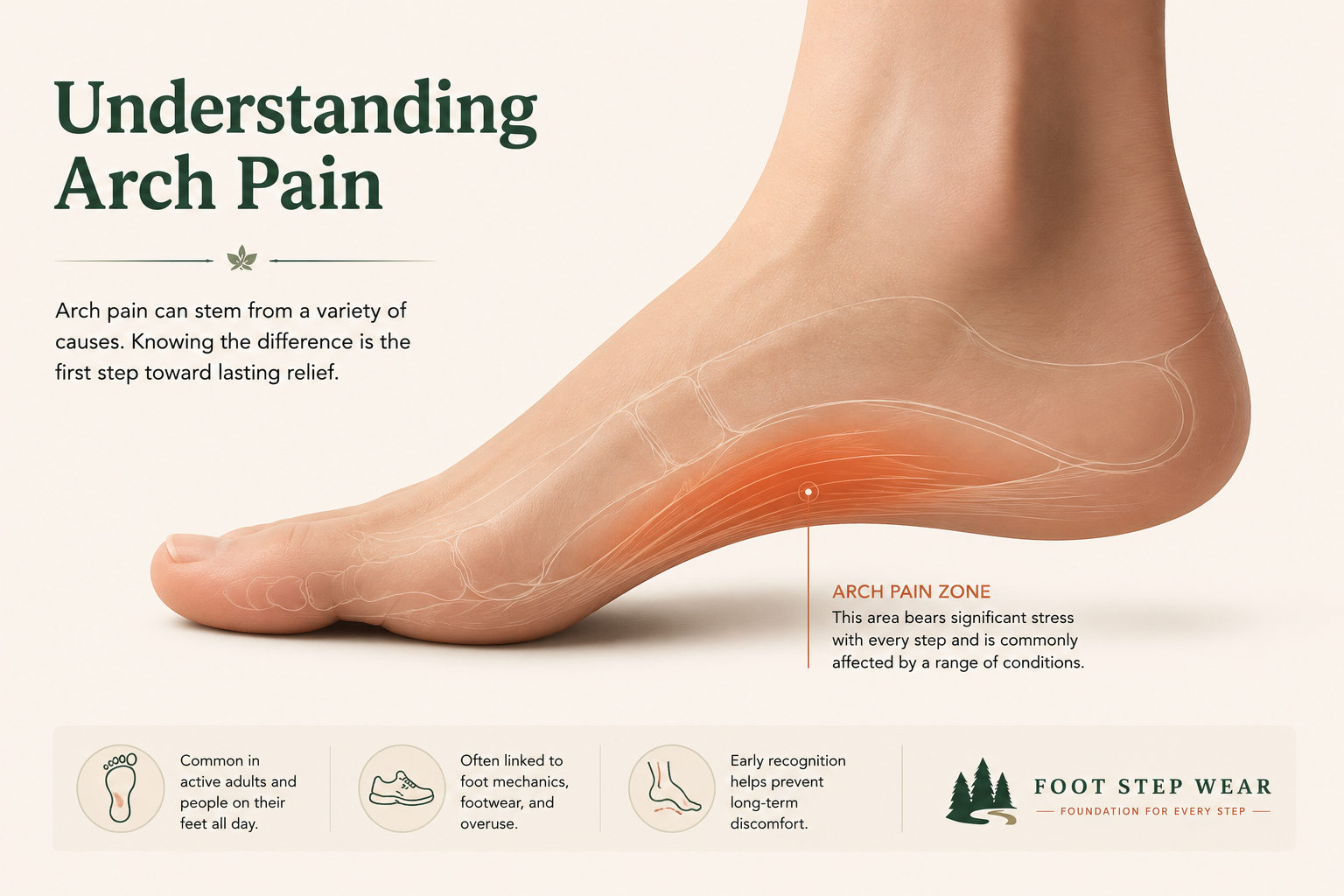
Arch pain has several distinct causes, each with its own pattern. This guide helps you identify what's driving your pain based on location and symptoms, then walks through proven treatment options and what to look for in supportive footwear
Arch pain is almost never a diagnosis on its own. It's a symptom, and the cause usually comes down to one of a handful of culprits: plantar fasciitis, flat feet, high arches, posterior tibial tendon dysfunction, or overuse from too much time on your feet in the wrong shoes. The most common cause is plantar fasciitis, which causes pain along the bottom of the arch that's sharpest with your first steps in the morning.
The fastest way to narrow things down is to notice where the pain sits and how your foot is shaped. Pain along the inner arch that's worse in the morning points toward plantar fasciitis. A flattened, collapsing arch with pain that builds throughout the day suggests flat feet or posterior tibial tendon dysfunction. A high, rigid arch with pain under the ball of the foot or heel often means it isn't absorbing shock well.
Most arch pain responds well to supportive footwear, targeted stretching and strengthening, and short-term activity changes within 6 to 12 weeks. Use the breakdown below to identify what's driving your pain, then move into the treatment section to build a plan around the actual cause.
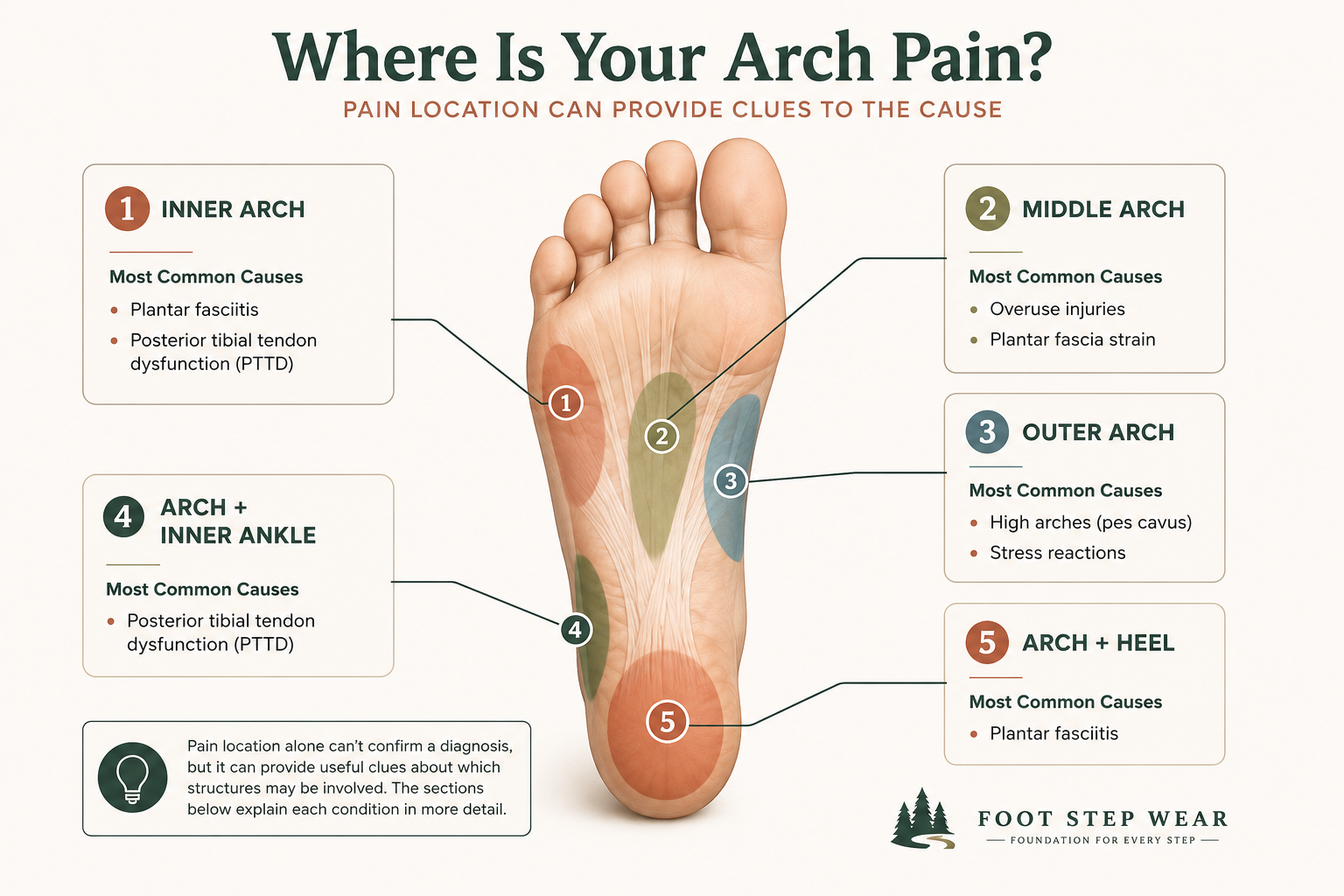
Pinpointing exactly where along the arch your pain sits is a useful clue for narrowing down the cause.
Where Is Your Arch Pain Located?
Most Common Causes
Most Common Causes
Most Common Causes
Most Common Causes
Most Common Causes
If your pain matches one of these patterns closely, the corresponding section below walks through that cause in detail.
Most arch pain is mechanical and manageable at home, but a few symptoms point to something that needs prompt evaluation rather than a wait-and-see approach. Seek medical care promptly if you experience:
These signs can indicate a stress fracture, tendon rupture, or nerve involvement that needs care beyond footwear changes and stretching, so it's worth getting checked rather than pushing through it.
Arch pain refers to discomfort anywhere along the underside of the foot between the ball and heel, the region supported by the foot's arch system. The foot has three arches working together: the medial longitudinal arch (the main arch most people picture, along the inner foot), the lateral longitudinal arch (smaller and flatter, along the outer foot), and the transverse arch (running side to side across the midfoot). Most arch pain involves the medial arch, since it bears the most load and has the least natural bone support.
The medial arch relies heavily on the plantar fascia, a thick band of connective tissue running from heel to toes, along with supporting muscles, ligaments, and the posterior tibial tendon, which runs along the inside of the ankle and helps hold the arch in shape. Together, these structures absorb shock and distribute weight evenly as the foot rolls from heel to toe. When any one is irritated, overloaded, or compromised, pain shows up along the arch.
Roughly one in four adults experience arch or foot pain significant enough to affect daily activity. Identifying which structure is involved matters, since the right treatment for plantar fasciitis can do very little for PTTD, and vice versa.
Arch pain doesn't feel the same for everyone, and the specific sensation often hints at what's going on underneath.
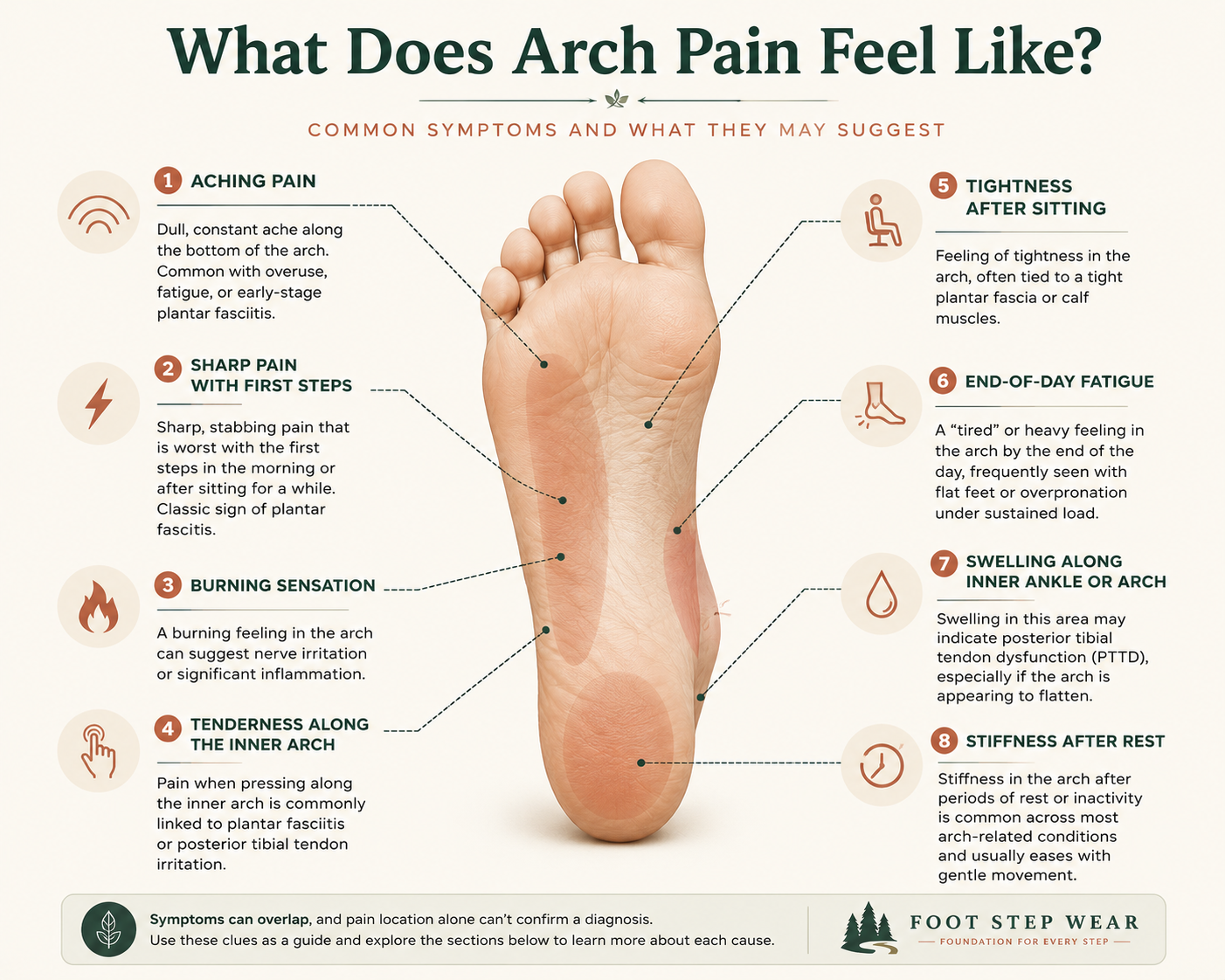
The way arch pain feels can provide useful clues about what's causing it. While symptoms alone can't confirm a diagnosis, certain patterns tend to appear more frequently with specific conditions.
What It May Suggest
General overuse, foot fatigue, or early-stage plantar fasciitis.
What It May Suggest
A classic sign of plantar fasciitis. Pain is often worst in the morning and improves after a few minutes of walking.
What It May Suggest
Nerve irritation or significant inflammation within the foot.
What It May Suggest
Often associated with plantar fasciitis or posterior tibial tendon irritation.
What It May Suggest
Commonly linked to plantar fascia tension or tight calf muscles.
What It May Suggest
Frequently seen with flat feet, overpronation, or prolonged standing.
What It May Suggest
May indicate posterior tibial tendon dysfunction (PTTD), especially if the arch appears to be flattening.
What It May Suggest
Common across many arch conditions and often improves with gentle movement.
Symptoms also vary depending on activity and time of day, which is part of why identifying the underlying cause, rather than just treating "arch pain" generically, leads to better results.
Arch pain typically comes from one of eight overlapping categories: irritation of the plantar fascia, a structural arch that's too flat or too high, a failing posterior tibial tendon, overuse, footwear that isn't doing its job, a stress fracture, or arthritis. Each has a distinct pattern.
Plantar fasciitis is the most common cause of arch pain by a wide margin. It develops when the plantar fascia, the band of tissue running along the bottom of the foot, becomes irritated from repetitive strain, often due to tight calf muscles, sudden activity increases, or unsupportive footwear. The hallmark pattern is sharp pain at the bottom of the arch that often radiates toward the heel, worst with the first few steps in the morning, easing as the tissue warms up, then sometimes returning after long periods on your feet. Arch pain near the heel that follows this pattern is one of the clearest signs that plantar fasciitis is the cause. Most cases improve within 6 to 12 weeks with consistent stretching, supportive shoes, and activity modification. See our complete guide to plantar fasciitis for more.
Flat feet occur when the medial arch collapses or never fully develops, causing more of the sole to contact the ground than it should. This often leads to overpronation, where the foot rolls inward excessively with each step, straining the plantar fascia, posterior tibial tendon, and surrounding muscles. Not everyone with flat feet experiences pain, but when they do, it tends to build throughout the day rather than appear suddenly. We cover this condition in full in our complete guide to flat feet.
A high, rigid arch doesn't flatten or flex the way a typical arch does when absorbing impact, so less shock from walking or running gets distributed across the foot. Pressure instead concentrates on the ball of the foot and heel, with the arch itself sometimes feeling tight or strained. High arches are less common than flat feet but tend to cause more concentrated, pressure-point pain rather than the diffuse fatigue associated with flat feet.
The posterior tibial tendon runs along the inside of the ankle and is largely responsible for holding the medial arch in position while you walk. When this tendon becomes inflamed, overstretched, or starts to fail, often gradually with no single triggering injury, the arch can flatten progressively, sometimes called adult-acquired flatfoot. Early signs include pain and swelling along the inner ankle and arch, particularly during or after activity. Left untreated, PTTD tends to worsen, which makes early evaluation more important here than with most other causes. See our complete guide to posterior tibial tendon dysfunction for more.
Arch pain frequently develops because the tissues involved haven't adapted to a new level of demand. A new running routine, a sudden increase in walking distance, or a job shift to longer hours on your feet can outpace what the plantar fascia, tendons, and small foot muscles are conditioned to handle. The result is a slow buildup of irritation rather than a single injury moment, which is why overuse-related arch pain often gets dismissed early, only to worsen with continued activity.
Shoes that lack adequate arch support, have worn-out midsoles, or simply don't match your foot's structure are a common, frequently overlooked contributor to arch pain. A shoe can look fine externally while the internal cushioning has broken down well past the point of being useful, particularly with regular use for walking, standing, or running. Minimalist or unsupportive flats can aggravate arch pain in people who need more structure underfoot. See our guide to the best shoes for arch pain for specific recommendations.
Less common than the other causes here, a stress fracture in one of the small bones of the midfoot can mimic soft tissue irritation at first. The key distinguishing feature is that stress fracture pain worsens with continued activity and does not improve with rest, unlike plantar fasciitis or general fatigue-related arch pain. Stress fractures require medical evaluation, often including imaging, and a genuine reduction in weight-bearing activity to heal properly.
Both osteoarthritis and inflammatory arthritis, such as rheumatoid arthritis, can affect the small joints within the midfoot and arch, leading to pain, stiffness, and sometimes visible swelling. Arthritis-related arch pain tends to be more constant and less activity-dependent than mechanical causes like plantar fasciitis, often with morning stiffness that lasts longer than the brief stiffness typical of plantar fascia irritation.
Several factors make arch pain more likely, regardless of the underlying cause:
One of the most common questions isn't what's causing arch pain, it's whether to push through it or stop. The answer depends on how the pain behaves, not just how much it hurts in the moment.
Mild discomfort that doesn't worsen as you continue is generally okay to work through, especially with supportive footwear, shorter sessions, or stretch breaks. This level often responds well to the treatment approaches covered later in this guide without requiring a full stop in activity.
Increasing pain that gets steadily worse the longer you're on your feet is a signal to scale back, not push through. Continuing on arch pain that's actively worsening tends to delay recovery and can turn a mild issue into a stubborn one.
Sharp, sudden pain during walking or running, especially if it's new or more intense than your baseline, is a sign to stop and assess. Arch pain when walking that feels sharp rather than achy often points to acute irritation that benefits from a few days of reduced load.
Pain that doesn't improve with rest and worsens with continued activity raises the possibility of a stress fracture, one of the few situations where continuing to walk or run can genuinely make things worse. Arch pain after running that doesn't ease up over a day or two warrants medical evaluation rather than continued activity.
As a rule, mechanical arch pain like plantar fasciitis eases once you're warmed up, while pain that worsens the more you use the foot deserves caution. When in doubt, scaling back for a few days while starting supportive treatment is a reasonable middle ground.
Most arch pain can be reasonably narrowed down through a combination of self-assessment and a clinical evaluation, with imaging reserved for specific situations.
Self-identification starts with the same questions this guide walks through: where exactly the pain sits, when it's worst, and what your foot looks like when you're standing versus sitting. Noticing whether your arch appears unusually flat, unusually high, or seems to be changing shape over time narrows the likely cause considerably before you ever see a provider.
Clinical evaluation by a podiatrist, orthopedist, or sports medicine doctor typically includes a physical exam checking arch height while standing and sitting, tenderness location, range of motion, and gait assessment to see how your foot moves through each step. Providers will also ask about activity history, footwear, and any recent changes in routine.
Imaging isn't necessary for most straightforward cases of plantar fasciitis, but it becomes useful when symptoms don't fit a typical pattern, don't improve with standard treatment, or suggest a stress fracture or tendon tear. X-rays can assess bone alignment and rule out fractures, while ultrasound or MRI can evaluate soft tissue damage in the plantar fascia or posterior tibial tendon in more detail.
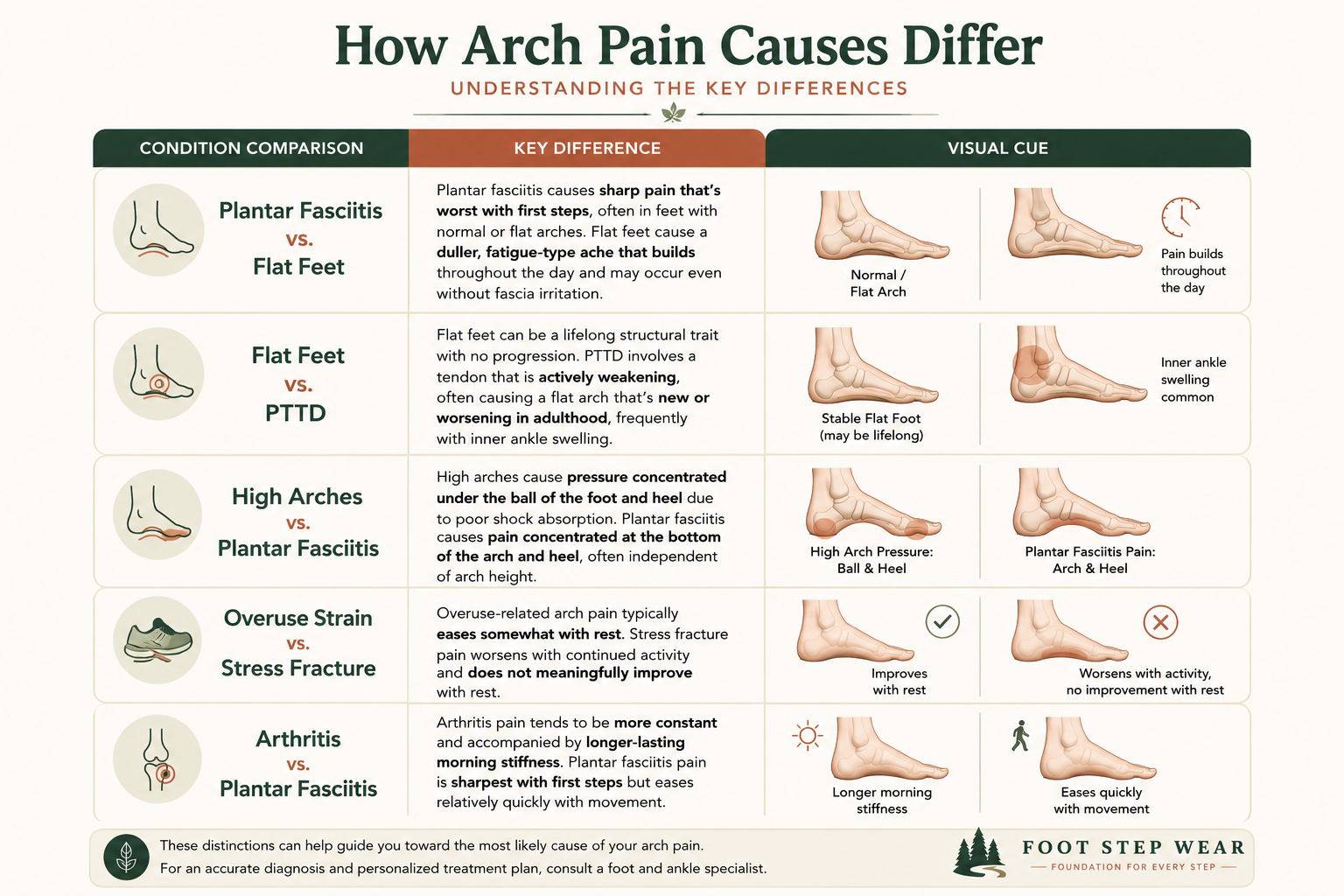
Many causes of arch pain share similar symptoms, making self-diagnosis difficult. The comparisons below highlight the differences that most often help distinguish one condition from another.
Most arch pain responds well to conservative treatment, and the right combination depends on which underlying cause is in play.
Temporarily reducing high-impact activity, such as running or jumping sports, while substituting lower-impact alternatives like swimming or cycling allows irritated tissue to recover without losing fitness entirely. This matters most for overuse injuries and stress fractures, where continuing to load the area can slow healing.
Switching to shoes with proper arch support, a stable heel counter, and adequate cushioning is one of the highest-impact changes for nearly every cause on this list. Worn-out shoes lose this support well before they look damaged, so replacing shoes used regularly for walking or running every 300 to 500 miles matters more than most people expect.
Over-the-counter inserts can provide reasonable arch support and pressure redistribution for mild to moderate cases, especially paired with supportive footwear. Custom orthotics, molded to your foot, tend to be reserved for more significant issues like advancing PTTD or pain that hasn't responded to OTC options after several weeks. Neither type "fixes" the underlying cause, but both can meaningfully reduce strain while other treatments take effect.
When arch pain doesn't improve with home stretching and footwear changes, a physical therapist can provide a more structured plan, including manual therapy, targeted strengthening, and gait analysis. This is particularly useful for PTTD, where progressive tendon weakening benefits from professional guidance.
Short-term use of ice, OTC anti-inflammatory medication, or rest from aggravating activity can help manage pain and swelling while other treatments address the underlying cause. These help with symptom control but don't resolve structural issues like flat feet or PTTD on their own.
Surgery is uncommon for arch pain and generally only considered after 6 to 12 months of consistent conservative treatment without improvement, most often for advanced PTTD where the tendon has significantly weakened. Even then, outcomes vary, and most people with arch pain never need to consider it.
The exercises below target the structures most involved in arch pain: the calf muscles, the plantar fascia, and the small muscles that support the arch from underneath. Consistency matters more than intensity. Daily practice for 6 to 8 weeks beats occasional aggressive sessions.
Purpose: Reduces tension transferred from tight calf muscles into the plantar fascia and arch.
How To: Stand facing a wall with your hands against it. Step one foot back, keeping that leg straight and heel flat. Bend your front knee slightly and lean forward until you feel a stretch in the back calf. Hold, then switch sides.
Sets & Reps: 3 sets of 30 seconds per side, once or twice daily.
Common Mistakes: Letting the back heel lift off the ground, and bouncing instead of holding a steady stretch.
Purpose: Directly targets the band of tissue along the bottom of the foot, improving flexibility and reducing morning stiffness.
How To: Sit and cross the affected foot over your opposite knee. Grab your toes and gently pull them back toward your shin until you feel a stretch along the arch. You can also roll the arch over a frozen water bottle for added relief.
Sets & Reps: 10 reps, holding each for 10 seconds, before getting out of bed and again later in the day.
Common Mistakes: Pulling too aggressively, and skipping the morning repetition, when the fascia is tightest.
Purpose: Strengthens the small muscles that support the arch from underneath, reducing reliance on passive structures like the plantar fascia.
How To: While seated or standing, try to shorten your foot by drawing the ball toward your heel without curling your toes. You should feel the arch lift and the muscles underneath engage.
Sets & Reps: 2 sets of 10 holds, 5 seconds each, daily.
Common Mistakes: Curling the toes instead of engaging the arch muscles, the most common error.
Purpose: Builds strength in the muscles along the bottom of the foot and toes, supporting better arch function during walking and standing.
How To: Sit with a small towel laid flat under your foot. Use your toes to scrunch the towel toward you, then reset and repeat.
Sets & Reps: 2 to 3 sets of 10 curls per foot, several times a week.
Common Mistakes: Using mostly ankle movement instead of isolating the toes.
Purpose: Activates the small muscles between the toes that support overall foot stability, while maintaining toe joint flexibility.
How To: Sit or stand with your foot flat. Spread your toes apart as wide as possible without using your hands, hold briefly, then relax. For added mobility, follow each spread by curling your toes under.
Sets & Reps: 2 sets of 10 holds, 5 seconds each, daily.
Common Mistakes: Expecting visible results quickly. These small muscles respond slowly and consistency over several weeks matters more than effort in any single session.
Recovery time depends heavily on the underlying cause, how long symptoms were present before treatment started, and how consistently treatment is followed.
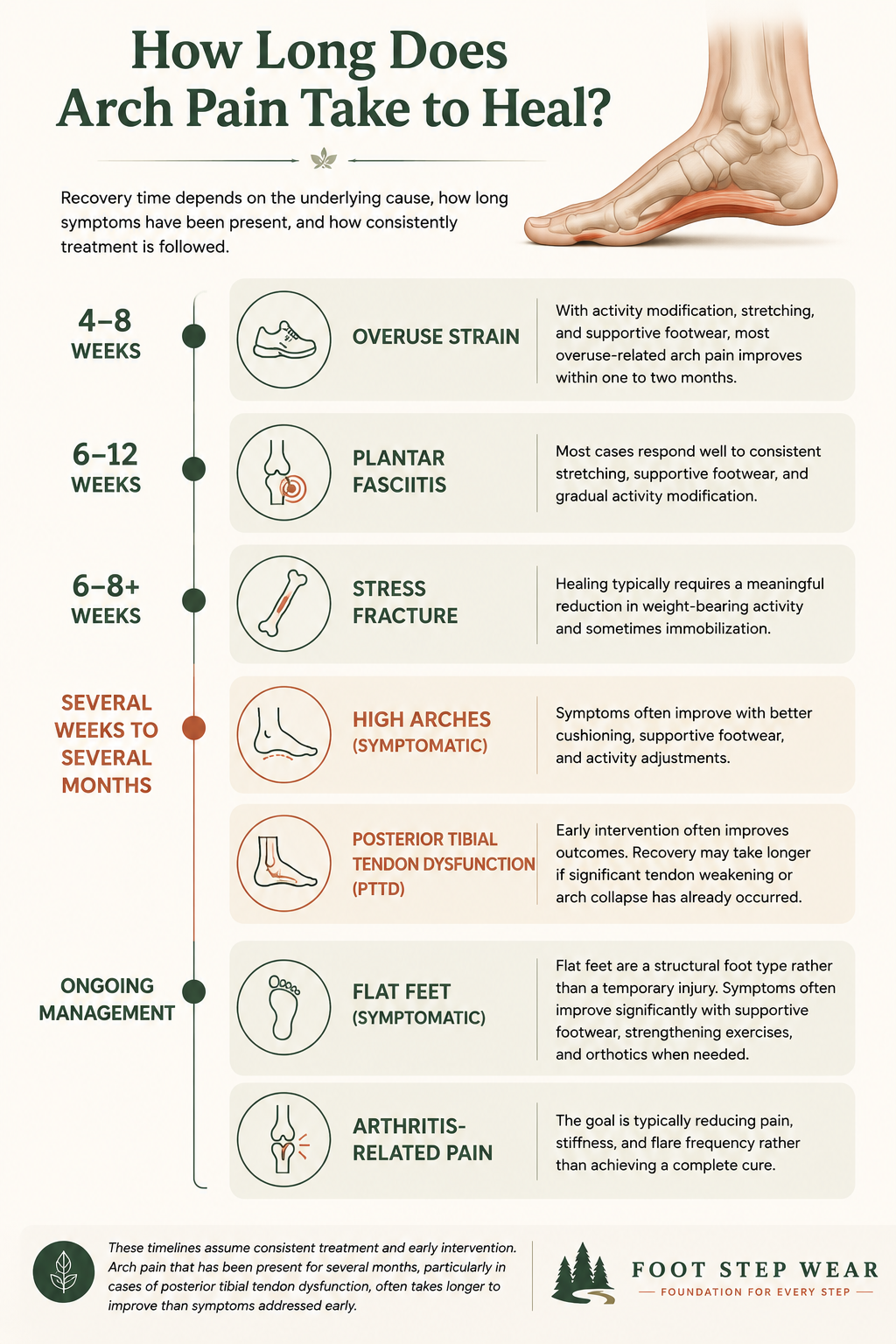
Typical Recovery Time
With activity modification, stretching, and supportive footwear, most overuse-related arch pain improves within one to two months.
Typical Recovery Time
Most cases respond well to consistent stretching, supportive footwear, and gradual activity modification.
Typical Recovery Time
Healing typically requires a meaningful reduction in weight-bearing activity and sometimes immobilization.
Typical Recovery Time
Symptoms often improve with better cushioning, supportive footwear, and activity adjustments.
Typical Recovery Time
Early intervention often improves outcomes. Recovery may take longer if significant tendon weakening or arch collapse has already occurred.
Typical Recovery Timeline
Flat feet are a structural foot type rather than a temporary injury. Symptoms often improve significantly with supportive footwear, strengthening exercises, and orthotics when needed.
Typical Recovery Timeline
The goal is typically reducing pain, stiffness, and flare frequency rather than achieving a complete cure.
These timelines assume consistent treatment and early intervention. Arch pain that has been present for several months, particularly in cases of posterior tibial tendon dysfunction, often takes longer to improve than symptoms addressed early.

The right shoe won't cure the underlying cause of arch pain, but certain design features can reduce stress on the plantar fascia, tendons, and supporting muscles while your foot recovers.
Why It May Help
Supports the foot's natural arch structure and may reduce strain on the plantar fascia and surrounding muscles.
Why It May Help
Limits excessive heel motion that can contribute to overpronation and additional arch stress.
Why It May Help
Absorbs impact forces that would otherwise transfer directly into the arch with every step.
Why It May Help
Allows the toes to spread naturally, supporting better balance and overall foot mechanics.
Why It May Help
Reduces the amount of bending required through the midfoot, potentially decreasing strain on irritated tissues.
Why It May Help
Promotes a smoother toe-off phase during walking without forcing the arch to compensate for excessive stiffness.
Why It May Help
Reduces cumulative impact loading throughout the day, especially beneficial for people who spend long hours standing or walking.
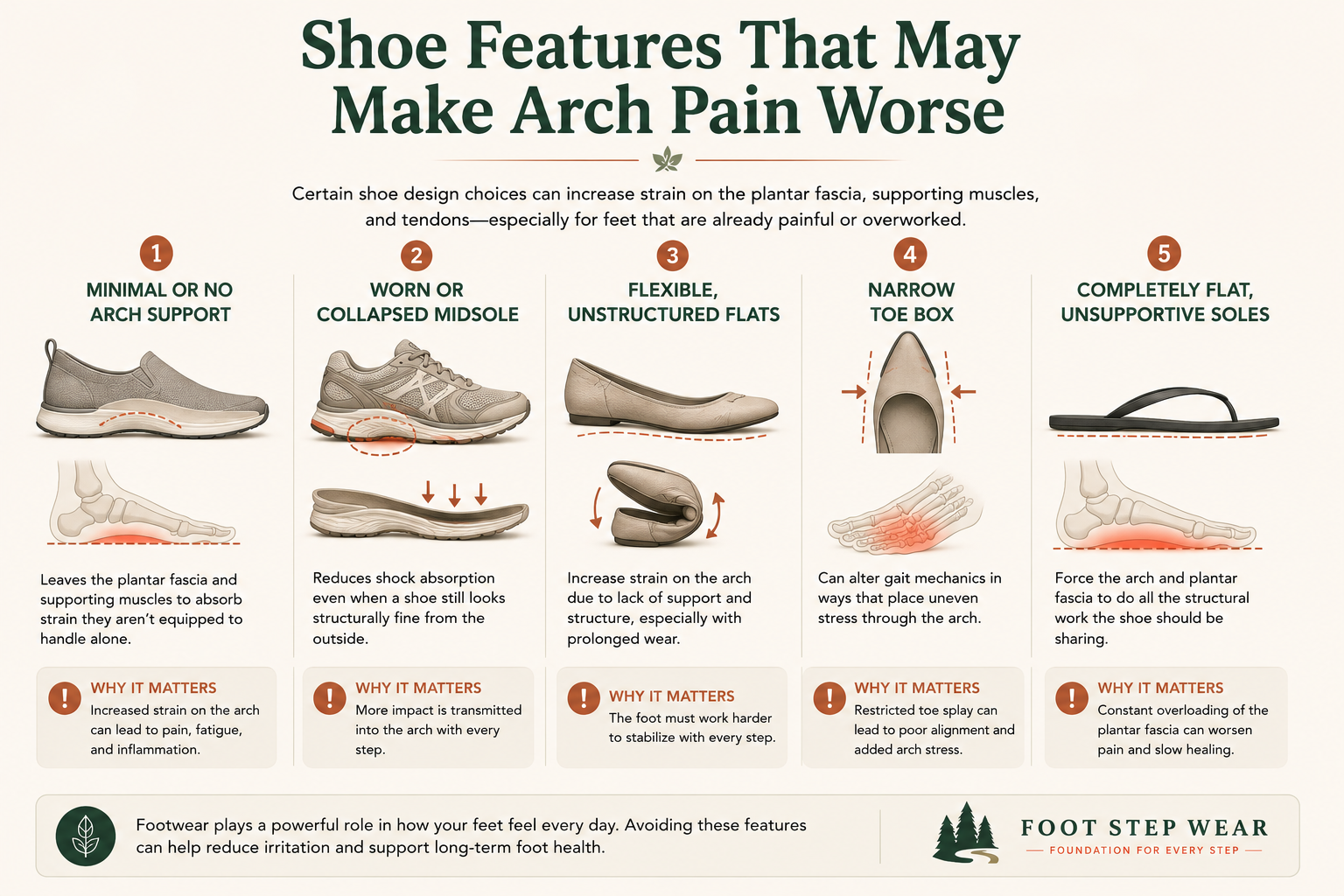
Not every shoe is built to support the foot's natural mechanics. Certain design features can increase strain on the plantar fascia, supporting muscles, and tendons, particularly for people already dealing with arch pain.
Why It May Aggravate Symptoms
Leaves the plantar fascia and supporting muscles responsible for absorbing forces they may not be equipped to handle on their own.
Why It May Aggravate Symptoms
Reduces shock absorption even when the shoe still appears structurally sound from the outside.
Why It May Aggravate Symptoms
Provide little support or stability, increasing strain on the arch during prolonged standing and walking.
Why It May Aggravate Symptoms
Restricts natural toe splay and may alter gait mechanics in ways that place uneven stress through the arch.
Why It May Aggravate Symptoms
Force the arch and plantar fascia to absorb more load because the shoe contributes very little structural support.
Keep in mind that footwear needs differ depending on the underlying cause. Someone with high arches generally needs more cushioning and shock absorption, while someone with flat feet or PTTD typically needs more structured arch support and stability. There isn't one universal "best shoe for arch pain," which is part of why identifying the underlying cause matters before shopping for a fix.
The sensation itself, not just the location, is often the clearest signal pointing to a specific cause.
Plantar Fasciitis
Sharp pain along the inner arch and heel, worst with the first few steps in the morning or after sitting. It typically eases within minutes of walking, then can return after long periods on your feet.
Flat Feet
A dull, aching fatigue rather than sharp pain, often described as a tired feeling that builds steadily throughout the day. Standing or walking for extended periods makes it worse.
High Arches
Pressure-point discomfort under the arch, heel, or ball of the foot rather than diffuse fatigue. It often feels like the foot isn't absorbing impact properly, with certain spots taking the brunt of every step.
Posterior Tibial Tendon Dysfunction
Pain and swelling along the inner ankle and arch, often with a sense that the arch is gradually flattening. Discomfort worsens with activity and can come with visible swelling near the inner ankle.
Overuse Strain
A gradual ache that builds in proportion to recent activity increases, improving somewhat with rest and worsening again as activity resumes before the tissue has fully adapted.
Stress Fracture
Localized, pinpoint pain that worsens with continued activity and doesn't meaningfully improve with rest, sometimes with mild swelling. This pattern is the clearest signal a structure beyond soft tissue may be involved.
Why does my arch hurt when I walk?
Arch pain during walking is most often caused by plantar fasciitis, which creates pain along the bottom of the arch that's sharpest with the first several steps after rest. Flat feet and overpronation can also cause walking-related arch pain, though it tends to build gradually rather than appear sharply at the start.
Can shoes cause arch pain?
Yes. Shoes with worn-out midsoles, minimal arch support, or a poor fit are a common, often overlooked contributor. A shoe can look fine externally while the internal support has broken down well past the point of being useful.
Is arch pain related to plantar fasciitis?
Often, yes. Plantar fasciitis is the single most common cause of arch pain, since the plantar fascia runs directly along the bottom of the arch. That said, arch pain can also come from flat feet, high arches, posterior tibial tendon dysfunction, and other causes unrelated to the fascia.
Can flat feet cause arch pain?
Flat feet can cause arch pain, though not everyone with flat feet experiences symptoms. When pain occurs, it tends to build throughout the day as a dull ache or fatigue, sometimes with overpronation, rather than the sharp morning pain typical of plantar fasciitis.
Do orthotics help arch pain?
Orthotics can meaningfully help by redistributing pressure and adding arch support, particularly for flat feet, mild PTTD, or plantar fasciitis that hasn't fully responded to footwear changes alone. They work best as part of a broader plan that also includes stretching and supportive footwear.
Why does my arch hurt after running?
Post-run arch pain often points to overuse, where training volume has increased faster than the plantar fascia and supporting muscles have adapted. It can also indicate early plantar fasciitis or, less commonly, a stress fracture if pain doesn't ease with rest.
Can high arches cause pain?
Yes. High, rigid arches don't absorb shock as efficiently as a typical arch, which concentrates pressure on the ball of the foot and heel. This often feels like pressure-point discomfort rather than the diffuse fatigue associated with flat feet.
How long does arch pain take to heal?
Most arch pain, especially plantar fasciitis, improves substantially within 6 to 12 weeks with consistent treatment. PTTD and arthritis-related arch pain tend to involve longer-term management rather than a fixed healing timeline.
What's the difference between arch pain and plantar fascia arch pain specifically?
"Plantar fascia arch pain" generally refers to plantar fasciitis, where pain originates from irritation of the fascia band itself. General arch pain is broader and can also stem from arch structure issues, tendon dysfunction, or other causes unrelated to the fascia.
Should I see a doctor or try home treatment first?
For gradually developing arch pain without red flag symptoms, trying home treatment for 2 to 3 weeks is reasonable before seeking care. If pain is severe, came on suddenly, involves visible changes to your arch shape, or doesn't improve after several weeks, it's time to see a podiatrist or doctor.
There's no shortage of misinformation surrounding arch pain. Understanding what's true—and what's not—can help you make better decisions about footwear, treatment, and long-term foot health.
❌ Myth: Arch Pain Is Always Plantar Fasciitis
✅ Fact
Plantar fasciitis is the most common cause of arch pain, but it's far from the only one. Flat feet, high arches, posterior tibial tendon dysfunction (PTTD), overuse injuries, and arthritis can all cause arch pain independently.
❌ Myth: Flat Feet Always Cause Pain
✅ Fact
Many people with flat feet experience no symptoms at all. Pain depends more on individual biomechanics, activity level, and tissue tolerance than arch height alone.
❌ Myth: Expensive Shoes Automatically Fix Arch Pain
✅ Fact
Price doesn't determine whether a shoe is right for your foot. Arch support, heel stability, cushioning, and overall fit matter far more than the cost of the shoe.
❌ Myth: Orthotics Weaken Your Feet Over Time
✅ Fact
There's no strong evidence that properly fitted orthotics weaken foot muscles. They simply redistribute pressure and provide support, much like glasses improve vision without weakening the eyes.
❌ Myth: Rest Alone Solves Every Case
✅ Fact
Rest can be helpful for overuse injuries and stress fractures, but many causes of arch pain—such as flat feet, high arches, and PTTD—often require supportive footwear, strengthening exercises, or additional intervention.
Arch pain can be frustrating, especially when it shows up first thing in the morning or builds steadily over a long day. The encouraging part is that nearly every cause responds well to the right combination of supportive footwear, targeted exercises, and patience. Use the breakdowns above to identify what's actually driving your pain, then build a plan around the real cause instead of guessing at quick fixes.
This article is for informational and educational purposes only and is not a substitute for professional medical advice, diagnosis, or treatment. Always consult a qualified podiatrist, orthopedist, or physician regarding any foot pain or condition. Foot Step Wear does not provide medical advice.