


Burning heels, aching arches, swollen feet? Learn why standing all day causes foot pain and the simple changes that can make a big difference.
You already know the feeling. You kick off your shoes after a long shift and the relief lasts about three seconds before the real ache sets in. That deep throb in your arches. The burning at your heel. The swelling that makes your feet feel like they belong to someone twice your size.
If you're a nurse, a teacher, a chef, a retail worker, or anyone else who spends hours on their feet, you've probably just accepted this as part of the deal. Part of the job. Something you push through.
But here's the thing: it doesn't have to be.
The pain you're feeling isn't random. It isn't just "tired feet." It's your body sending a very specific set of signals, and once you understand what those signals actually mean, you can do something about them.
This guide breaks down exactly what's happening inside your foot during a long standing day, in plain English. No medical degree required. We'll cover the real reasons your feet are hurting, and then give you practical steps you can start using today, not someday.
Quick note: Everything here is educational and based on current research. It is not a replacement for seeing a doctor or podiatrist. If your pain is severe, getting worse, or has been going on for weeks, please get it looked at professionally.
Before we get into the science, let's start where you are right now, with the actual pain you're feeling. Different locations and types of foot pain point to different underlying causes. Use this table to find what's most likely going on, then follow the sections below for the full explanation.
Common Foot Pain Locations and What They Usually Mean
How it feels: Stabbing or burning pain, often worst first thing in the morning or after sitting for a while.
Most likely cause: Plantar fasciitis.
Learn more: See Section 4.
How it feels: Deep aching, soreness, or burning after standing for long periods.
Most likely cause: Plantar fascia strain or flat-foot overload.
Learn more: See Section 4.
How it feels: Sharp, burning, or bruised feeling under the forefoot, just behind the toes.
Most likely cause: Metatarsalgia (pressure overload on the forefoot bones).
Learn more: See Section 8.
How it feels: Burning, tingling, or numbness that may radiate into the third or fourth toe.
Most likely cause: Morton's neuroma, a thickened nerve caused by toe compression.
Learn more: See Section 14.
How it feels: Heavy, aching, swollen, and generally fatigued.
Most likely cause: General fatigue and fluid pooling from poor circulation.
Learn more: See Section 5.
How it feels: Dull aching, tightness, or pressure across the top of the foot.
Most likely cause: Extensor tendon strain from lacing pressure or overuse.
Learn more: See Section 8.
How it feels: Tightness and soreness directly behind the heel.
Most likely cause: Achilles tendon strain.
Learn more: See Section 7.
How it feels: Soreness along the inner edge of the big toe, often with a visible bony bump.
Most likely cause: Bunion irritation caused by narrow toe box compression.
Learn more: See Section 8.
Seeing more than one area in there? That's actually common. Foot pain from standing often involves a few overlapping causes at once, which is exactly why understanding the full picture matters more than trying to pin it on one diagnosis.
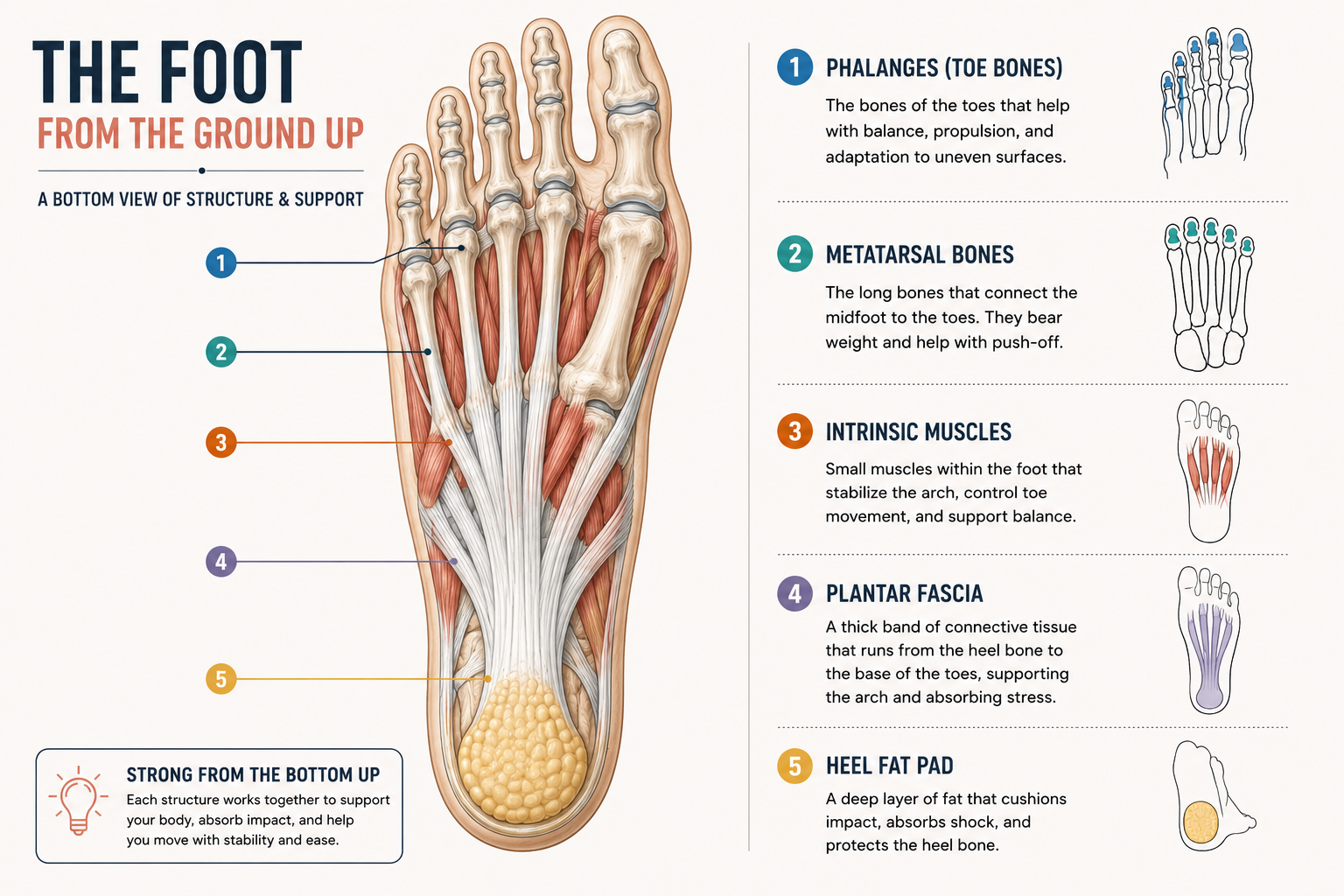
Before we get into the why, let's take a quick look at what's actually inside your foot, because it's a lot more complicated than most people realize. And that complexity is exactly why it hurts when things go wrong.
Your foot contains 26 bones (picture a small, three-dimensional puzzle of interlocking pieces), 33 joints (the hinges between those pieces that allow movement in every direction), and over 100 muscles, tendons, and ligaments. To put those last two in simple terms: tendons connect muscle to bone, and ligaments connect bone to bone. Think of them as the cables and zip ties that hold the whole structure together.
All of that, packed into the space of one shoe.
When you're walking or running, this system is doing exactly what it was designed to do: absorbing impact, adjusting to uneven ground, and springing you forward with every step. It's dynamic. It's load-sharing. Honestly, it's kind of brilliant.
But standing still? That's a different story.
When you stand in one place for hours, your foot is stuck holding a compressed, load-bearing position without the natural movement that normally helps it recover. It's a bit like holding your arm straight out in front of you. Fine for 30 seconds. Genuinely difficult after 10 minutes. Painful after an hour. Now imagine doing that all day, with your full body weight pressing down.
That's what your feet are dealing with every shift.
Research consistently backs up what your feet are already telling you. A 2017 review by Messing et al. in the journal Ergonomics found that workers who stand for more than 4 hours per shift are significantly more likely to report lower limb pain, especially in the feet and lower back. (Messing K et al., Ergonomics, 2017)
Here's what's actually happening beneath the surface during those hours:
The bottom of your foot has layers of protective soft tissue. The fat pad under your heel, for example, works like a built-in gel insert that your body grew for you. Every minute you stand, that tissue is being squeezed under your body weight. Over a full shift, the cumulative stress adds up and the tissue starts losing its ability to cushion you effectively.
Your foot is packed with nerve endings that give your brain real-time feedback about balance and position. Scientists call this proprioception (pro-pree-oh-SEP-shun), which you can think of as your body's internal GPS. When you're moving, this system refreshes constantly. When you're standing still for hours, it fatigues. And when it fatigues, your foot starts shifting the load onto its passive structures: connective tissue, ligaments, the plantar fascia. To compensate. Those structures weren't designed to be the primary worker. They feel it.
Your joints are lubricated by something called synovial fluid (SIN-oh-vee-ul). Think of it as the WD-40 of your body. Movement is what keeps this fluid circulating around the joint so everything glides smoothly. Stand still long enough, and that circulation slows down. The joints in your foot start to feel stiff and locked up, which is exactly how most people describe their feet toward the end of a long shift.
If the arch or heel is where you feel the most pain after standing, there's a very good chance your plantar fascia (PLAN-tar FASH-ee-uh) is involved.
The plantar fascia is a thick band of tough connective tissue that runs along the entire bottom of your foot, from your heel bone all the way to the base of your toes. Picture a tightly pulled rubber band stretched along the sole of your foot. Its job is to support the arch and help absorb energy when you move.
Here's the problem with standing: that rubber band is under constant tension all day with no relief. It never gets to relax.
Unlike muscle, the plantar fascia has very limited blood supply, which means it recovers from stress slowly. When you stand for hours, especially on hard surfaces like concrete or tile, tiny micro-tears can develop in the fascia, most often right where it attaches to the heel bone. Research by Wearing et al. in Sports Medicine identified that attachment point, where the fascia meets the calcaneus (KAL-kay-nee-us, which is just the medical word for heel bone), as the primary site of damage in standing-related plantar fascia injury. (Wearing SC et al., Sports Medicine, 2006)
That's what causes the burning, stabbing, or deep aching heel and arch pain you feel after a long shift. In chronic cases, when this stress happens day after day without enough recovery, it develops into a condition called plantar fasciitis (plan-tar fash-ee-EYE-tus). It's one of the most common foot conditions in adults who work on their feet, and it's also one of the most preventable.
Related reading: [What Is Plantar Fasciitis? Causes, Symptoms & the Footwear Fix]
Ever noticed that your shoes feel tighter at the end of the day than when you put them on in the morning? That's not your imagination, and it's not just fatigue. Your feet are actually bigger by the end of a shift.
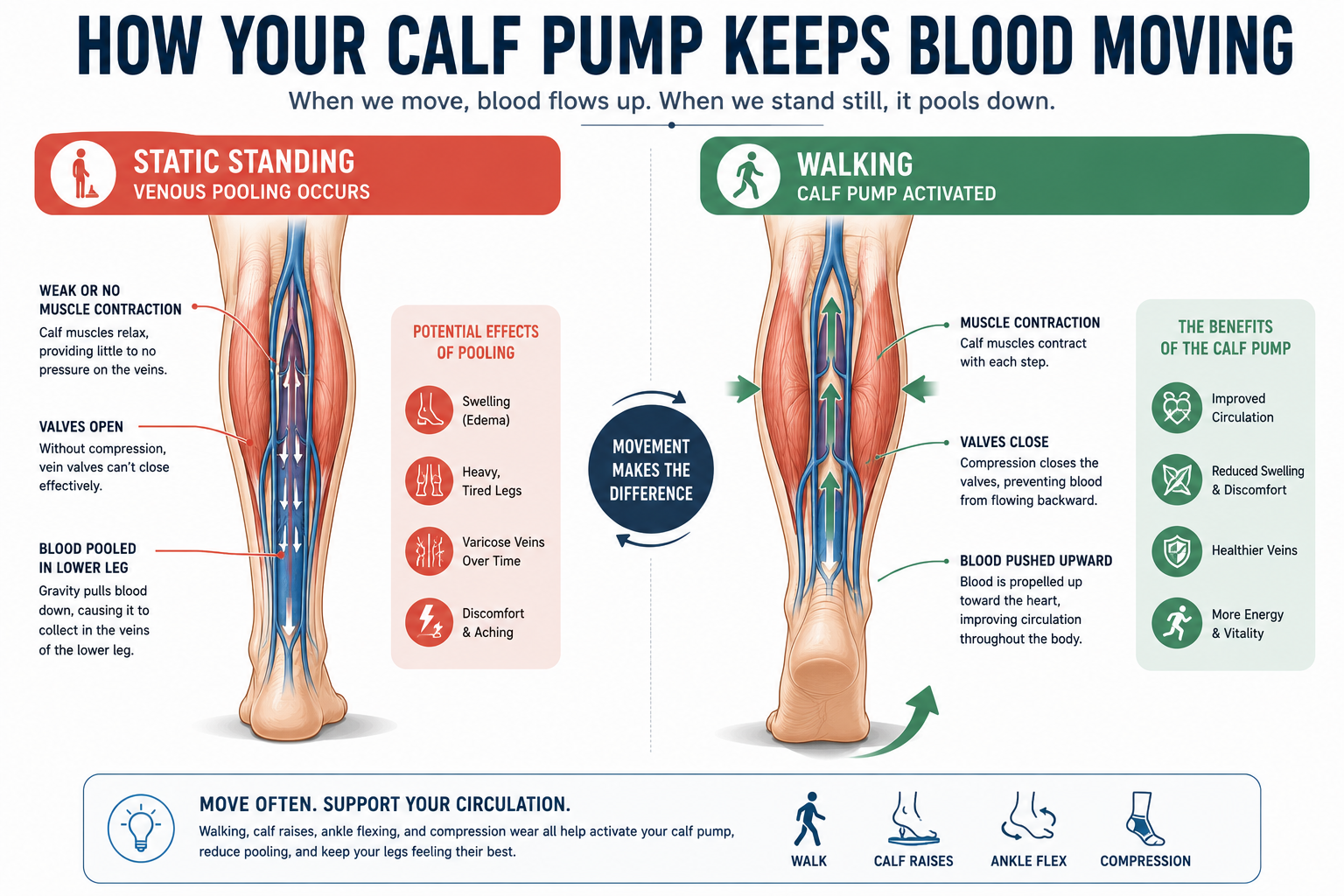
Here's why: your body is constantly fighting gravity to push blood from your feet back up to your heart. It does this using your veins and a clever system of one-way valves inside them. Think of those valves like tiny trap doors that only open upward, preventing blood from sliding back down. When you walk, your calf muscles contract and squeeze the veins, pushing blood upward. That process is called the calf pump, and it's exactly as functional as it sounds.
When you're standing still, that pump barely runs. Blood and fluid start pooling in your lower legs and feet. Pressure builds in the smallest blood vessels, called capillaries (CAP-ih-lair-eez, vessels so tiny they're thinner than a human hair), and fluid gets pushed out into the surrounding soft tissue. That's the swelling you're seeing and feeling.
A landmark study by Tüchsen et al. found that people in occupations requiring prolonged standing had a significantly higher rate of developing chronic venous insufficiency (KROH-nik VEE-nus in-suh-FISH-en-see, a condition where the vein valves gradually weaken and blood return becomes persistently difficult) compared to people in sedentary jobs. (Tüchsen F et al., Scand J Work Environ Health, 2005)
Even without that kind of long-term condition, the day-to-day swelling explains something many people find confusing: why foot pain that starts as a 3 out of 10 at hour two becomes an 8 out of 10 by hour eight. Swelling increases pressure inside the foot, which compresses nerves and blood vessels and amplifies every pain signal your foot is already sending.
Here's something most people never think about: your feet have their own muscles. Not just the big ones in your calf or shin that you can see and feel. There's also a whole separate group of small muscles that live entirely inside the foot itself.
These are called the intrinsic foot muscles (in-TRIN-zik). "Intrinsic" just means they both start and end inside the foot, as opposed to the "extrinsic" muscles higher up in the calf that send long tendons down into the foot from above. The intrinsic muscles are the local crew. They control the toes, help hold up the arch, and make thousands of tiny balance adjustments every minute you're on your feet.
They are also small. And they fatigue.
During prolonged standing, these muscles work continuously to keep the arch supported. After a few hours, they start running out of steam, the same way your arm would if you held something heavy long enough. When they fatigue, the job of holding up your arch transfers to the passive structures below them, mainly the plantar fascia and the long tendons coming down from the calf. Those structures can handle some of the load, but they were never designed to do the whole job.
A study by Headlee et al. demonstrated that when intrinsic foot muscles were fatigued in a lab setting, arch height measurably dropped, meaning the arch physically collapses as these muscles get tired, putting even more strain directly on the plantar fascia. (Headlee DL et al., J Electromyogr Kinesiol, 2008) That finding was later confirmed by Garofolini et al., who showed a direct increase in plantar fascia tension following intrinsic muscle fatigue. (Garofolini A et al., J Biomech, 2019)
In plain terms: tired foot muscles lead to a collapsing arch, which leads to an overloaded plantar fascia, which leads to the heel and arch pain you feel after work.
The good news is that muscles respond to training. You can build these muscles up so they don't fatigue as early in the day, which means they hold the arch longer before handing the load off to the fascia. We'll cover exactly how in Section 9.
Related reading: [Foot Strengthening Exercises for Plantar Fasciitis Relief]
This one surprises almost everyone when they first hear it: one of the biggest contributors to foot pain after standing isn't even in your foot. It's in your calf.
Here's how the connection works.
Your calf is actually made up of two muscles. There's the gastrocnemius (gas-trok-NEE-mee-us), the big one you can see and feel on the back of the leg, and the soleus (SO-lee-us), the deeper, flatter one sitting underneath it. Both muscles connect to your heel bone through the Achilles tendon (uh-KIL-eez, the thick ropy cord you can feel at the back of your ankle). The whole system needs to lengthen every time your shin moves forward over your foot, whether you're walking or just shifting your weight.
When the calf is tight, it can't lengthen properly. So the heel compensates by trying to lift slightly, weight shifts forward, the arch starts to collapse inward, and tension in the plantar fascia increases. What started as tightness in your lower leg becomes pain in your arch. The calf muscle isn't even in the foot, but it's pulling strings the whole time.
Here's what makes it worse: most work shoes have at least a small heel, sometimes just a centimeter or two. That slight elevation keeps the calf in a shortened position throughout the entire shift. Do that for years and the calf gradually adapts to that shortened length and loses the ability to fully lengthen at all.
Research has shown that limited ankle dorsiflexion (DOOR-sih-FLEK-shun, which is basically how far your foot can bend upward toward your shin) is one of the most consistent predictors of plantar fasciitis in people who stand for work. (Riddle DL et al., J Orthop Sports Phys Ther, 2003)
Stand facing a wall. Place one foot a few inches from it, keep that heel completely flat on the floor, and try to touch your knee to the wall. If you can't get there, or it's a genuine struggle, your calf is tight and it is almost certainly contributing to your foot pain.
For someone who stands all day, your shoes aren't just an outfit decision. They are literally the only thing standing between your body and the hard ground beneath you. The wrong pair makes every problem we've talked about dramatically worse.
Here's what actually matters:
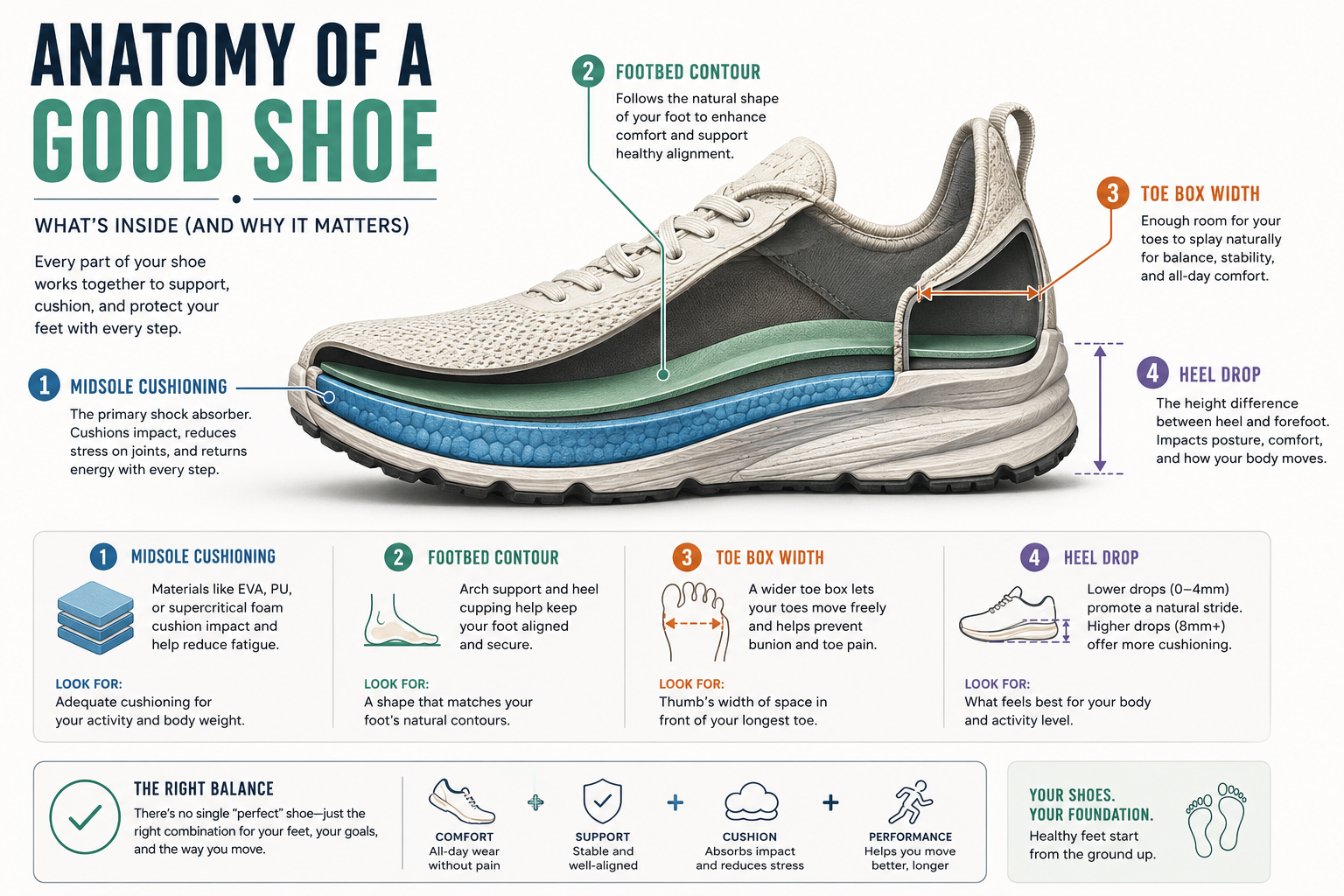
Hard surfaces send all of the force from your body weight directly back up into your foot with no absorption whatsoever. Good cushioning in a shoe's midsole (the layer of foam or rubber sandwiched between the outer sole on the ground and the insole you stand on) intercepts that force and absorbs a meaningful chunk of it before it ever reaches your soft tissue. You want real cushion with some energy return, not the feeling of sinking into a couch, which actually makes your stabilizing muscles work harder.
The footbed (the contoured inner surface your foot sits on) should follow the natural curve of your arch, giving the plantar fascia a resting surface so it doesn't have to carry the full load alone. Research by Rome et al. found that supportive footbeds reduced plantar fascia strain by up to 34% in standing populations. (Rome K et al., J Am Podiatr Med Assoc, 2010) That is not a minor improvement. For someone on their feet eight hours a day, a 34% reduction in fascia strain compounds into a dramatically less painful shift.
The toe box is the front section of the shoe where your toes live. Most conventional shoes, especially dress shoes and a lot of everyday athletic shoes, compress the toes together in a tapered or pointed shape. But the foot was designed to spread. When you stand, the front of the foot naturally wants to splay outward to create a wider, more stable base.
A narrow toe box blocks that splay, creates pressure points across the forefoot, and can compress the nerves running between the toes, which is a direct driver of metatarsalgia and Morton's neuroma symptoms. A wider toe box simply gives the foot the room it needs to function the way it was built to.
Related reading: [Wide Toe Box Shoes Explained: Why Your Toes Need Room to Spread]
Heel drop (also called heel-to-toe drop) is the height difference between the heel of the shoe and the forefoot. A shoe with 12mm of heel drop keeps the heel significantly elevated compared to the toes. A zero-drop shoe puts the entire foot on the same level, the same as standing barefoot.
Even moderate heel elevation shifts more of your body weight forward onto the forefoot, changes your posture all the way up through the knee and hip, and holds the calf in that shortened position we talked about in Section 7. For people who stand for a living, lower drop means more even load distribution across the whole foot.
Related reading: [Best Zero Drop Shoes for Plantar Fasciitis Recovery]
When you're evaluating work shoes, these are the things that actually move the needle:
Here's something that doesn't get talked about enough: modern footwear has quietly made our feet weaker.
This isn't a knock on supportive shoes. They genuinely help in the right contexts. But when you wear cushioned, structured footwear every waking hour of your life, the small muscles inside your feet receive less and less stimulus to do their job. Over time, they weaken from underuse, the same way a broken arm comes out of a cast smaller and weaker than the other one.
Research by Sichting et al. showed that people who regularly go barefoot or wear minimal footwear have significantly larger and stronger intrinsic foot muscles than people who have worn conventional shoes their whole lives. And those stronger muscles correlated directly with better arch support, less plantar fascia strain, and lower rates of foot pain. (Sichting F et al., Sci Rep, 2020)
This doesn't mean you should throw your shoes away. It means that actively building foot strength is one of the most effective and underused long-term strategies for people who stand for a living.
No gym needed. No equipment needed. Just a few minutes and some consistency.
1. Towel Scrunches
Put a small hand towel flat on the floor and sit in a chair with your bare foot resting on top of it. Using only your toes, scrunch the towel toward you like you're trying to grab it with your foot. Release and repeat. Do 3 sets of 15 reps per foot. This targets the small arch muscles and toe flexors, the exact muscles that fatigue first during a long standing day.
2. Short Foot Exercise
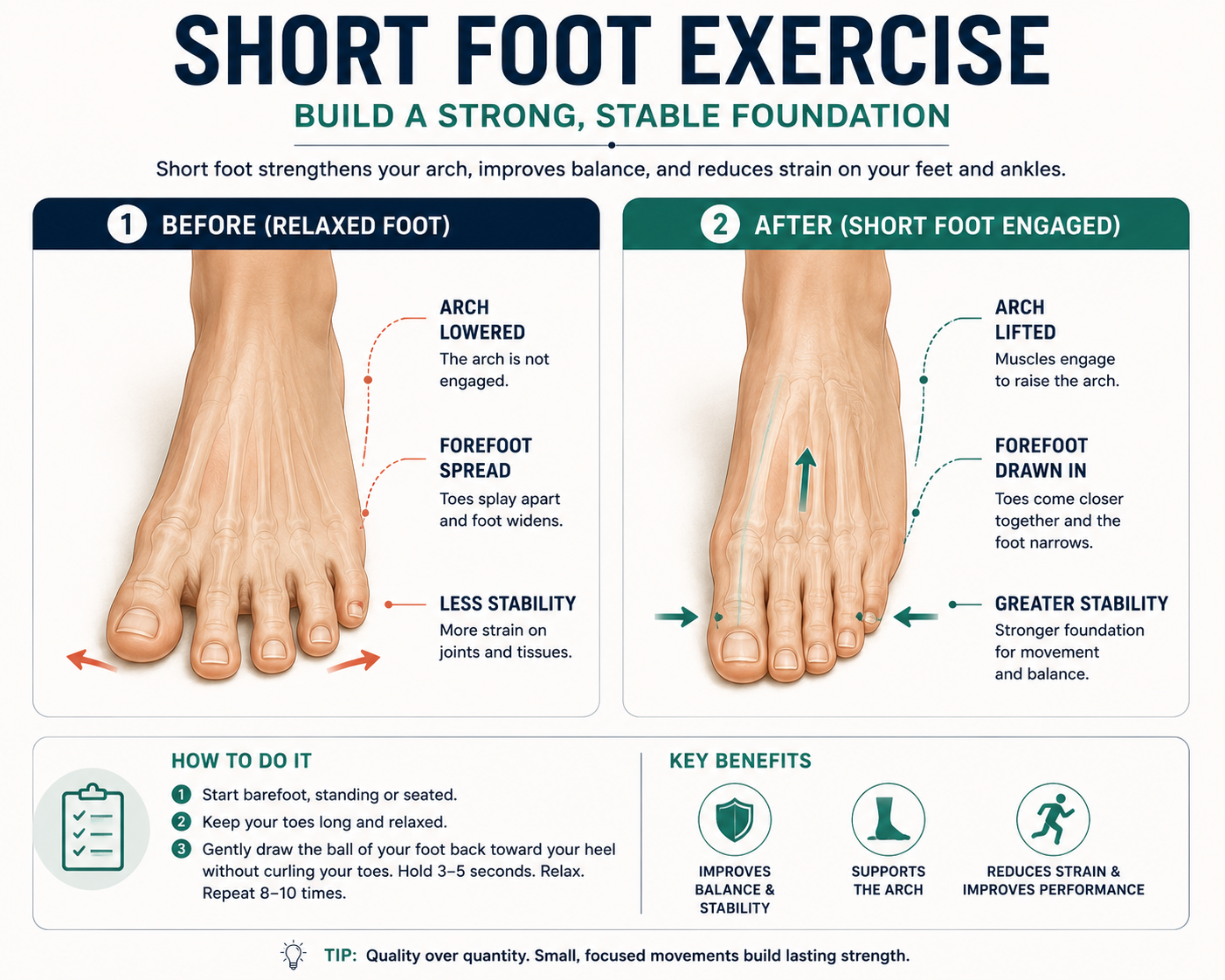
While seated or standing, try to shorten the length of your foot without curling your toes at all. Imagine you're drawing the ball of your foot (the padded area just behind the toes) toward your heel, lifting and doming the arch upward without gripping. Hold each contraction for 3 seconds, then release. Do 10–15 reps per foot. It's subtle, it feels almost too simple, and it's one of the most evidence-backed exercises in foot rehabilitation research.
3. Single-Leg Balance
Stand on one foot for 30 to 60 seconds. Once that feels easy, close your eyes. That one small change dramatically increases the difficulty because your foot's balance system now has to operate without any visual input. When that gets manageable, try it on a folded yoga mat for even more of a challenge. This exercise trains the entire neuromuscular system of the foot and lower leg at the same time, and all it costs is two minutes a day.
You just got home. Feet are done. Here's a sequence that actually addresses the physiological events causing your pain, in an order that makes sense.
Lie on your back and prop your feet above the level of your heart. Against a wall works well, so does a stack of pillows or the arm of the couch. You're using gravity to reverse the pooling of blood and fluid that's been building in your feet and lower legs all day. Ten minutes of this makes a noticeable difference in swelling and the pressure-related pain that comes with it.
Stand facing a wall. Step one foot back, keep the back knee completely straight, press that heel firmly into the floor, and lean forward gently until you feel the pull in the calf. Hold for 45 to 60 seconds. This targets the gastrocnemius. Then repeat the stretch with the back knee slightly bent, which lets you reach the deeper soleus underneath. Both muscles matter, and both are tight after a long shift. Releasing calf tension is one of the fastest ways to reduce the pull being transmitted through the Achilles tendon into the heel and plantar fascia.
Sit down and cross one foot over the opposite knee. Wrap your hand around your toes and gently pull them back toward your shin until you feel a stretch running along the bottom of your foot. Hold for 30 to 45 seconds. Do this 3 times per foot. This directly decompresses the plantar fascia after a full day of sustained tension, and if you do it consistently, it makes a real difference in how your mornings feel.
Grab a firm ball: a lacrosse ball, a golf ball, or even a frozen water bottle. Place it under one foot and slowly roll the sole over it with moderate pressure. Spend 2 to 3 minutes per foot. You're stimulating blood flow, reducing neural tension (the kind of nervous system tightness that builds up in overloaded tissue), and giving the foot's sensory receptors a fresh input to process. Most people find this feels good almost immediately.
If there's visible swelling or a burning sensation of heat in the foot, a 10 to 15 minute ice pack or cold water soak can help calm the acute inflammatory response. Some people prefer contrast therapy, alternating between cold and warm water, which creates a pumping effect in the blood vessels that helps move built-up fluid out of the tissue.
Related reading: [The 7-Day Plantar Fasciitis Stretching Schedule, Free Download]
Relief is for tonight. Prevention is for the rest of your career. These habits address root causes, not just symptoms.
If you have any say over your work environment, an anti-fatigue mat is one of the best investments you can make. Occupational research has shown reductions in lower limb discomfort of 20 to 50% when anti-fatigue mats are introduced in workplaces with hard floors. (NIOSH Occupational Ergonomics Research) They work by introducing subtle instability underfoot, just enough to keep the calf and foot muscles gently active rather than completely static. That keeps the calf pump running, improves circulation, and reduces the sustained pressure on fixed points in the foot.
Wearing the same pair every single day compresses the midsole foam faster than it can bounce back. Rotating between two pairs gives each pair 24-plus hours to decompress and restore its cushioning properties. It sounds like a small thing. Over a year, it's a meaningful one.
You don't need a formal break to give your feet a reset. Every 45 to 60 minutes, do 20 slow calf raises, walk to the other end of the building and back, or just shift your weight from foot to foot for a couple of minutes. These brief movement breaks activate the calf pump, improve venous return, and take pressure off whatever tissue has been bearing the static load.
Graduated compression socks apply gentle, calibrated pressure that helps the veins return blood back toward the heart, giving the whole circulatory system a little mechanical assist. For most people, a compression level of 15–20 mmHg (millimeters of mercury, the unit used to measure compression pressure) is appropriate for all-day wearing. For significant swelling, 20–30 mmHg tends to work better. The key is wearing them from the start of the shift, not just after. That way they prevent buildup rather than just managing it.
Foot pain from prolonged standing doesn't always originate in the foot. Tight hip flexors (the muscles that connect the hip to the lower spine), weak glutes (the backside muscles that stabilize the pelvis), and limited ankle flexibility all affect how load travels down through the leg and ultimately lands in the foot. A single session with a physical therapist can pinpoint where in that chain the breakdown is happening, and it's often somewhere the person never would have guessed.
For anyone who stands professionally, footwear is a clinical tool. The right shoe has real arch support, genuine midsole cushioning, a wide enough toe box for natural toe splay, and a low heel drop. This is the single highest-leverage intervention for most people, and also the most commonly underinvested in.
Related reading: [Best Walking Shoes for Heel Pain]Related reading: [Best Nurses' Shoes for Foot Pain]
Not all standing jobs carry the same foot pain risk. Understanding where your job falls on the spectrum can help you figure out which interventions to prioritize.
Healthcare workers (nurses, surgeons, medical technicians) consistently show up near the top of the data. Research has found plantar fasciitis rates of up to 15–25% in nursing populations, compared to roughly 10% in the general adult population. (Burns J et al., J Foot Ankle Res, 2011) Long shifts of 12-plus hours, hard hospital floors, and very little control over when you can take a break create near-perfect conditions for cumulative foot strain.
Food service and kitchen workers face similar conditions: hard tile floors, a cycle of constant movement interrupted by static standing at prep stations, and footwear that typically prioritizes slip resistance far ahead of anything biomechanical.
Retail and warehouse workers deal with concrete floors, inconsistent surfaces, and the added physical demand of lifting and carrying layered on top of prolonged standing.
Teachers stand 6 to 8 hours on classroom floors wearing shoes often chosen for appearance rather than function. They're rarely seen as an "at-risk" occupational group until the pain has already become chronic.
Total hours on your feet matter, but they're not the whole story. These factors amplify risk significantly:
Related reading: [Best Nurses' Shoes for Foot Pain]Related reading: [Best Shoes for Teachers Who Stand All Day] (future cluster page)
One of the most underappreciated contributors to standing-related foot pain is the surface you're standing on. Not all floors are the same, and the difference between eight hours on carpet versus eight hours on concrete is genuinely significant.
When your foot makes contact with the ground, the ground pushes back with a force equal to your body weight. This is called ground reaction force (GRF for short, which is just the force the ground sends back up into your body with every step or standing moment). Hard, non-compliant surfaces like concrete and tile return nearly all of that force directly into your foot. There is no give. No absorption. No recovery window between moments.
Softer surfaces like rubberized flooring, cork, and carpet absorb a portion of that force before it ever reaches the foot, which reduces cumulative stress on the plantar fascia, the heel fat pad, and the metatarsal bones (met-uh-TAR-sul, the five long bones that run through the middle of your foot, one behind each toe) over the course of a full shift.
Research on occupational surface hardness found that workers on concrete floors consistently report higher rates of foot fatigue and pain than those on cushioned or mixed surfaces. (Redfern MS & Cham R, Ergonomics, 2000)
Most people don't get to choose the floor they work on. But you can:
Some people come across the research on foot strength and decide to experiment with barefoot or minimalist footwear at work. On soft, natural surfaces, that can produce real long-term benefits. On hard concrete, removing cushioning before the intrinsic muscles are strong enough to compensate almost always makes things worse, not better. If going minimal is a goal, build the foot strength foundation first (Section 9), then gradually reduce shoe structure from there.
Related reading: [The Barefoot Transition Guide: How to Switch Safely in 8 Weeks] (future cluster page)Related reading: [Best Zero Drop Shoes for Plantar Fasciitis Recovery]
Everything in this guide covers the most common causes of foot pain from prolonged standing. But some situations genuinely need professional attention, and pushing through them without it can make things worse.
See a podiatrist, sports medicine doctor, or physical therapist if you're experiencing any of the following:
A clinician can use imaging when needed, fit you for custom orthotics (or-THOT-iks, custom-molded inserts built specifically for the shape and mechanics of your foot), and design a rehabilitation program that's actually tailored to what your body needs.
The ache you come home with every night is not just the price of a hard day's work. It's a collection of messages from your plantar fascia, your fatigued intrinsic muscles, your slowed circulation, your tight calves, and the unforgiving surfaces under your feet, all telling you that something in the system needs a little more support.
The good news is that none of these problems are permanent. They respond to the right information, the right habits, and the right footwear.
Stretch your calves. Strengthen your foot muscles. Give your feet a few minutes to decompress after your shift. And take a real look at what you're putting on your feet every day, because for people who stand for a living, the right shoe isn't a luxury. It's part of the job.
Your feet carry you through everything. It's time to start carrying them back.
Q: Why do my feet hurt so much after standing all day?
Feet hurt after prolonged standing because of several things happening at once. The plantar fascia, the thick band of tissue along the bottom of the foot, gets strained under sustained load. Blood and fluid pool in the lower limbs because the calf pump slows way down when you stop moving. The small muscles inside the foot fatigue and push their workload onto connective tissue that was never meant to carry it. And the joints stiffen up from reduced synovial fluid circulation. Hard floors, unsupportive shoes, and tight calf muscles all make each of these worse.
Q: What is the best thing to do for sore feet after standing all day?
Start by lying down and elevating your feet above heart level for 10 minutes to let gravity drain the fluid that's built up. Follow that with calf stretches and a plantar fascia stretch (gently pulling your toes back toward your shin). Then roll the sole of your foot over a firm ball for 2 to 3 minutes per side. For long-term improvement, foot strengthening exercises, better work footwear, and brief movement breaks throughout the shift make the biggest difference over time.
Q: Why do my arches hurt after standing at work?
Arch pain after standing is most often plantar fascia strain. Under prolonged standing load, especially on hard surfaces, the fascia develops micro-tears and inflammation where it attaches to the heel bone. Flat feet, high arches, tight calves, and shoes without adequate arch support all increase how much strain the fascia absorbs throughout the shift.
Q: How can I prevent foot pain from standing all day?
The habits that make the biggest long-term difference are wearing footwear with proper arch support, a wide toe box, and good midsole cushioning; using an anti-fatigue mat on hard floors; taking 2-minute movement breaks every 45 to 60 minutes; wearing graduated compression socks from the start of your shift; and doing calf stretches and foot strengthening exercises regularly. Rotating between two pairs of work shoes also helps maintain effective cushioning over time.
Q: Is standing all day bad for your feet long-term?
Chronic occupational standing without proper footwear, supportive surfaces, and recovery habits is linked to higher rates of plantar fasciitis, varicose veins, chronic swelling, and persistent lower limb pain. But those outcomes are not inevitable. Workers who invest in the right footwear, use anti-fatigue mats, take regular movement breaks, and do targeted strengthening exercises tend to see dramatically better results long-term.
Q: Should I see a doctor for foot pain after standing all day?
Most foot pain from standing responds to consistent self-care. But get it looked at professionally if you have sharp first-step heel pain in the morning, pain that is getting progressively worse over weeks, burning or tingling between the toes, swelling that doesn't resolve overnight, or numbness anywhere in the foot. Those are signs that self-care alone may not be enough.
Q: What type of flooring is hardest on your feet?
Concrete and ceramic tile are the toughest on feet during prolonged standing because they return nearly all ground reaction force directly into the foot with no absorption. If you work on those surfaces, prioritizing shoes with genuine midsole cushioning and requesting an anti-fatigue mat at your main standing station are the two most impactful immediate steps you can take.
Q: Why do the balls of my feet hurt after standing?
Pain in the ball of the foot after prolonged standing is most commonly metatarsalgia, an overloading of the metatarsal bones just behind the toes. It's worsened by shoes with a high heel drop (which shifts body weight forward onto the forefoot), narrow toe boxes (which compress the metatarsal heads together), and insufficient forefoot cushioning. A wider toe box and lower heel drop typically provide meaningful relief.