


Heel pain has several distinct causes, each with its own pattern. This guide helps you identify what's causing your pain based on location and symptoms, then points you to the right treatment path.
Heel pain is almost never random. It shows up because of a specific, identifiable cause, usually tied to where on the heel it hurts, when it hurts, and what you've been doing with your feet lately. The most common cause is plantar fasciitis, which causes stabbing pain under the heel that's worst with your first steps in the morning. But heel pain can also come from Achilles tendinitis (back of the heel), heel spurs, nerve entrapment, stress fractures, or a thinning fat pad, each with a different pattern and a different fix.
The fastest way to figure out what's going on is to locate the pain first. Bottom-of-heel pain points toward plantar fasciitis or fat pad syndrome. Back-of-heel pain usually means the Achilles tendon or a bone deformity called Haglund's deformity. Inner heel pain can signal nerve involvement, and pain that doesn't ease with rest, especially in runners, raises the possibility of a stress fracture.
Most heel pain responds well to footwear changes, targeted stretching, and short-term activity modification within 6 to 12 weeks. Use the location guide and condition breakdowns below to identify what's likely causing your pain, then follow the link to the full guide for that condition.
Most heel pain is mechanical and can be managed at home, but certain symptoms point to something that needs prompt evaluation rather than a wait-and-see approach. Seek medical evaluation promptly if you experience:
These signs can indicate a fracture, infection, or other condition that requires care beyond footwear changes and stretching, so it's worth getting checked rather than treating these symptoms at home.
Pinpointing the exact location of your pain is the single most useful clue for figuring out what's wrong. Use the table below as a starting point.
Location | Possible CausesBottom of Heel | Plantar Fasciitis, Fat Pad Syndrome, Heel SpurBack of Heel | Achilles Tendinitis, Haglund's Deformity, Sever's Disease (in kids and teens)Inner Heel (toward the arch) | Baxter's Nerve Entrapment, Tarsal Tunnel SyndromeOuter Heel | Stress Fracture, Peroneal Tendon IssuesHeel Pain That's Worse at Night or Constant | Stress Fracture, Nerve Entrapment (less likely to be plantar fasciitis)Heel Pain Only With First Steps in the Morning | Plantar Fasciitis (classic pattern)
If your pain matches one of these patterns closely, jump to that condition's section below for a quick overview, or head straight to the full guide.
Heel pain is a general term for any discomfort felt in the heel, the large bone (calcaneus) at the back of your foot that absorbs the bulk of your body weight with every step. The heel isn't just bone. It's surrounded by a thick layer of fat padding, connected to the plantar fascia (a band of tissue running along the bottom of your foot), and anchored by the Achilles tendon at the back. Pain can originate from any of these structures, which is why "heel pain" isn't a diagnosis on its own. It's a symptom with several possible underlying causes.
Roughly 1 in 10 people will experience heel pain significant enough to seek treatment at some point in their life, making it one of the most common foot complaints podiatrists and orthopedists see.
While the underlying cause varies, most heel pain falls into a few recognizable patterns. Knowing how your pain behaves, not just where it is, helps narrow things down further.

Symptom | What It Feels Like
Sharp, stabbing pain with first steps | Classic sign of plantar fasciitis. Often eases after a few minutes of walking.
Dull ache that builds during the day | Often fat pad syndrome or general overuse.
Pain and stiffness at the back of the heel | Typically Achilles tendinitis. Often worse after rest, then with activity.
Burning or tingling sensation | Suggests nerve involvement, such as Baxter's nerve entrapment.
Pain that worsens with activity and doesn't improve with rest | Red flag for stress fracture, especially in runners.
Swelling or visible bump | Can indicate Haglund's deformity or significant inflammation.
Pain in children or teens during sports | Often Sever's disease, a growth plate issue specific to younger athletes.
Heel pain almost always comes down to one of three mechanical problems: repetitive stress on a tissue that hasn't adapted to the load, a structural change in the foot that shifts pressure where it shouldn't go, or compression of a nerve as it travels through the heel and ankle.
Repetitive strain is the most common pathway. The plantar fascia and Achilles tendon both tolerate a certain amount of daily load, but sudden increases (a new running plan, a job that has you standing longer, switching to less supportive shoes) can outpace what the tissue can handle. Microscopic damage accumulates faster than the body repairs it, leading to inflammation and pain.
Structural and biomechanical factors also play a major role. Flat feet or high arches change how force travels through the foot with every step, often concentrating stress at the heel. Overpronation (when the foot rolls inward excessively) is a frequent contributor to both plantar fasciitis and Achilles issues.
Nerve compression is a less common but often overlooked cause. As nerves pass through narrow spaces in the ankle and heel, swelling or structural changes can pinch them, producing burning, tingling, or shooting pain that's easy to mistake for a tendon or fascia problem.
Aging-related changes matter too. The fat pad under the heel naturally thins over time, reducing the cushioning available during impact and making fat pad syndrome more likely after age 50 or so.
Several factors make heel pain more likely, even when the underlying mechanical cause is the same:
Heel pain has several distinct causes, and treating the wrong one wastes time. Below is a short breakdown of each major condition. Find the one that matches your symptoms and location, then visit the full guide for a complete walkthrough of causes, exercises, and treatment.
By far the most common cause of heel pain, plantar fasciitis is inflammation and irritation of the plantar fascia, the thick band of tissue connecting your heel to your toes. It causes sharp pain at the bottom of the heel that is typically worst with your first steps in the morning or after sitting for a while, then eases somewhat as you move, only to return after long periods of standing or walking. It's strongly linked to tight calf muscles, flat feet or high arches, and sudden increases in activity. Most cases improve significantly within 6 to 12 weeks with calf and plantar fascia stretching, supportive footwear, and activity modification.
Learn more in our complete guide to Plantar Fasciitis.
This condition involves inflammation of the Achilles tendon, the thick cord connecting your calf muscles to your heel bone. Pain shows up at the back of the heel and lower calf, usually worse with activity and after periods of rest, such as first thing in the morning or after sitting at a desk. It's common in runners and anyone who increases activity too quickly, and it's closely tied to calf tightness. Left untreated, it can progress to a more chronic, harder-to-treat condition, so early intervention with eccentric calf strengthening and load management matters.
Learn more in our complete guide to Achilles Tendinitis.
A heel spur is a bony growth that forms on the underside of the heel bone, often (though not always) alongside plantar fasciitis. Many people have heel spurs with zero pain at all. They're frequently found incidentally on X-rays. When they do cause symptoms, it's usually because of the associated soft tissue inflammation rather than the spur itself. Treatment overlaps heavily with plantar fasciitis treatment, and surgery to remove the spur is rarely necessary or even helpful.
Learn more in our complete guide to Heel Spurs.
Often mistaken for stubborn plantar fasciitis that won't respond to treatment, Baxter's nerve entrapment happens when a small nerve branch near the heel gets compressed. It produces burning, tingling, or shooting pain, often along the inner heel, and unlike plantar fasciitis it may not improve much with rest or typical fascia stretches. It's frequently underdiagnosed because the symptoms overlap so closely with plantar fasciitis. A clinical exam that specifically tests nerve involvement is usually needed to tell the two apart.
Learn more in our complete guide to Baxter's Nerve Entrapment.
A stress fracture is a small crack in the heel bone caused by repetitive impact, most common in runners, military recruits, and anyone who rapidly increases weight-bearing activity. The hallmark sign is pain that worsens with activity and does not improve with rest, sometimes accompanied by swelling. This is one of the few heel conditions where pushing through pain can genuinely make things worse, and proper diagnosis (often requiring imaging) followed by a true rest period is essential.
Learn more in our complete guide to Heel Stress Fractures.
Underneath your heel bone sits a specialized cushion of fat that absorbs shock with every step. As this pad thins with age or from repetitive impact, the heel loses natural cushioning, leading to a deep, bruise-like ache directly under the heel that worsens with barefoot walking on hard surfaces. Unlike plantar fasciitis, the pain tends to be more centered and less sharp, and it often responds well to cushioned footwear and heel pads rather than stretching.
Learn more in our complete guide to Fat Pad Syndrome.
Despite the name, this isn't a disease at all. It's a growth plate irritation at the back of the heel that affects active children and teens, typically between ages 8 and 14, during growth spurts. It's the most common cause of heel pain in young athletes, particularly those in running and jumping sports. The good news is that it resolves on its own once growth plates close, and management mostly involves activity modification, stretching, and supportive footwear in the meantime.
Learn more in our complete guide to Sever's Disease.
Sometimes the clearest clue isn't where your heel hurts, but when. The activity that triggers or worsens your pain often points toward a specific cause just as reliably as location does.
Heel pain that flares up during walking is most often plantar fasciitis, especially if it's sharpest in the first several steps and eases somewhat after you've warmed up. Fat pad syndrome can also cause walking pain, particularly on hard surfaces like tile or concrete, though it tends to feel like a deeper ache rather than a sharp stab.
Runners dealing with heel pain are usually looking at Achilles tendinitis, plantar fasciitis aggravated by repetitive impact, or, if mileage or intensity has increased quickly, an early stress fracture. The common thread across all three is a "too much, too soon" pattern, where training volume outpaces what the tissue has adapted to handle.
Prolonged standing tends to aggravate plantar fasciitis and fat pad syndrome, since both involve tissue that's under constant low-level load throughout the day rather than a single high-impact moment. This pattern is extremely common among nurses, teachers, retail workers, and anyone whose job keeps them on their feet for long stretches.
Sharp pain with your very first steps out of bed is one of the most recognizable patterns in foot health, and it's the hallmark sign of plantar fasciitis. The fascia tightens overnight while at rest, so the sudden stretch of those first steps causes a brief but intense stabbing sensation that usually fades within several minutes.
Heel pain that shows up at night or stays constant regardless of activity is a different pattern altogether, and it's worth paying closer attention to. This presentation is less typical of plantar fasciitis and more often associated with nerve involvement or, in some cases, a stress fracture, particularly if the pain doesn't ease with rest the way mechanical heel pain usually does.
Most heel pain can be reasonably identified through a combination of self-assessment and a clinical exam, though imaging becomes important in specific situations.
Self-identification starts with the questions this article walks through: where exactly does it hurt, when is it worst, and what activities make it better or worse. This narrows the likely cause significantly before you ever see a provider.
Clinical evaluation by a podiatrist, orthopedist, or sports medicine doctor typically includes a physical exam checking for tenderness location, range of motion, swelling, and specific tests like the Windlass test for plantar fasciitis or palpation along the Achilles tendon. Providers will also ask about activity history, footwear, and any recent changes in training or work routine.
Imaging isn't needed for most straightforward cases of plantar fasciitis or Achilles tendinitis, but it becomes important when symptoms don't fit a typical pattern, don't improve with standard treatment, or suggest a stress fracture. X-rays can reveal heel spurs or fractures, while ultrasound or MRI can assess soft tissue damage in the fascia or tendon and help identify nerve entrapment.
Several heel conditions share overlapping symptoms, which leads to frequent misdiagnosis or self-diagnosis. Here's how to tell them apart.

Condition | Key Difference
Plantar Fasciitis vs. Fat Pad Syndrome | Plantar fasciitis causes sharp pain concentrated near the inner heel, worst with first steps. Fat pad syndrome causes a deeper, more centered ache that worsens with barefoot walking on hard floors.
Plantar Fasciitis vs. Baxter's Nerve Entrapment | Plantar fasciitis typically improves somewhat with rest and stretching. Nerve entrapment often includes burning or tingling and doesn't respond well to standard fascia stretches.
Achilles Tendinitis vs. Haglund's Deformity | Tendinitis is a soft tissue inflammation issue. Haglund's deformity is a bony bump at the back of the heel that causes irritation against shoe heel counters, sometimes alongside tendinitis.
Heel Spur vs. Plantar Fasciitis | A heel spur is a bone growth, often with no symptoms at all. Plantar fasciitis is the soft tissue inflammation that may or may not occur alongside a spur.
Stress Fracture vs. Plantar Fasciitis | Stress fractures worsen with continued activity and don't improve with rest. Plantar fasciitis often eases somewhat once you're moving.
Switching to shoes with proper arch support, a slightly cushioned heel, and a stable heel counter (the structured back portion of the shoe) is one of the highest-impact changes for almost every heel condition on this list. Worn-out shoes lose this support well before they look visibly damaged, so replacing shoes used for walking or running every 300 to 500 miles matters more than people expect.
Over-the-counter or custom orthotic inserts can redistribute pressure away from painful areas and correct biomechanical issues like overpronation. Heel cups specifically help with fat pad syndrome by adding cushioning, while arch-supporting inserts help more with plantar fasciitis.
Calf stretching, plantar fascia stretches, and Achilles strengthening (particularly eccentric heel drops) form the backbone of treatment for most heel conditions. Consistency matters more than intensity. Daily stretching for 6 to 8 weeks produces far better results than occasional aggressive sessions.
Temporarily reducing high-impact activity, such as running or jumping sports, while substituting lower-impact options like swimming or cycling allows inflamed tissue to recover without losing overall fitness. This is especially critical for stress fractures, where continuing impact activity can worsen the injury.
When conservative measures stall after several weeks, providers may recommend anti-inflammatory medication, corticosteroid injections for short-term relief, or physical therapy for more structured rehabilitation. Night splints, which keep the foot in a stretched position overnight, are sometimes used for plantar fasciitis that's especially stubborn in the morning.
Surgery is a last resort for heel pain and is typically only considered after 6 to 12 months of consistent conservative treatment without improvement. It's more commonly discussed for severe Achilles tendinitis or symptomatic heel spurs that don't respond to anything else, and even then, outcomes vary and aren't guaranteed to fully resolve symptoms. Most people with heel pain never need surgery.
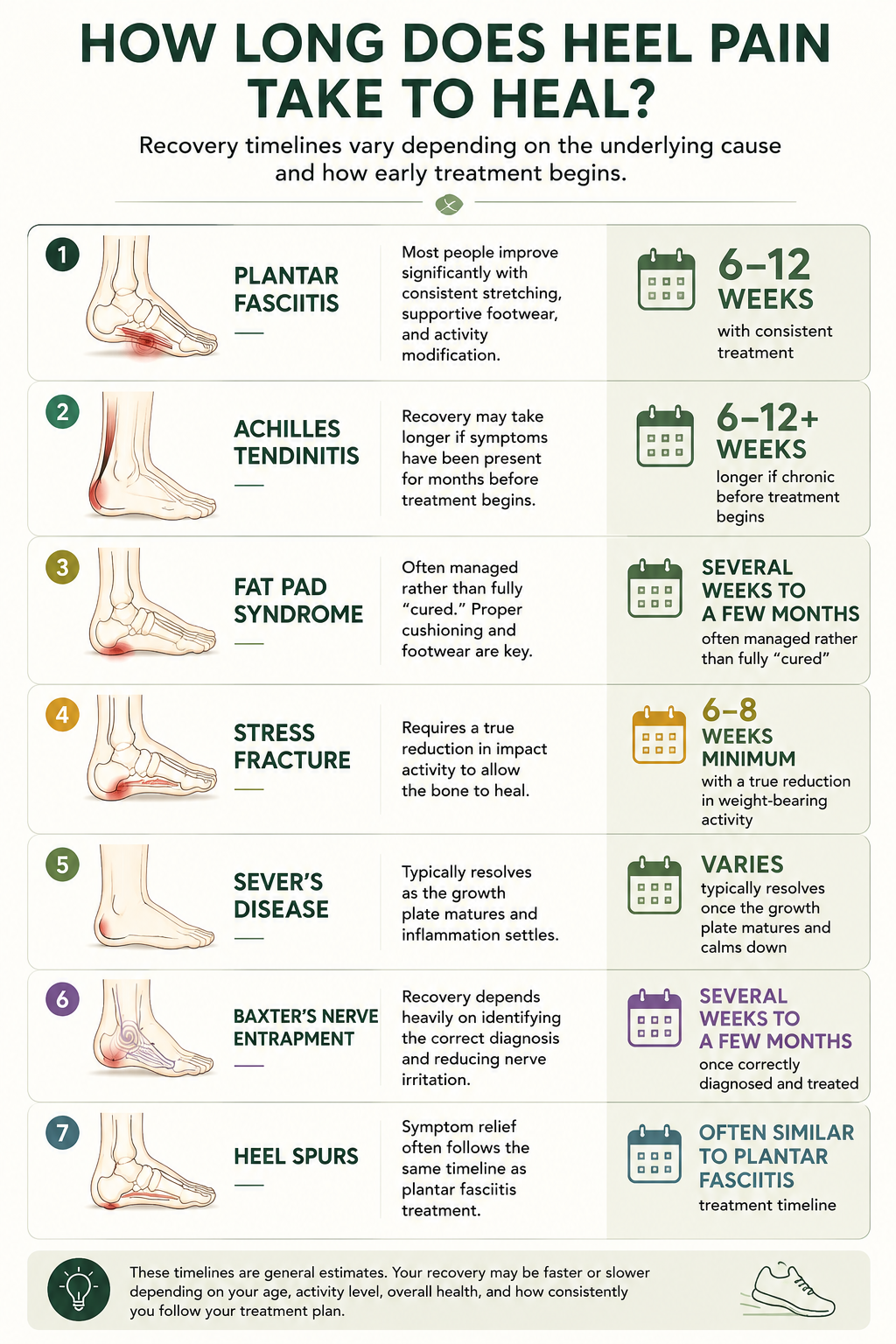
Recovery time depends heavily on which condition is causing the pain, how long it's been present before treatment starts, and how consistently treatment is followed. Here's a general timeline for the most common causes.
Condition | Typical Recovery Time
Plantar Fasciitis | 6 to 12 weeks with consistent treatment.
Achilles Tendinitis | 6 to 12+ weeks. Recovery may take longer if symptoms were chronic before treatment began.
Fat Pad Syndrome | Several weeks to a few months. Often managed rather than completely cured.
Stress Fracture | 6 to 8 weeks minimum with a significant reduction in weight-bearing activity.
Sever's Disease | Varies. Typically improves as the growth plate matures and inflammation settles.
Baxter's Nerve Entrapment | Several weeks to a few months once properly diagnosed and treated.
Heel Spurs | Symptom relief often follows a timeline similar to plantar fasciitis treatment.
These ranges assume consistent, early treatment. Heel pain that's gone untreated for many months tends to take longer to resolve than pain addressed in its early stages, which is part of why getting an accurate diagnosis sooner rather than later matters.

Feature | Why It Matters
Structured Heel Counter | Stabilizes the heel and limits excess motion that can aggravate the plantar fascia and Achilles tendon.
Adequate Heel Cushioning | Helps absorb impact and compensates for natural fat pad thinning.
Arch Support | Supports the foot's natural arch and reduces strain on the plantar fascia.
Firm Midsole | Prevents excessive flexing that can aggravate fascia and tendon irritation.
Slightly Elevated Heel-to-Toe Drop | Can reduce tension on the Achilles tendon during flare-ups.
Removable Insole | Allows room for custom orthotics or supportive inserts.
Wide Toe Box | Encourages natural foot positioning and reduces compensatory gait changes.
Just as some features help, others quietly work against recovery, even in shoes that look supportive at first glance.
Feature | Why It May Aggravate Symptoms
Minimal Cushioning | Increases impact loading on the heel with every step, especially on hard surfaces.
Collapsed or Worn Midsole | Reduces shock absorption and support, even if the shoe still looks fine externally.
Worn-Out Heel | Alters foot mechanics and can shift pressure onto already irritated tissue.
Unsupportive Flats | Increase strain on the plantar fascia due to lack of arch support and structure.
Flexible, Bendy Soles | Allow excessive midfoot flexing that can aggravate fascia and tendon irritation.
Flat, Zero-Structure Heel Counter | Lets the heel move side to side excessively, increasing strain during walking or running.
Why does my heel hurt when I walk?
Heel pain during walking is most often caused by plantar fasciitis, which creates sharp pain at the bottom of the heel, especially with the first few steps after rest. Other possibilities include fat pad syndrome (a deeper ache from cushioning loss) or, in more serious cases, a stress fracture if the pain worsens rather than eases with continued movement. Identifying exactly where the pain occurs and whether it improves or worsens with activity helps narrow down the cause.
Why does my heel hurt in the morning specifically?
Morning heel pain that's sharp and concentrated at the bottom of the heel is the classic sign of plantar fasciitis. Overnight, the plantar fascia tightens while at rest, so the first steps after waking stretch it suddenly, causing a stabbing sensation. This usually eases within 5 to 10 minutes of walking as the tissue warms up and stretches out, then can return later if you've been on your feet for extended periods.
Can heel pain go away on its own?
Mild heel pain sometimes resolves on its own with rest and reduced activity, particularly in early-stage cases. However, most moderate to persistent heel pain benefits significantly from active treatment like stretching, footwear changes, and activity modification. Waiting it out without addressing the underlying cause often allows the problem to become more chronic and harder to treat.
How long does heel pain usually last?
Most heel pain, especially plantar fasciitis, improves substantially within 6 to 12 weeks with consistent treatment. Some cases take several months to fully resolve, particularly if the condition was present for a long time before treatment started. Stress fractures typically require 6 to 8 weeks of reduced weight-bearing activity to heal properly.
What does heel pain at the back of the foot mean?
Pain at the back of the heel typically points to the Achilles tendon or a bony prominence called Haglund's deformity, rather than the plantar fascia, which causes pain at the bottom of the heel. Achilles-related pain is often worse with activity and after rest periods, while Haglund's deformity tends to be aggravated by shoe heel counters rubbing against the bony bump.
Is heel pain a sign of something serious?
Most heel pain is mechanical and not a sign of a serious underlying condition, but a few warning signs warrant prompt medical attention: pain that worsens with activity rather than easing, significant swelling or redness, inability to bear weight, or pain accompanied by fever. These can indicate a stress fracture, infection, or other condition requiring more immediate care.
Why does my heel hurt only when I run?
Heel pain isolated to running often points toward Achilles tendinitis, plantar fasciitis aggravated by impact, or in some cases an early stress fracture, especially if mileage or intensity increased recently. The "too much, too soon" pattern (ramping up distance, speed, or hill work faster than the tissue can adapt) is one of the most common underlying causes in runners specifically.
Can shoes alone fix heel pain?
Footwear changes are one of the most effective single interventions for heel pain, but they work best combined with stretching and, when needed, orthotics. Shoes with proper heel support and cushioning reduce the mechanical stress that's driving the pain, but they don't reverse tissue inflammation or tightness on their own.
What's the difference between a heel spur and plantar fasciitis?
A heel spur is a bony growth on the heel bone, often present with zero symptoms, found incidentally on X-rays. Plantar fasciitis is inflammation of the soft tissue band along the bottom of the foot, and it's the actual source of pain in the vast majority of cases, even when a spur happens to be present alongside it.
Should I see a doctor for heel pain or try home treatment first?
For typical, gradually developing heel pain without red flag symptoms, trying home treatment (footwear changes, stretching, rest from aggravating activity) for 2 to 3 weeks is reasonable before seeking care. If pain is severe, came on suddenly after an injury, worsens with activity, or doesn't improve after a few weeks of consistent home treatment, it's time to see a podiatrist or doctor.
Does heel pain mean I need orthotics?
Not necessarily. Many cases of heel pain improve with footwear changes and stretching alone. Orthotics tend to help most when there's an underlying structural factor at play, like flat feet or significant overpronation, or when over-the-counter footwear adjustments haven't fully resolved symptoms after several weeks.
❌ MYTH | ✅ FACT
❌ "Heel pain is just part of getting older"
✅ While the risk of heel pain increases with age, it is treatable at any stage of life and isn't something you simply have to accept.
❌ "You should push through the pain to work it out"
✅ Continuing high-impact activity through sharp or worsening heel pain often makes the underlying problem worse, especially with stress fractures.
❌ "Heel spurs are the main cause of heel pain"
✅ Most heel spurs cause no pain at all. The associated soft tissue inflammation is usually responsible for symptoms.
❌ "Only athletes get heel pain"
✅ Long hours of standing, body weight, footwear choices, and natural aging all contribute to heel pain, making it common among non-athletes as well.
❌ "Surgery is the only real fix for chronic heel pain"
✅ The vast majority of heel pain cases improve with conservative treatment. Surgery is typically reserved for conditions that fail to improve after several months of consistent care.
❌ "Expensive shoes always fix heel pain"
✅ Price alone doesn't determine whether a shoe is supportive. Heel counter stability, cushioning, arch support, and overall fit matter far more than the cost.
Heel pain can feel discouraging, especially when it shows up first thing in the morning or after a long day on your feet. The good news is that nearly every cause of heel pain responds well to the right combination of footwear, stretching, and a little patience. Use the location and symptom patterns above to get a clearer sense of what you're dealing with, then dive into the full guide for your specific condition to build a plan that actually addresses the root cause instead of just masking the pain.
This article is for informational and educational purposes only and is not a substitute for professional medical advice, diagnosis, or treatment. Always consult a qualified podiatrist, orthopedist, or physician regarding any foot pain or condition. Foot Step Wear does not provide medical advice.