

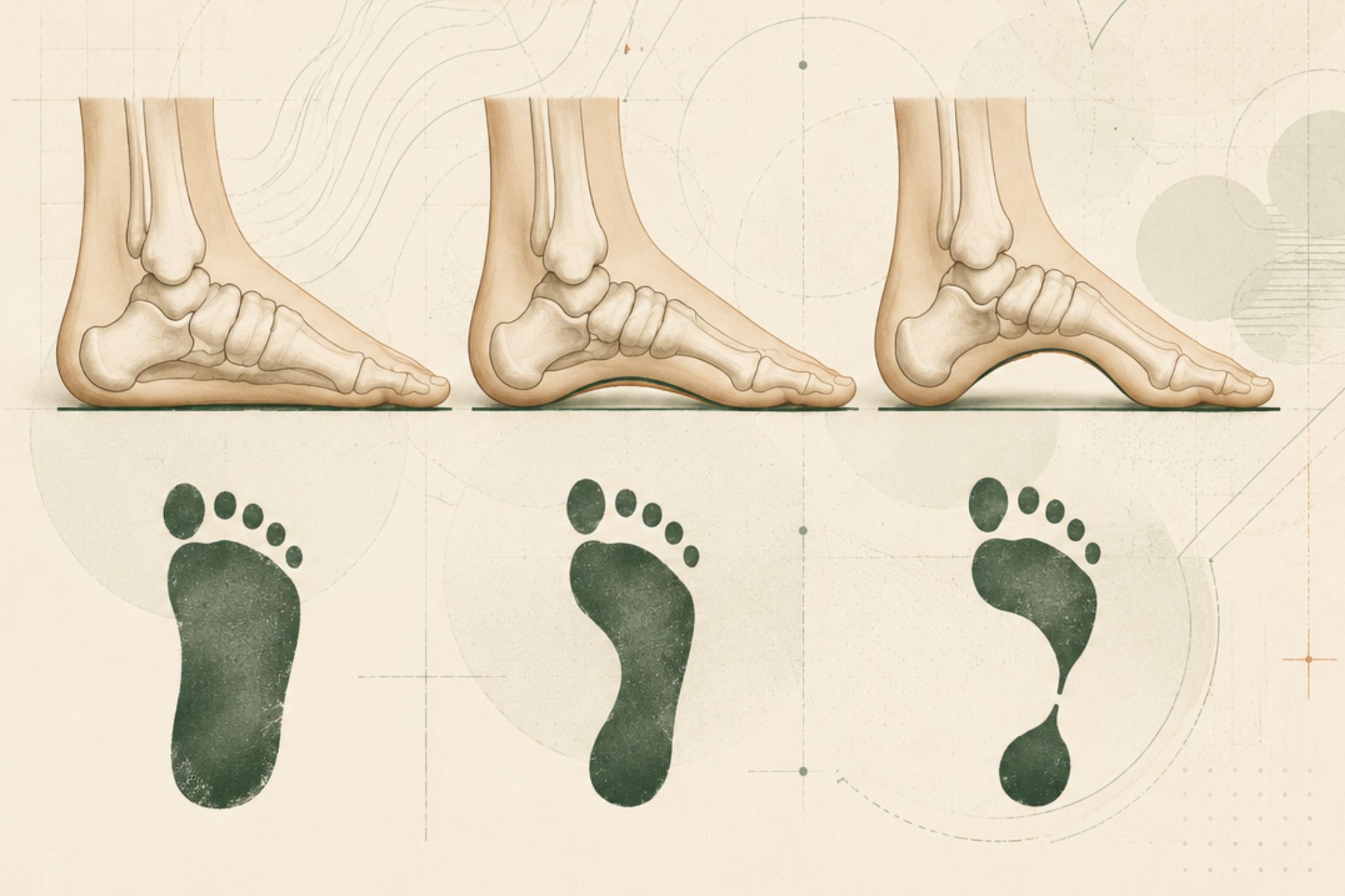
Not sure what shoes are right for your feet? Learn how to identify your foot type, understand key footwear features, and choose shoes that match your arch shape, biomechanics, and daily activities.
Most people buy shoes the way they buy almost everything else: based on how they look, what brand is on the side, or what their friend recommended. None of that is wrong, exactly. But it skips the one factor that actually determines whether a shoe will feel good on your foot for the next six months: your foot type.
Foot type refers to the structure of your arch and how your foot moves when you walk or run. It is not the most exciting topic in the world, but it has an outsized effect on comfort, performance, and how your feet feel at the end of a long day. Two people can buy the exact same popular sneaker and have completely different experiences with it. One feels supported and comfortable. The other develops arch pain by week two. Foot type is often the reason why.
This guide walks through how to figure out your foot type, what that type tends to need from a shoe, and which features actually matter when you're standing in the shoe aisle or scrolling through an online store trying to make sense of terms like "stability" and "motion control." None of this replaces a conversation with a podiatrist or physical therapist if you're dealing with ongoing pain. But for most people, understanding foot type is a genuinely useful starting point for choosing footwear that works with your body instead of against it.
Start by identifying whether your arch is flat, neutral, or high, since this affects how your foot distributes weight and absorbs impact. Flat feet often benefit from stability or motion control shoes with firmer arch support and a structured heel counter. High arches tend to do better in cushioned, flexible shoes that help compensate for reduced natural shock absorption. Neutral arches usually have the most flexibility in shoe choice, often doing well in neutral cushioned shoes. Beyond arch type, proper fit matters more than any single feature. A shoe that matches your foot type but doesn't fit well will still cause problems, so always prioritize fit alongside arch-appropriate support and cushioning.
Common traits:
Often benefits from:
✅ Stability shoes
✅ Motion control shoes (for more significant overpronation)
✅ Structured arch support
✅ Firm heel counter
Common traits:
Often benefits from:
✅ Neutral cushioned shoes
✅ Balanced support and flexibility
✅ Moderate cushioning
✅ Wide variety of shoe options
Common traits:
Often benefits from:
✅ Extra cushioning
✅ Flexible sole design
✅ Softer midsoles
✅ Shoes that promote smooth weight distribution
When footwear specialists talk about foot type, they're mainly talking about two related things: the height of your arch and how your foot moves through its natural range of motion when you walk or run, sometimes called your gait pattern.
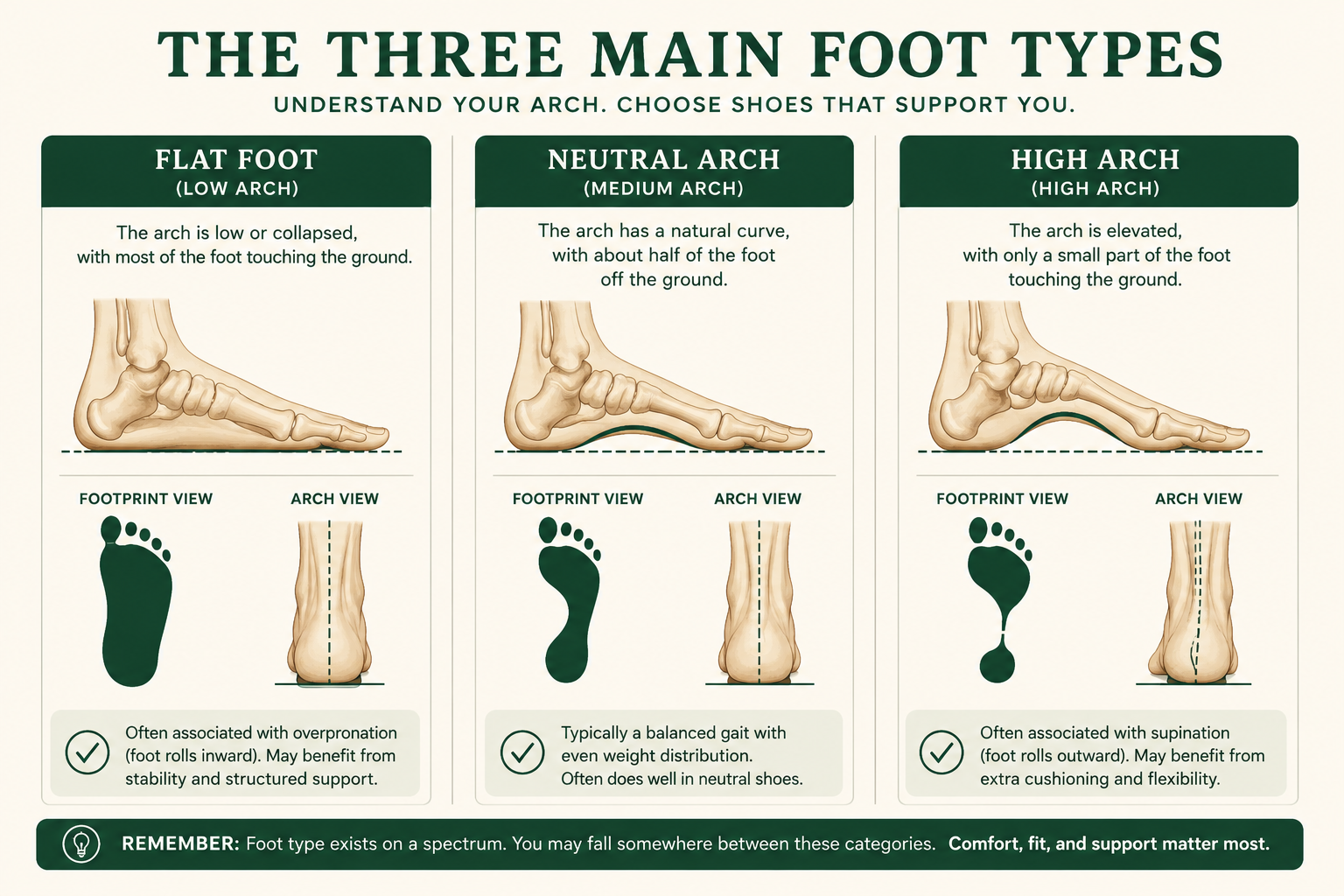
The three broad categories you'll see referenced most often are:
Neutral arch. A moderate, naturally curved arch that allows the foot to move through a fairly typical range of motion, with controlled inward rolling during the gait cycle.
Low arch, often called flat feet. An arch that sits closer to the ground, which often correlates with a tendency toward overpronation, meaning the foot rolls inward more than average during walking or running.
High arch. An arch that sits noticeably higher than neutral, which often correlates with supination, meaning the foot rolls outward and doesn't absorb shock as efficiently through natural pronation.
Here's the part that often gets lost in oversimplified shoe-shopping advice: foot type isn't a strict box you fit into. It exists on a spectrum. Plenty of people land somewhere between neutral and flat, or between neutral and high arch, with biomechanics that don't perfectly match a textbook description. Your foot type can also be influenced by genetics, footwear history, body weight changes, pregnancy, aging, injury, and activity level. None of this is fixed in stone forever, though significant changes are usually gradual.
This is why foot type is best treated as a useful starting framework rather than a rigid label. It gives you a reasonable place to begin narrowing down shoe features, not a guarantee that any one shoe will work perfectly just because it's marketed toward your category.
There are a few low-cost ways to get a reasonable read on your foot type at home, plus a note on when it's worth getting a professional opinion.
This is the classic at-home method, and it's simple enough to do in about two minutes.
Wet the sole of your foot, then step onto a surface that will show an imprint, such as a piece of cardboard, a brown paper bag, or a dark-colored towel. Step down normally with your full body weight, then step away and look at the imprint left behind.
A neutral arch typically leaves an imprint with a moderate curve along the inside of the foot, showing roughly half of the arch area connected to the heel and forefoot. A flatter foot tends to leave an imprint that shows most or nearly all of the foot, with little to no curve cut into the inner edge. A higher arch usually leaves an imprint with a very narrow band connecting the heel and forefoot, sometimes with barely any connection at all on very high arches.
This test gives you a helpful visual reference, but it's a snapshot of static foot shape, not a full picture of how your foot moves dynamically when you're actually walking or running.
Your old shoes can tell you a lot, since wear patterns reflect how your foot actually moves and distributes pressure over thousands of steps.
Flip over a pair of shoes you've worn regularly for several months and look at the outsole. Even wear across the middle of the sole, without heavy wear concentrated on one edge, often suggests a fairly neutral gait pattern. Wear concentrated along the inner edge of the sole, particularly toward the ball of the foot, can be a sign of overpronation often associated with flatter feet. Wear concentrated along the outer edge of the sole, especially toward the heel and out through the forefoot, can suggest supination often associated with higher arches.
Wear patterns are useful supporting evidence, especially when they match what the wet foot test suggests. They're not perfectly diagnostic on their own, since shoe construction, walking surface, and even how a shoe was broken in can all influence wear.
If you've tried the wet foot test and wear pattern check and still aren't confident about your foot type, or if you're dealing with ongoing pain, recurring injuries, or you're training seriously for a sport, a professional gait analysis can be worth the time.
A podiatrist, physical therapist, sports medicine specialist, or even a knowledgeable footwear specialist at a specialty running or walking store can watch you walk or run, sometimes on a treadmill with video analysis, and give you a much more precise read on your biomechanics than any at-home test can offer. This is particularly useful if your foot type seems to be borderline between categories, or if you've had limited success with shoes that should theoretically work for your foot type on paper.
Sometimes the clearest signal isn't a test you run, it's how your feet already feel in the shoes you're wearing right now. A few patterns tend to show up when a shoe and a foot type are mismatched.
Arch pain after walking. If your arch aches after a normal amount of walking, especially in shoes that lack structured support, that's often a sign the shoe isn't offering enough of what your foot type needs.
Heel slipping. A heel that lifts or slides inside the shoe with every step usually points to a fit problem rather than a foot type problem, but a heel counter that's too soft or too wide for your heel shape can make this worse.
Excessive toe rubbing. Regular friction, redness, or blistering across the toes often means the toe box is too narrow or too short for your foot shape, regardless of arch type.
Uneven outsole wear that doesn't match expectations. If you know your foot type and the wear pattern on a shoe looks dramatically different than what that foot type would typically produce, the shoe's structure may be fighting your natural gait instead of supporting it.
Foot fatigue after short periods. Feeling noticeably tired or sore after standing or walking for a shorter amount of time than usual can indicate a shoe that isn't providing the right level of cushioning or support for your foot type and activity level.
None of these signs are a diagnosis on their own, but together they're a reasonably reliable signal that it's time to reconsider whether your current shoes actually match your foot type and how you use them.
Characteristics. A neutral foot has a moderate arch height, neither notably flat nor notably high, with an imprint that shows a clear but moderate curve along the inner edge.
Common biomechanics. During a typical gait cycle, a neutral foot rolls inward slightly after heel strike, which is a normal and healthy part of shock absorption, then transitions smoothly through the stride without excessive rolling in either direction.
Typical footwear needs. Neutral feet generally have the most flexibility in shoe selection. Neutral cushioned shoes, which provide even support without aggressive correction features, tend to work well. This doesn't mean every shoe works equally well, since fit, cushioning preference, and activity type still matter, but neutral feet aren't usually fighting against a shoe's design the way flat or high-arched feet sometimes are.
Common issues. Even with favorable biomechanics, neutral feet can still develop foot pain, especially from worn-out shoes, poor fit, sudden increases in activity, or shoes that don't match the specific demands of an activity like running versus standing all day.
Characteristics. Flat feet, sometimes called low arches or pes planus, have minimal visible arch height, with the inner edge of the foot sitting closer to the ground.
Overpronation tendencies. Flat feet often correlate with overpronation, where the foot rolls inward more than is typical during the gait cycle. This isn't automatically a problem, since some people with flat feet have no symptoms at all, but more pronounced overpronation can place extra stress on certain structures of the foot and lower leg over time.
Common symptoms. People with flat feet and significant overpronation sometimes report arch fatigue, inner ankle discomfort, or general foot tiredness, particularly after long periods of standing or walking on hard surfaces. Symptoms vary widely and many people with flat feet experience no discomfort at all.
Footwear considerations. Flat feet often benefit from shoes with firmer arch support, a supportive heel counter to help limit excessive inward rolling, and either stability or motion control features depending on the degree of overpronation. A straighter shoe shape, rather than one with a heavily curved last, can also help by providing a more stable base under the arch.
Characteristics. High arches sit noticeably above neutral, with an imprint showing a narrow connection between the heel and forefoot.
Supination tendencies. High arches often correlate with supination, meaning the foot tends to roll outward and doesn't pronate inward as much as a neutral or flat foot would during the gait cycle. Because pronation plays a natural role in shock absorption, a more rigid, high-arched foot sometimes absorbs less shock on its own.
Pressure distribution challenges. With less natural inward rolling to spread pressure across the foot, weight can concentrate more heavily on the outer edge and the ball of the foot. This sometimes shows up as calluses or pressure discomfort in those areas.
Footwear considerations. High arches often do better in shoes with generous cushioning to help compensate for reduced natural shock absorption, along with enough flexibility in the sole to allow the foot to move through its range of motion rather than fighting against a rigid structure. Excessively firm motion control shoes, which are generally built for the opposite problem, are usually not the best match here.
Once you have a reasonable sense of your foot type, the next step is understanding what these shoe features actually mean and why they're relevant.
Arch support refers to the structure built into a shoe's midsole or insole that helps support the arch of the foot. The amount and firmness of arch support that feels right varies significantly by foot type and personal preference. Flatter feet often benefit from more pronounced arch support, while neutral and high-arched feet may prefer a lower profile or softer support that doesn't feel intrusive under an already elevated arch.
Cushioning refers to the soft material in the midsole that absorbs impact with each step. More cushioning generally means more shock absorption, which can benefit high arches that don't pronate as much naturally, as well as anyone who spends long hours standing or walking on hard surfaces. Too much cushioning can sometimes feel unstable for people who prefer a firmer, more grounded feel, which is a common consideration for some flat-footed individuals who want more structure underfoot.
Stability features are design elements, often a firmer foam density on the inner side of the midsole, intended to help control excessive inward rolling of the foot. These features are most often associated with shoes designed for mild to moderate overpronation, commonly seen in some flat feet.
The heel counter is the structural piece, often made of firmer material, that wraps around the back of the heel inside the shoe. A firm heel counter helps keep the heel in place and can assist with controlling excessive motion, which often benefits flatter feet. A softer or more flexible heel counter is sometimes preferred by people with neutral or high arches who don't need as much heel control.
Heel-to-toe drop refers to the height difference between the heel and the forefoot of a shoe. A higher drop, often in the range of 10 to 12 millimeters, shifts some pressure away from the Achilles and calf, while a lower or zero drop encourages a more natural foot position but requires more ankle and calf flexibility. Foot type isn't the only factor here, since activity type, Achilles health, and personal preference also play significant roles in drop selection.
A rocker sole has a curved shape built into the bottom of the shoe, designed to help the foot roll forward through a stride with less bending required at the toe joints. This can be helpful for certain foot conditions or limited joint mobility, though it's not specifically tied to one foot type and is worth discussing with a professional if you're considering it for a particular issue.
The toe box is the front portion of the shoe where the toes sit. A wider toe box allows the toes to spread naturally, which many footwear specialists consider beneficial regardless of foot type, particularly for anyone dealing with bunions or general forefoot discomfort. A narrow or tapered toe box can compress the toes over time, especially with frequent wear.
Midsole construction refers to the overall design and material composition of the layer between the outsole and the foot. Dual-density midsoles, which use a firmer material on one side and softer material on the other, are common in stability shoes designed for flatter feet. Single-density midsoles are more typical in neutral shoes.
Flexibility describes how easily a shoe bends, particularly at the forefoot. More flexible shoes generally allow a more natural range of motion, often preferred for high arches that benefit from less restriction. Less flexible, more structured shoes often suit feet that benefit from additional control, frequently associated with flatter foot types.
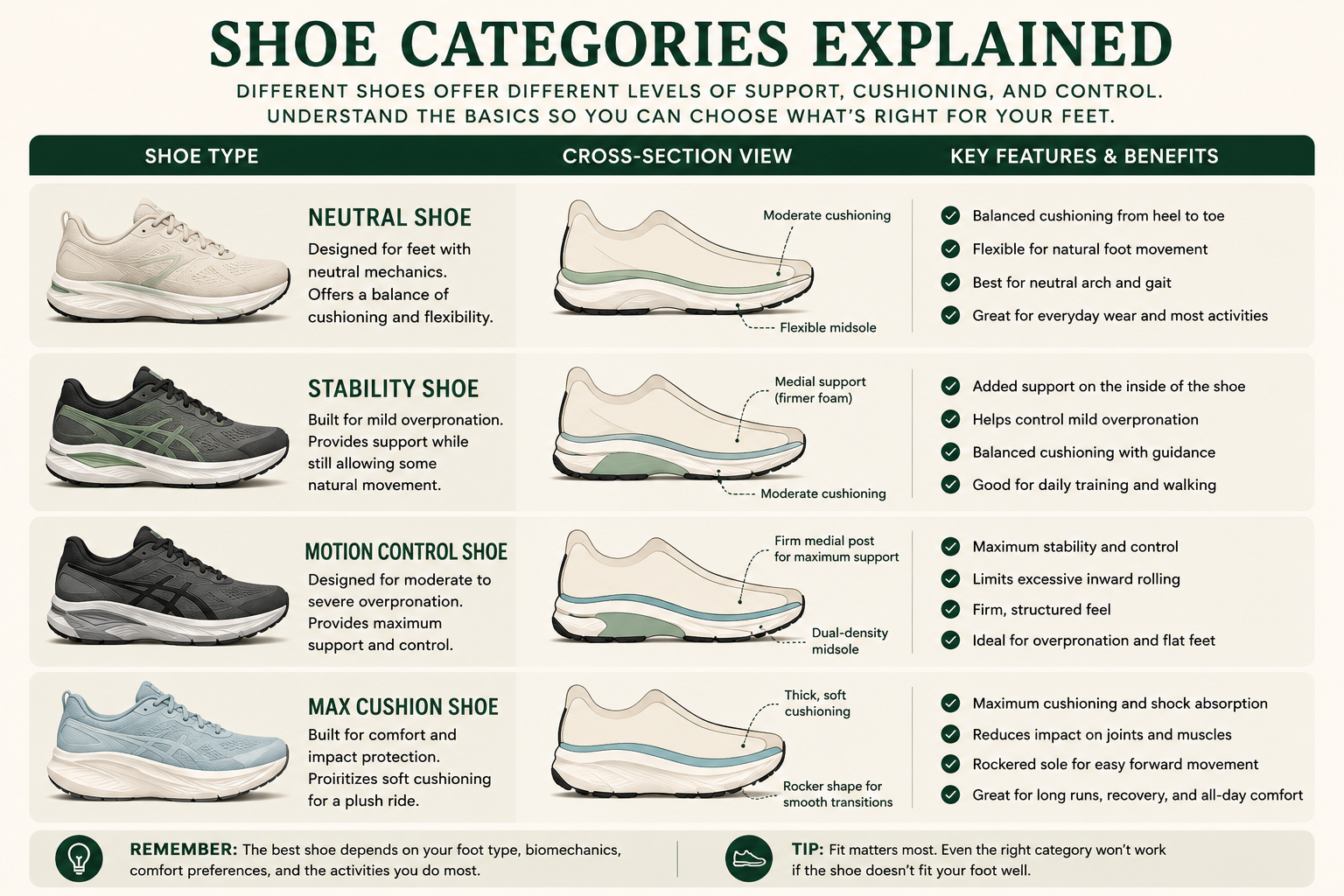
Once you understand individual features, it helps to know how the footwear industry typically bundles them into named categories. These terms show up constantly on shoe boxes and product pages, and knowing what they actually mean takes a lot of the guesswork out of shopping.
Neutral shoes are built without aggressive correction features, offering balanced cushioning and a fairly even midsole density throughout. They're the default starting point for neutral feet and are also commonly used by high-arched feet that want flexibility and cushioning without added structure on the inner side of the shoe.
Stability shoes include moderate support features, often a firmer density of foam along the inner side of the midsole, designed to gently guide the foot and limit excessive inward rolling. These are frequently recommended for mild to moderate overpronation, which is common among flatter feet, while still allowing a reasonably natural stride.
Motion control shoes are the most structured category, built with reinforced support, firmer midsoles, and sometimes a straighter overall shape. They're generally intended for more pronounced overpronation, offering maximum control over excessive foot motion. This category tends to suit only a smaller subset of flatter feet with significant overpronation, rather than flat feet in general.
Max cushion shoes prioritize a thick, soft midsole designed to absorb as much impact as possible. They can appeal to high arches looking for extra shock absorption, as well as anyone covering long distances or spending long hours on their feet, regardless of foot type. The tradeoff is sometimes a less stable or less responsive feel compared to lower-profile shoes.
Minimalist shoes use a thin, flexible sole with little to no cushioning or heel-to-toe drop, designed to let the foot move and flex naturally. These can work well for some neutral feet with strong foot and ankle mechanics, but they generally require a gradual transition period and are usually not the first recommendation for flatter feet with significant overpronation or high arches with reduced shock absorption.
Walking shoes and running shoes are built around different demands, even when they're marketed to similar foot types. Running shoes are designed to absorb the higher impact forces of running and often have more cushioning concentrated under the heel and forefoot to support a running gait. Walking shoes are typically built with a more rigid sole, a smoother heel-to-toe transition tailored to a walking stride, and sometimes a slightly different flex point than a running shoe. Using a running shoe for all-day walking, or a walking shoe for regular running, can feel fine for some people but often doesn't hold up as well as a shoe built for the specific activity.
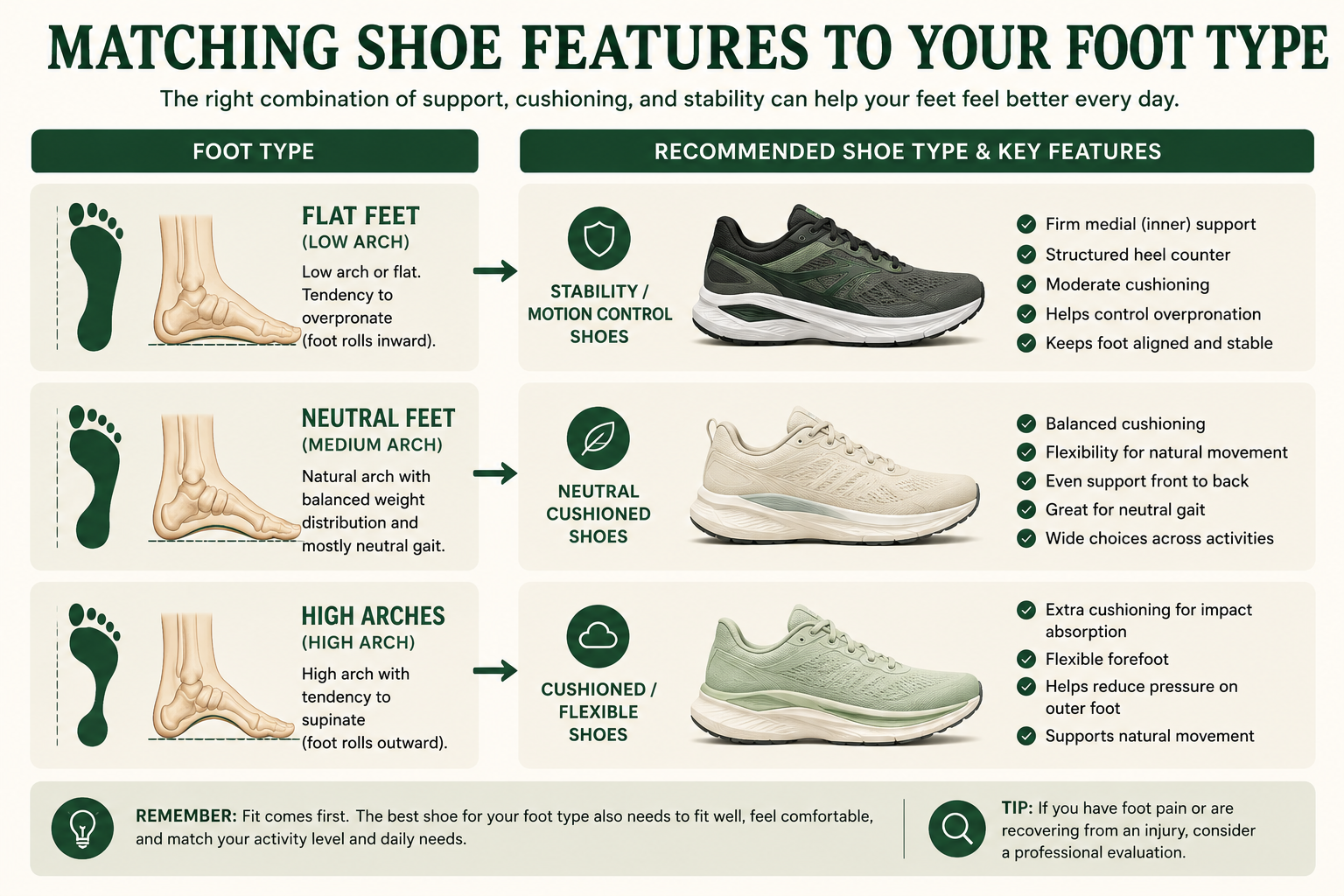
Common characteristics:
Helpful shoe features:
✅ Neutral cushioned shoes
✅ Moderate arch support
✅ Balanced flexibility
✅ Comfortable, well-fitted heel counter
Common characteristics:
Helpful shoe features:
✅ Stability or motion control shoes
✅ Firmer arch support
✅ Structured heel counter
✅ Straighter shoe shape
✅ Moderate cushioning
Common characteristics:
Helpful shoe features:
✅ Cushioned neutral shoes
✅ Flexible sole design
✅ Softer, shock-absorbing midsole
✅ Wider toe box when appropriate
✅ Less aggressive medial support
If you're working through symptoms tied to a specific foot type, our guides on flat feet and arch pain go deeper into footwear strategies for those situations. If you're ready to start narrowing down actual options, our roundup of the best shoes for flat feet and best shoes for high arches break down specific picks worth considering.
It's worth being clear about something here: foot type can be associated with certain foot problems, but association isn't the same as causation. Plenty of people with flat feet or high arches go through life with no foot pain at all, while plenty of people with textbook neutral feet still develop foot problems. Foot type is one factor among several, not a guarantee of any particular outcome.
Plantar fasciitis. Overpronation can place additional strain on the plantar fascia, the band of tissue running along the bottom of the foot, which some research and clinical observation associates with a higher likelihood of plantar fasciitis symptoms in certain individuals. Our plantar fasciitis guide covers this connection along with footwear considerations in more depth.
Posterior tibial tendon dysfunction. This condition involves the tendon that helps support the arch, and it's sometimes associated with flat feet, particularly when arch collapse progresses over time.
Bunions. While bunions have multiple contributing factors, including genetics and shoe fit, some research has noted associations between flatter foot mechanics and bunion development. Our bunions guide covers this in more detail.
Achilles irritation. Increased pronation can sometimes alter the angle and stress placed on the Achilles tendon, which is one reason some people with flat feet report Achilles discomfort during or after activity. More on this in our Achilles pain guide.
Metatarsalgia. Reduced natural shock absorption can mean more concentrated pressure under the ball of the foot, which is associated with metatarsalgia, a general term for pain in this area.
Stress injuries. Because high arches often absorb shock less efficiently through natural pronation, some research has associated this foot type with a somewhat elevated risk of certain stress-related injuries in highly active individuals, though training load and surface play a significant role as well.
Lateral ankle instability. A tendency toward supination can place more weight on the outer edge of the foot, which some clinicians associate with a higher likelihood of ankle rolling or instability in certain individuals.
Having a neutral foot type doesn't mean immunity from foot pain. Neutral feet can still develop plantar fasciitis, arch pain, heel pain, or other common foot issues, often related to factors like worn-out footwear, sudden changes in activity level, body weight changes, prolonged standing, or unrelated medical conditions. If you're dealing with foot pain despite having a fairly neutral foot type, our foot pain location guide can help narrow down what might be contributing to your specific symptoms.
It's worth repeating that footwear is only one factor among many that influence foot health. Activity level, overall mobility, muscular strength, anatomy beyond arch height, age, body weight, and underlying medical conditions all play a role. Choosing well-suited shoes is a meaningful piece of the puzzle, not a complete solution on its own.
A few patterns show up again and again in how people choose shoes, often without realizing the impact.
❌ Buying shoes based only on brand
❌ Assuming expensive means better
❌ Ignoring toe box width
❌ Wearing shoes long past their lifespan
❌ Copying someone else's shoe recommendation without considering your own foot type
❌ Switching to a dramatically different shoe type too quickly
On the other side of that list:
✅ Understanding your own foot structure before shopping
✅ Prioritizing fit first, even above specific features
✅ Replacing worn footwear on a reasonable schedule
✅ Matching shoe features to your actual needs, not just trends
There isn't one single best shoe for flat feet, since individual fit, activity level, and the degree of overpronation all vary. Generally, shoes with firmer arch support, a structured heel counter, and stability or motion control features tend to work well for flatter feet with noticeable overpronation. Trying on multiple options and paying attention to how your arch and heel feel during actual movement, not just standing still, is more reliable than relying on a single recommendation. Our best shoes for flat feet roundup walks through specific options if you want a starting point.
High arches generally do well with cushioned, flexible shoes that help compensate for reduced natural shock absorption. Look for adequate midsole cushioning and a sole that allows your forefoot to bend naturally rather than a stiff, heavily structured shoe built for the opposite problem. As with flat feet, individual comfort and fit should guide the final decision more than any single feature in isolation.
Yes, to a reasonable degree. The wet foot test and checking wear patterns on older shoes both give useful clues about whether your arch leans flat, neutral, or high, and whether your gait shows signs of overpronation or supination. These methods aren't as precise as a professional gait analysis, but they're a solid starting point for most people who aren't dealing with significant pain or injury history.
No. Arch support is one piece of a larger picture that includes overall fit, cushioning, heel structure, toe box width, and how a shoe matches your specific activities. A shoe with excellent arch support but a poor overall fit can still cause discomfort. Think of arch support as one important factor among several, not the single deciding feature.
Not typically. Custom orthotics are designed to work in combination with appropriately supportive footwear, not as a substitute for it. A well-built orthotic inside a shoe with poor support or poor fit often won't perform as intended. If you use orthotics or are considering them, it's worth discussing footwear compatibility with the provider who fitted them.
This varies by shoe type and usage, but as a general guideline, athletic shoes used regularly for walking or running often start losing meaningful cushioning and support somewhere in the range of 300 to 500 miles, or roughly every four to six months for regular use, though this depends heavily on body weight, walking surface, and gait. Watch for flattened cushioning, uneven wear, or a noticeable change in comfort as practical signs that it's time to replace a pair.
Footwear that doesn't match your foot type, fits poorly, or has worn past its useful life can contribute to foot pain or make existing discomfort worse. That said, foot pain is often multifactorial, meaning footwear is frequently one contributing factor alongside activity level, body mechanics, and sometimes underlying medical conditions, rather than the sole cause. If foot pain persists despite reasonable footwear changes, it's worth exploring further with a professional.

Most foot type questions can be reasonably addressed with the information in this guide, some trial and error, and attention to fit. That said, certain situations are worth bringing to a professional rather than continuing to self-manage through shoe shopping alone.
Consider reaching out to a podiatrist, physical therapist, or other qualified provider if you're dealing with persistent foot pain that doesn't improve with reasonably supportive footwear, significant difficulty walking, a foot deformity that appears to be progressing over time, recurrent injuries that keep showing up in the same area, or a sudden, noticeable change in your foot structure or arch height. These situations benefit from a trained eye and sometimes diagnostic tools that go beyond what shoe shopping alone can address.
With all of this in mind, here's a simple framework to actually put it into practice.
1. Identify your foot type. Use the wet foot test, check wear patterns on your current shoes, or get a professional gait analysis if you want a more precise read.
2. Consider your primary activity. Walking, running, standing for long shifts, and general daily wear all place different demands on a shoe, sometimes more than foot type alone.
3. Determine your support needs. Match your foot type and activity to a shoe category, whether that's neutral, stability, motion control, max cushion, or minimalist, and decide how much arch support and structure you actually need.
4. Check fit and toe box width. Even the right category of shoe in the wrong size or shape will cause problems. Make sure there's enough room for your toes to sit naturally without crowding.
5. Test comfort before committing. Walk around in the shoe, ideally for more than just a few steps in a store, and pay attention to how your arch, heel, and toes actually feel rather than relying on how the shoe looks or what it's supposed to do on paper.
Understanding your foot type gives you a genuinely useful framework for narrowing down footwear choices, but it isn't a rigid formula. There's no single universal best shoe for any foot type, including yours. Fit, comfort, support, and how a shoe matches your actual daily activities all matter as much as, or more than, the broad category your arch falls into.
The best shoe isn't the most expensive shoe, the most popular shoe, or the shoe someone else recommends. It's the shoe that fits your foot, supports your biomechanics, and matches the demands of your daily life.
If you're dealing with a specific area of discomfort, our guides on heel pain arch pain, toe pain, and neuropathy in the feet go deeper into footwear strategies tailored to those particular issues, and our shoe roundups can help you turn this foundation into an actual shortlist worth trying on.