

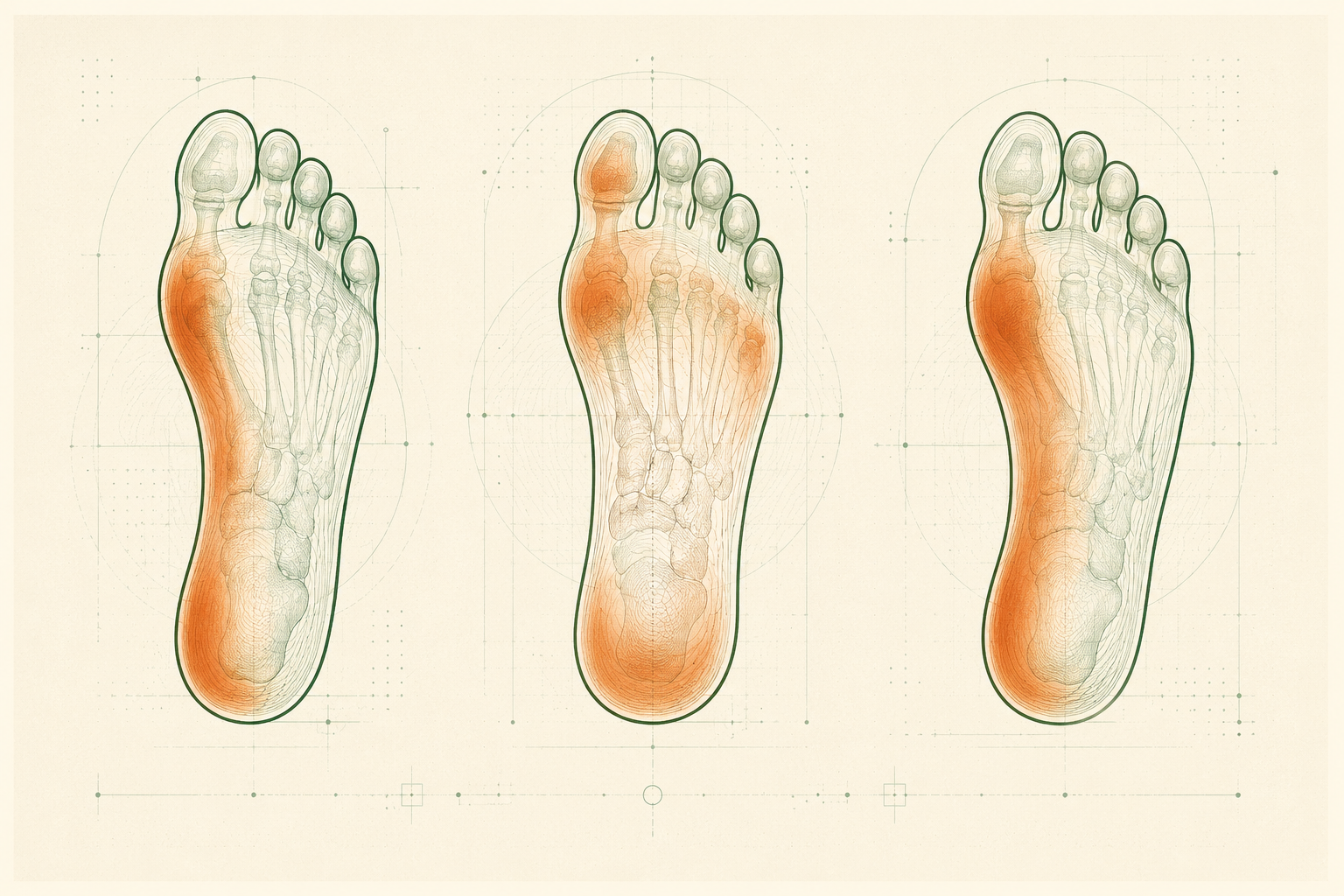
What’s the difference between pronation and supination? This guide explains how your foot naturally moves during walking and running, how to identify your gait pattern, and which footwear features may help support your unique biomechanics.
Every time your foot hits the ground, it rolls a little. That's not a flaw. It's the entire point.
The direction and degree of that roll is what people mean when they talk about pronation and supination. These two words show up constantly in shoe descriptions, running forums, and physical therapy offices, but most explanations either oversimplify them into "good roll" and "bad roll" or bury them in biomechanics jargon that doesn't actually help you buy better shoes.
Here's the short version: pronation and supination are simply the names for which way your foot rolls as it absorbs impact. Everyone does some version of both. The question that actually matters isn't whether you pronate or supinate — it's whether you do too much of either, and what that means for your comfort and your footwear choices.
This guide breaks down what's normal, what's worth paying attention to, how to figure out your own pattern at home, and how to think about shoe features once you know where you land. No fear-mongering, no diagnosis — just a clear map of your own mechanics.
Key Takeaways
Quick answer: Pronation is the natural inward roll of the foot after it strikes the ground, and it's a normal shock-absorbing motion everyone has to some degree. Supination is the outward roll, also a normal part of gait, especially right before push-off. Problems arise only with excess in either direction — overpronation (too much inward roll) or oversupination/underpronation (too little inward roll, sometimes called supination as a pattern). Most people fall into a "normal" or mild range on this spectrum, not an extreme.
Pronation is the natural inward roll of the foot that happens after your heel strikes the ground. As your foot moves through a stride, it doesn't land and stay flat. It rolls slightly inward, the arch flattens a little, and the lower leg rotates inward along with it.
This isn't your foot malfunctioning. It's your foot doing its job.
When your heel makes contact with the ground, your body needs a way to absorb the force of impact before it travels up into your ankles, knees, hips, and spine. Pronation is one of the primary mechanisms your foot uses to do that.
Think of it like a car's suspension system. A rigid, unmoving foot would transmit every bit of ground-impact force straight up the leg. A foot that pronates appropriately spreads that force out over a fraction of a second, distributing it instead of slamming it through the joints.
Pronation isn't a single event — it's a phase. A typical walking or running stride moves through:
Every walking or running step you've ever taken has included some version of this sequence. Pronation is step two. It's not the exception. It's the baseline.

A lot of marketing language around footwear treats pronation itself as a problem to be corrected. That framing isn't accurate. Pronation, in a typical and moderate range, is simply how a healthy foot manages impact.
The issue only emerges with degree — when the inward roll is more pronounced or prolonged than what the rest of the body can comfortably compensate for. That's a different concept, called overpronation, and it's covered in detail further down.
For now, the key takeaway: if someone tells you that you "pronate," that's not a diagnosis. It's a description of normal human movement.
Supination is the outward roll of the foot. It's the mirror image of pronation, and it also happens during every normal gait cycle — specifically during the push-off phase, when your foot rolls slightly outward and your weight shifts toward the outer edge of your foot and your big toe for propulsion.
Where pronation absorbs shock, supination assists with propulsion. As your foot prepares to leave the ground, it needs to become a more rigid lever rather than a shock-absorbing platform. Supination helps create that rigidity, allowing for a more efficient push-off.
This is sometimes described as the foot's "locking" mechanism. A foot that's mid-pronation is loose and adaptable. A foot that's mid-supination is firmer and ready to generate force.
Arch height plays a meaningful role in how much a person naturally supinates. Higher arches tend to be more rigid structures overall, which can mean less of the flattening motion associated with pronation, and a tendency to spend more time in a supinated position throughout the gait cycle.
This connects directly to our [High Arches Guide], which covers how arch structure influences pressure distribution and footwear needs in more depth.
Just like pronation, supination exists on a spectrum. Most people land somewhere in a moderate, functional range. A foot that supinates as part of the natural push-off phase is not a foot with a problem.
The concern again , is one of degree. When the outward roll is excessive or when a foot spends too much time in a supinated position without enough pronation to absorb shock, that pattern is typically referred to as oversupination or, more commonly in casual usage, simply "supination" as a category, often grouped together with underpronation. We'll separate that out clearly in the sections ahead.
Most of the conversation around pronation and supination focuses on the extremes, which can make it feel like every foot is sorted into one camp or the other. In reality, the majority of people fall somewhere in the middle. That middle ground is called a neutral gait.
A neutral gait still pronates. That's worth repeating, because it surprises people. A neutral foot rolls inward after heel strike, just like any other foot, but the roll happens within a moderate, expected range rather than an excessive one. It absorbs shock efficiently without rolling far enough inward to be classified as overpronation.
Because the inward roll is moderate, pressure tends to distribute fairly evenly across the foot through the stance phase, rather than concentrating heavily along the inner or outer edge. This is part of why neutral gait is often used as the baseline reference point in shoe wear analysis and gait assessments.
One of the practical upsides of a neutral gait is flexibility in footwear choice. Without a strong pull toward extra stability features or extra cushioning to compensate for an extreme pattern, most well-built, well-fitting shoes across a wide range of categories tend to feel comfortable.
It's worth being direct about this: having a neutral gait is not a guarantee against foot or lower-leg discomfort. Fit, footwear condition, activity level, training load, and overall strength all still matter. A neutral gait simply removes one variable from the equation. It doesn't remove all of them.
[IMAGE OPPORTUNITY: A simple horizontal spectrum graphic labeled "Supinated ← Neutral → Overpronated," with a small foot-and-ankle icon positioned along the spectrum at each label to visually anchor where each pattern sits relative to the others.]
Foot Movement
Rolls inward after heel strike
When It Occurs
Early-to-mid stance phase
Associated Arch Type
More common with flatter or flexible arches
Pressure Distribution
Spreads toward the inner (medial) side of the foot
Typical Shoe Wear Pattern
Wear concentrated on the inner edge of the heel and forefoot
Common Footwear Characteristics
Structured arch support, stability features, supportive midsoles
Shock Absorption Role
Primary shock-absorbing motion
Foot Movement
Rolls inward within a moderate, balanced range
When It Occurs
Throughout a typical, balanced stance phase
Associated Arch Type
Often associated with a medium arch height
Pressure Distribution
Distributes fairly evenly across the foot
Typical Shoe Wear Pattern
Even wear, with slightly more at the center-rear and center-front
Common Footwear Characteristics
Balanced cushioning, comfortable all-around fit
Shock Absorption Role
Efficient, moderate shock absorption
Foot Movement
Rolls outward, especially during push-off
When It Occurs
Late stance phase / toe-off
Associated Arch Type
More common with higher, more rigid arches
Pressure Distribution
Concentrates toward the outer (lateral) side of the foot
Typical Shoe Wear Pattern
Wear concentrated on the outer edge of the heel and forefoot
Common Footwear Characteristics
Extra cushioning, flexible midsoles, neutral construction
Shock Absorption Role
Limited shock absorption; more focused on propulsion and rigidity
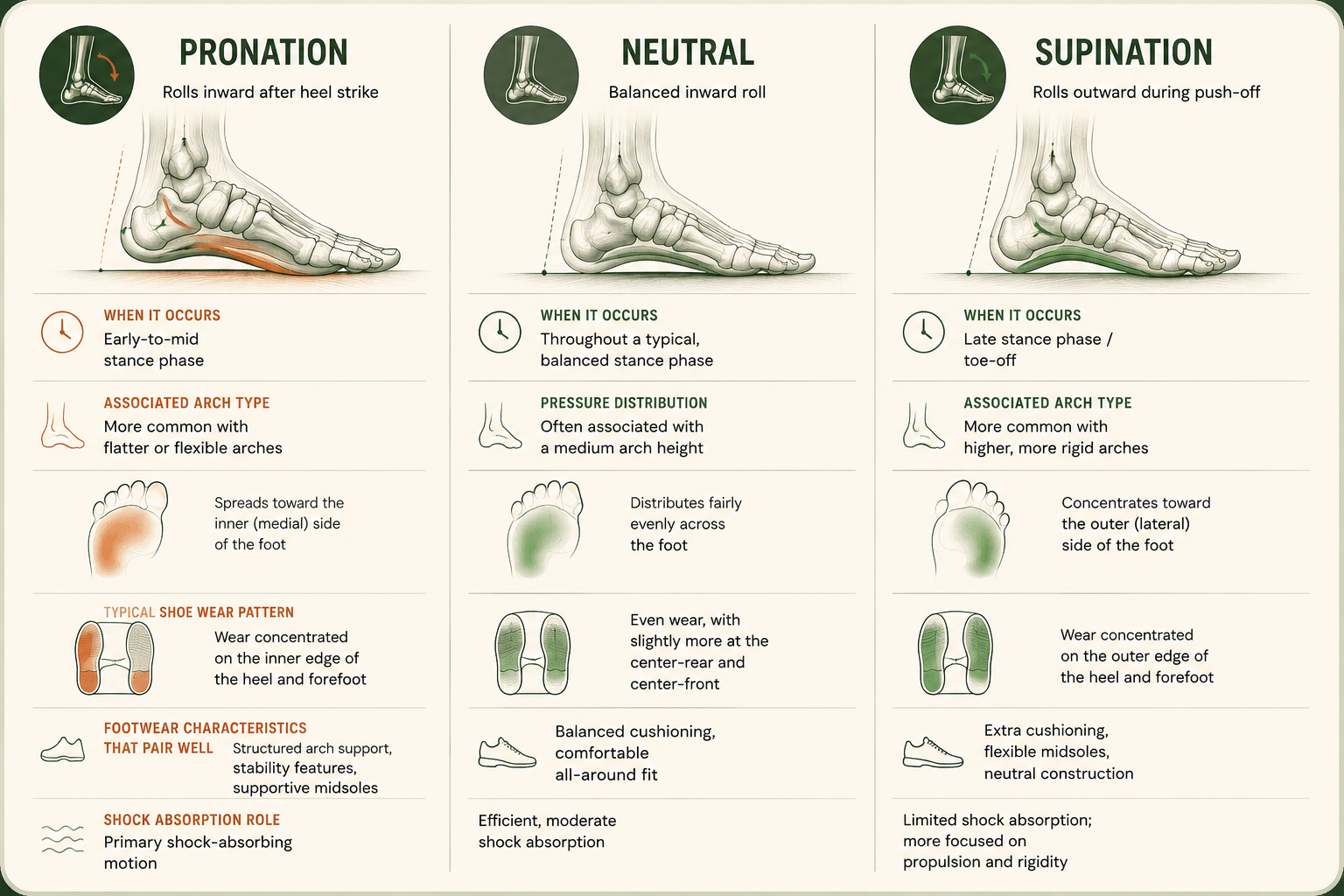
It's worth repeating: this table describes two phases of one normal gait cycle, not two competing foot "types" where you're permanently sorted into one camp. Most feet do both — they just may lean further in one direction than the other.
Overpronation describes an inward roll that goes beyond what's typical — either rolling further than average, continuing for longer than average through the stance phase, or both.
If normal pronation is your foot's suspension system working as designed, overpronation is more like a suspension system that compresses a bit too far. It's still doing its job. It's just doing more of it than the rest of your leg and foot structure may comfortably accommodate over time.
Several structural and situational factors are associated with a tendency toward overpronation, including:
None of these factors guarantee overpronation on their own, and having one or more of them doesn't mean a person needs to "fix" anything. They're simply common contributing patterns.
Overpronation is commonly discussed alongside several other foot and lower-leg concerns. It's important to frame this correctly: these are associations researchers and clinicians have observed, not direct cause-and-effect relationships. Many people overpronate without ever developing any of the following, and many people who experience these issues do not overpronate.
Flat feet. Flatter arches and overpronation often occur together, since a flatter arch tends to allow more inward roll. Our [Flat Feet Guide] goes deeper into this relationship and what it means for footwear.
Plantar fasciitis. Extended or excessive pronation has been associated with added strain on the plantar fascia, the band of tissue along the bottom of the foot. For a full breakdown of this condition, see our [Plantar Fasciitis Guide].
Achilles strain. Because overpronation involves additional inward rotation through the lower leg, some people associate it with added stress on the Achilles tendon. Our [Achilles Pain Guide] covers this connection along with other contributing factors.
Shin splints. The repetitive inward rotation associated with overpronation is sometimes discussed as a contributing factor in shin splint discomfort, particularly in runners increasing mileage quickly.
None of these associations mean overpronation should be treated as a red flag. They simply mean it's a mechanical pattern worth understanding if you're already dealing with discomfort in one of these areas.
Underpronation — also frequently just called supination when discussed as a pattern rather than a single phase of gait — describes a foot that doesn't roll inward enough during the stance phase. Instead of pronating to absorb shock, the foot stays closer to a supinated position throughout, putting more emphasis on the outer edge of the foot.
This is less common than overpronation but follows the same basic principle: a normal motion, present in everyone, that becomes notable mainly in its degree.
Underpronation is frequently associated with a stiffer, less flexible foot structure. Because the foot isn't rolling inward to flatten and absorb shock the way a more flexible foot would, more of the impact force tends to stay concentrated along the outer edge of the foot rather than being spread across a broader area.
Because force isn't being distributed as widely, underpronation is sometimes associated with concentrated stress along the lateral (outer) structures of the foot and ankle.
High arches. A more rigid, higher arch is one of the most consistent associations with underpronation, since a higher arch naturally limits how far the foot can flatten and roll inward. Our [High Arches Guide] explores this relationship in detail.
Ankle instability. Some research and clinical observation has linked a supinated foot pattern with a higher likelihood of ankle rolling or instability, particularly during quick direction changes, though individual ankle strength and history play a significant role as well.
Lateral foot discomfort. Because pressure concentrates along the outer foot, some people with this pattern notice discomfort specifically along that outer edge rather than centrally or medially.
Stress-related concerns. Concentrated, repetitive loading along a narrower portion of the foot is sometimes discussed in connection with stress-related discomfort in the outer foot and lower leg, especially with high-impact or high-mileage activity.
As with overpronation, none of these associations are a guarantee or a diagnosis. They're patterns worth being aware of, not conclusions to jump to.
You don't need a lab or a treadmill with sixteen cameras to get a reasonable read on your own pattern. A few simple, at-home observations can tell you a lot.
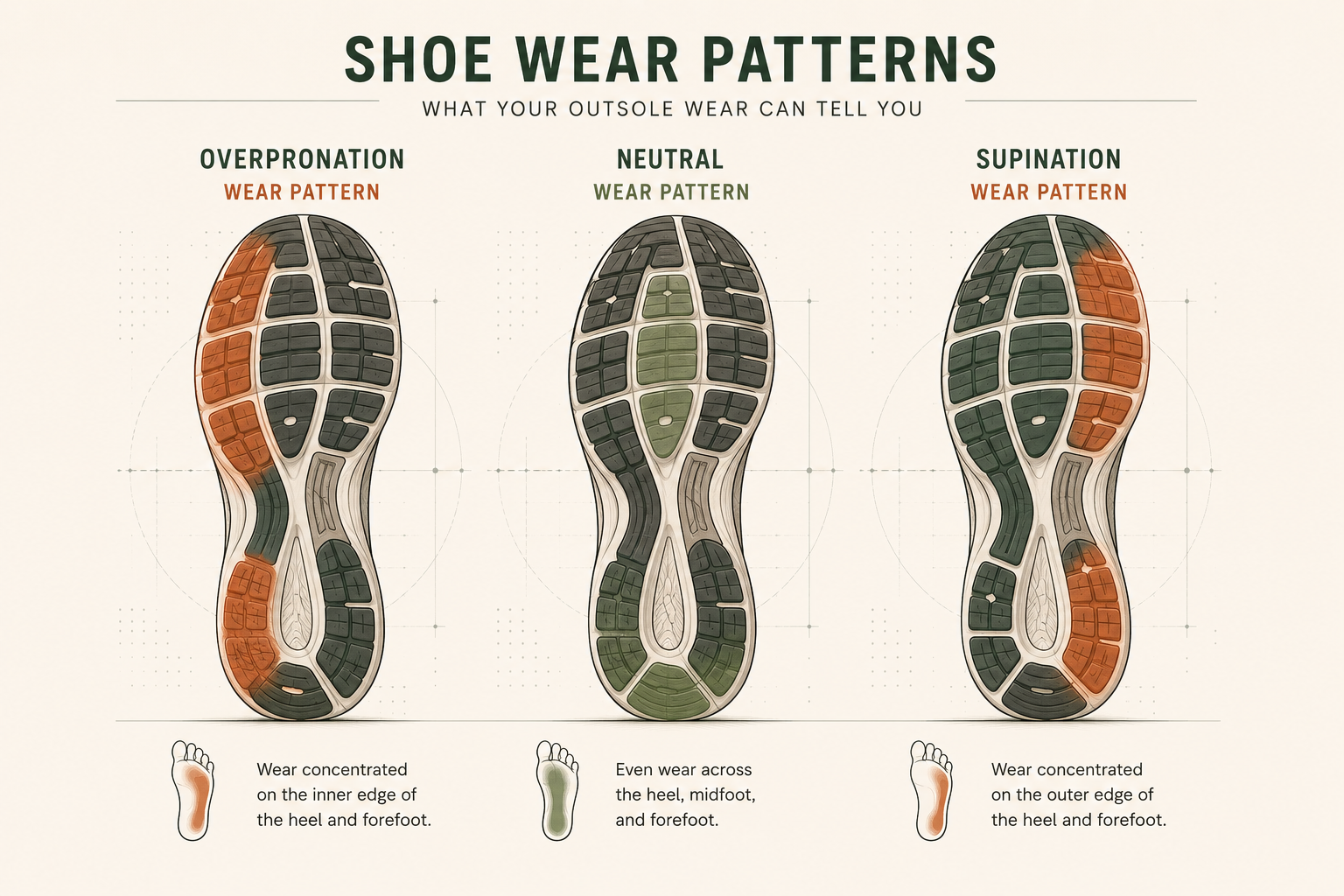
Flip over a pair of shoes you've worn regularly for several months — ideally a casual or athletic shoe you wear often, not a brand-new pair.
Look at the outsole, especially the heel and forefoot.
This is one of the most accessible self-assessment tools available, and it reflects real-world, repeated movement rather than a single snapshot.
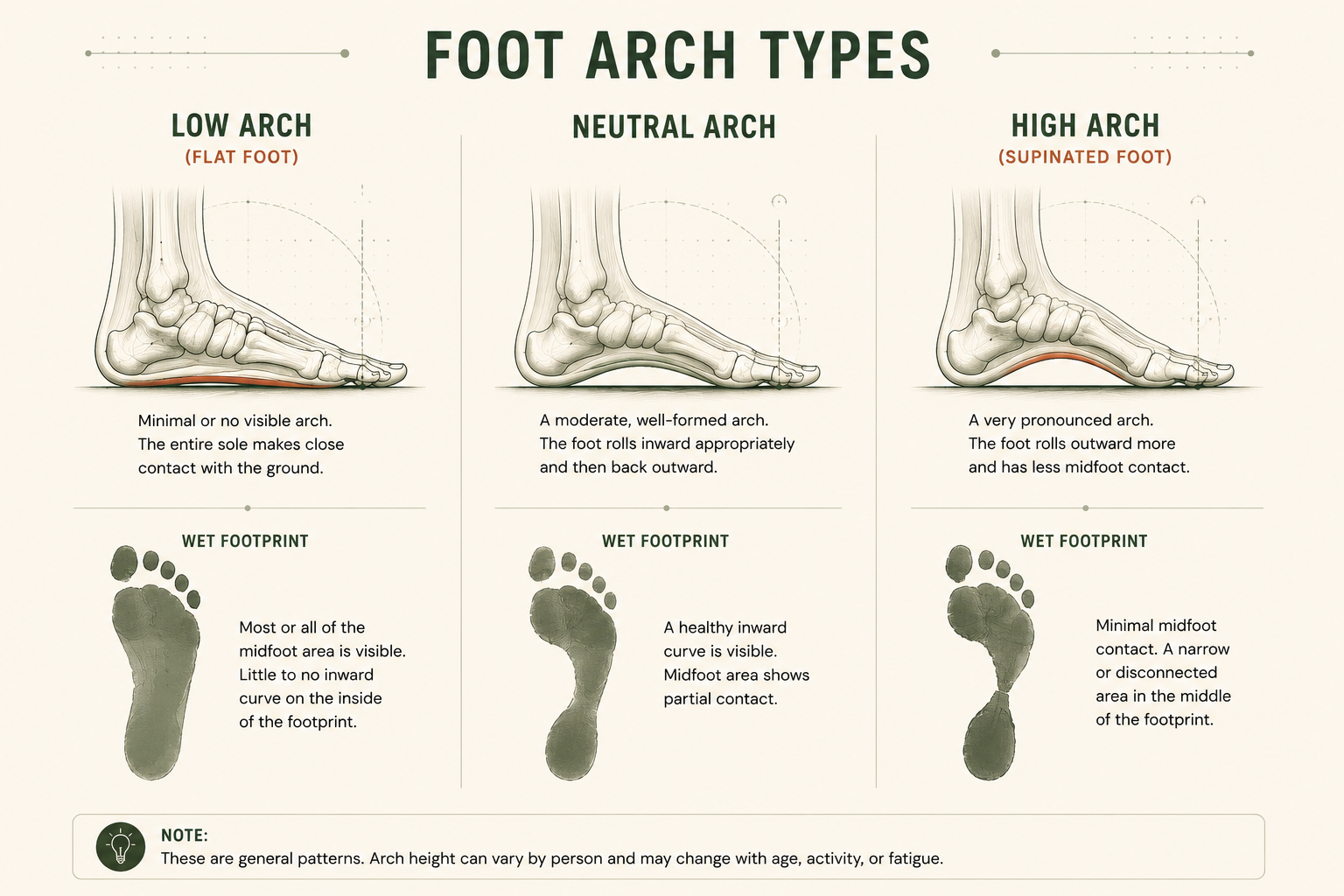
Arch height correlates loosely with pronation tendency, though it's not a perfect predictor on its own.
The wet footprint test is a simple way to get a rough read at home:
For more detail on what arch height means for footwear decisions specifically, see our guide on [how to choose shoes for your foot type].
If you have access to a slow-motion camera (most smartphones have this built in), filming yourself walking or running — ideally from behind, on a treadmill or a straight path — can offer a clearer picture than static tests alone.
Watch the ankle and heel area specifically:
For a more precise read, many running specialty stores offer free or low-cost gait analysis using treadmill video review. Physical therapists, podiatrists, and some orthotics specialists can also perform a more formal assessment, sometimes using pressure-mapping technology that shows exactly where and how force travels across your foot through a full stride.
This level of analysis isn't necessary for everyone, but it can be genuinely useful if you're training seriously, dealing with recurring discomfort, or simply want a precise answer rather than an estimate.
Use this as a quick reference before diving deeper:
These are possible indicators, not a diagnostic checklist. Having one or two of these on their own is common and not necessarily meaningful.
✅ Visible inward rolling of the ankle when standing or walking, viewed from behind
✅ Wear concentrated on the inner edge of your shoe soles
✅ A flatter or lower arch when standing
✅ Shoes that tend to break down or lean inward at the heel over time
✅ A history of discomfort along the inner arch or heel
✅ A sense that your knees track slightly inward during walking or running
✅ Visible outward rolling of the ankle, particularly noticeable during push-off
✅ Wear concentrated on the outer edge of your shoe soles
✅ A higher, more rigid-feeling arch
✅ A history of ankle rolling or a sense of instability on uneven surfaces
✅ Discomfort concentrated along the outer edge of the foot rather than centrally
✅ Shoes that feel like they lose cushioning quickly along the outer edge
This is the question that actually matters more than the label itself, and it trips a lot of people up.
The honest answer: for most people, in most situations, pronation and supination patterns aren't something to "correct" so much as something to accommodate. Pronation and supination aren't dysfunctions waiting to be fixed. They're your particular version of a completely normal mechanism.
That reframes the real decision in front of you. It's less "how do I stop pronating" and more "what kind of footwear works with the way my foot already moves."
There are a few scenarios where deeper intervention — like custom orthotics, physical therapy, or targeted strength work — genuinely makes sense, and we cover those in the professional evaluation section below. But for the average person reading shoe wear patterns off the bottom of their sneakers, the more useful move is usually buying shoes that complement your existing pattern rather than trying to force your foot into someone else's idea of "neutral."
That's also exactly where footwear feature selection becomes useful — which is what the next section is for.
Different footwear features serve different mechanical purposes. None of these are guaranteed fixes, and the right choice depends heavily on individual comfort, not just a textbook gait label.
What it is:
Firmer material along the inner midsole designed to provide additional support.
Potential Benefit:
May help moderate excessive inward roll for those with an overpronation pattern.
What it is:
A reinforced heel cup that helps hold the rearfoot in a more stable position.
Potential Benefit:
May help control rearfoot motion and improve overall shoe fit at the heel.
What it is:
Built-in or removable support designed to match the natural shape of the arch.
Potential Benefit:
May reduce strain on the arch for flatter or more flexible foot types.
What it is:
Additional foam or impact-absorbing material throughout the midsole.
Potential Benefit:
May benefit those with a supination pattern, since their feet naturally absorb less shock on their own.
What it is:
A curved sole design that helps the foot roll smoothly from heel strike to toe-off.
Potential Benefit:
May assist with a smoother, more efficient roll through the gait cycle, particularly for more rigid feet.
What it is:
A shoe design that allows the midsole to bend and move naturally with the foot.
Potential Benefit:
May better accommodate a higher-arch, supinated foot that doesn't need as much structural correction.
What it is:
Additional space in the forefoot area that allows the toes to spread naturally.
Potential Benefit:
Can improve comfort and natural toe splay regardless of pronation pattern.

For a deeper dive into matching specific shoe categories to your foot mechanics, our [overpronation shoe guide] walks through real-world options across categories, from daily walking shoes to running-specific builds, organized by what tends to work well for this pattern.
[IMAGE OPPORTUNITY: A cutaway illustration of a shoe's midsole and heel counter, with labeled call-outs pointing to the stability post, arch support zone, and heel counter structure.]
Once you have a reasonable read on your own pattern, it helps to have a quick reference for what to look for and what to be cautious about. These are general considerations, not strict rules. Comfort and fit should always take priority over matching a category on paper.
✅ Stability features along the inner midsole
✅ A supportive, structured heel counter
✅ A firmer, structured midsole
✅ Moderate, consistent cushioning
❌ Extremely soft, unstable midsoles with no structure
❌ Severely worn-out shoes that have already broken down at the heel
✅ Balanced, all-purpose cushioning
✅ A comfortable, secure fit through the midfoot and heel
✅ A stable, even platform underfoot
❌ Choosing shoes based purely on trend or appearance rather than fit
❌ Ignoring wear and tear simply because your gait is balanced
✅ Extra cushioning to compensate for reduced natural shock absorption
✅ A flexible forefoot that moves with the foot through push-off
✅ Smooth heel-to-toe transitions
✅ A slightly wider landing platform for added stability
❌ Very firm, minimalist shoes during high-impact activity
❌ Excessively rigid midsoles that don't allow natural foot motion
❌ Myth: Pronation is bad and should be stopped.
✅ Fact: Pronation is a normal, necessary part of gait. The goal isn't eliminating it but understanding when excessive pronation may contribute to discomfort.
❌ Myth: Flat feet always overpronate.
✅ Fact: Flat feet are associated with a higher likelihood of overpronation, but not every person with flat feet overpronates significantly. Foot shape alone doesn't determine gait pattern.
❌ Myth: Shoes alone can permanently fix overpronation or supination.
✅ Fact: Footwear can support and accommodate a gait pattern, but it doesn't permanently retrain underlying foot structure or biomechanics on its own.
❌ Myth: Everyone needs a gait analysis before buying shoes.
✅ Fact: A gait analysis can be helpful, especially for serious training or persistent discomfort, but many people find comfortable footwear through simple self-assessment and proper fitting.
❌ Myth: If you don't have pain, your gait pattern doesn't matter.
✅ Fact: Understanding your gait can still be useful, even without pain. It can help guide footwear choices and improve overall comfort during daily activities and exercise.
❌ Myth: Supination is rare and only affects runners.
✅ Fact: Supination is a normal phase of every gait cycle, and a supinated movement pattern can occur in walkers, hikers, and non-athletes as well as runners.
Most people move through life with a pronation or supination pattern that's simply part of who they are, and that's perfectly fine. But there are situations where it's worth bringing in a professional rather than relying on self-assessment alone.
Consider reaching out to a podiatrist, physical therapist, or orthotics specialist if you're dealing with:
Persistent pain that doesn't improve with rest, better-fitting footwear, or a few weeks of reduced activity.
Recurrent injuries in the same area — repeated ankle rolling, recurring shin discomfort, or ongoing arch or heel pain that keeps coming back despite changes you've already made.
Significant gait changes, especially if they came on suddenly or followed an injury, surgery, or a major change in activity level.
Difficulty finding comfortable footwear even after trying multiple shoe types, brands, and features that are generally well-suited to your apparent pattern.
None of these signs are cause for alarm. They're simply signals that your situation might benefit from a more precise, individualized look than a general guide like this one can offer. A professional evaluation can rule things in or out with much more confidence, and often opens up options — like custom orthotics or targeted exercises — that go beyond what footwear alone can address.
Your gait pattern connects to several other foot health topics. These guides go deeper into the specific conditions and decisions mentioned throughout this article:
Is pronation bad?
No. Pronation is a normal, necessary part of how your foot absorbs shock while walking or running. It only becomes a consideration when it's significantly more pronounced than typical, a pattern called overpronation.
Is supination bad?
No. Supination is a normal phase of every gait cycle, particularly during push-off. A supination pattern — where the foot stays in a more outward-rolled position throughout the stride — is simply a variation in mechanics, not inherently a problem.
Can shoes fix overpronation or supination?
Footwear can accommodate and support a particular gait pattern, making movement more comfortable, but shoes don't permanently change underlying foot structure or mechanics. Think of supportive footwear as working with your pattern rather than correcting it.
How do I know my gait type?
A combination of methods works best: checking the wear pattern on your shoes, trying the wet footprint test for arch height, and if possible, filming your walking or running gait from behind. For a precise answer, a professional gait analysis is the most reliable option.
Do flat feet always overpronate?
No. Flat feet are associated with a higher likelihood of overpronation, but it's not automatic. Plenty of people with flatter arches have a fairly neutral or only mildly pronated gait.
Do high arches always mean supination?
Not always, but there is a meaningful association. Higher, more rigid arches tend to limit the inward roll of pronation, which often results in more time spent in a supinated position throughout the gait cycle.
Can your gait pattern change over time?
Yes. Factors like weight changes, injury history, aging, muscle strength, and activity level can all influence gait mechanics over time. It's not necessarily a fixed, lifelong trait.
Does overpronation always cause pain?
No. Many people overpronate without ever developing pain or injury. It's an association, not a guarantee, and individual factors like overall strength, activity level, and footwear choices all play a role.
What's the difference between underpronation and supination?
In casual use, these terms are often used interchangeably to describe a foot that doesn't roll inward much during the gait cycle. Some sources draw a more technical distinction, but for most everyday purposes, they refer to the same general pattern.
Should I buy stability shoes if I overpronate?
Stability features can be a helpful starting point for many people with an overpronation pattern, but comfort and fit should still come first. The best shoe is one that feels supportive and comfortable for your specific foot, not just one that matches a textbook category.
This article is for educational purposes and is not a substitute for individualized medical or biomechanical evaluation. If you're experiencing persistent foot or ankle pain, consider speaking with a podiatrist, physical therapist, or other qualified professional.