

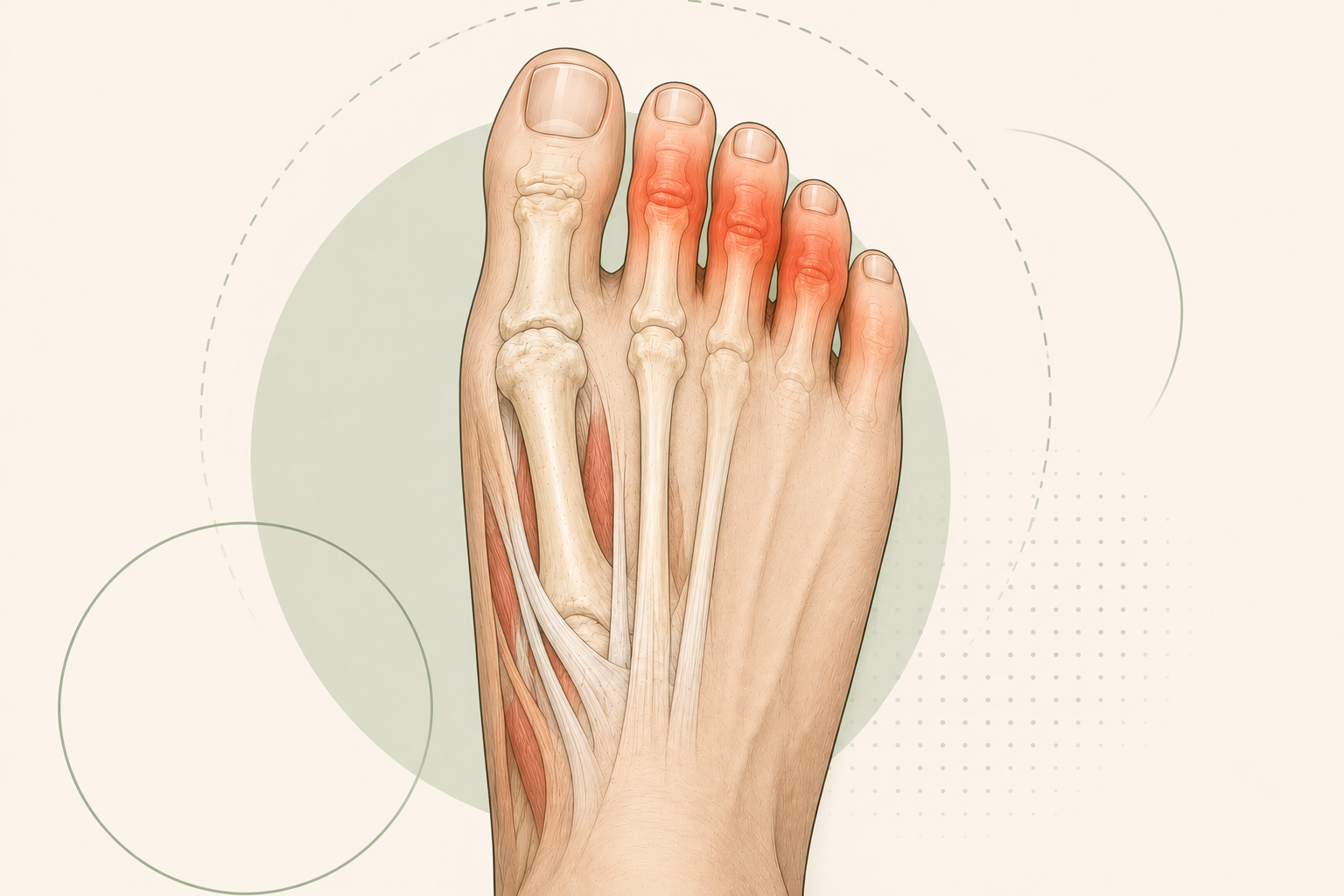
Toe pain can stem from a wide range of causes, including bunions, arthritis, gout, and nerve conditions. Learn what your symptoms might mean and how to find relief.
Toe pain can result from bunions, arthritis, gout, nerve irritation, injuries, and footwear-related pressure. Understanding where your pain occurs and how it behaves can help identify the most likely cause and guide treatment.
Your toes do more work than they get credit for. Every step you take, they absorb force, help you balance, and push you forward. So when one of them starts hurting, even a little, it can throw off everything from your gait to your mood about getting out of bed.
Toe pain can come from a lot of different places. Sometimes it's a shoe that's too narrow. Sometimes it's an old injury that never quite healed right. Sometimes it's a sign of something happening deeper in the joint, like arthritis or gout. The pain itself can show up as a dull ache, a sharp jab, a burning sensation, or even numbness and tingling.
The good news is that where your pain is located, and how it behaves, usually gives real clues about what's going on. This guide walks through the most common causes of toe pain, how each one tends to feel, and what you can do about it, including when it's time to stop guessing and see a doctor.
Toe pain is most often caused by bunions, arthritis, gout, ingrown toenails, hammertoes, or injuries like fractures and turf toe. Nerve-related conditions like Morton's neuroma or neuropathy can also cause burning or tingling in the toes. Most toe pain improves with rest, proper footwear, and conservative care. See a doctor if you have severe swelling, can't bear weight, notice signs of infection, or have pain that lasts more than a few weeks.
Toe pain is discomfort, soreness, or sharp sensations affecting one or more toes, ranging from mild irritation to pain severe enough to affect walking. It can be caused by joint conditions, nerve irritation, footwear pressure, structural changes in the foot, or direct injury.
Your toes experience an outsized amount of stress for their size. Every time you take a step, your big toe joint alone absorbs roughly 40 to 60 percent of your body weight during the push-off phase of your stride. Multiply that by thousands of steps a day, and it becomes easier to understand why small problems in the toes can turn into persistent pain.
Common symptoms associated with toe pain include:
Foot pain in general can sometimes be mistaken for toe pain, especially when discomfort radiates forward from another part of the foot. This quick comparison can help confirm whether your symptoms are actually centered in the toes.
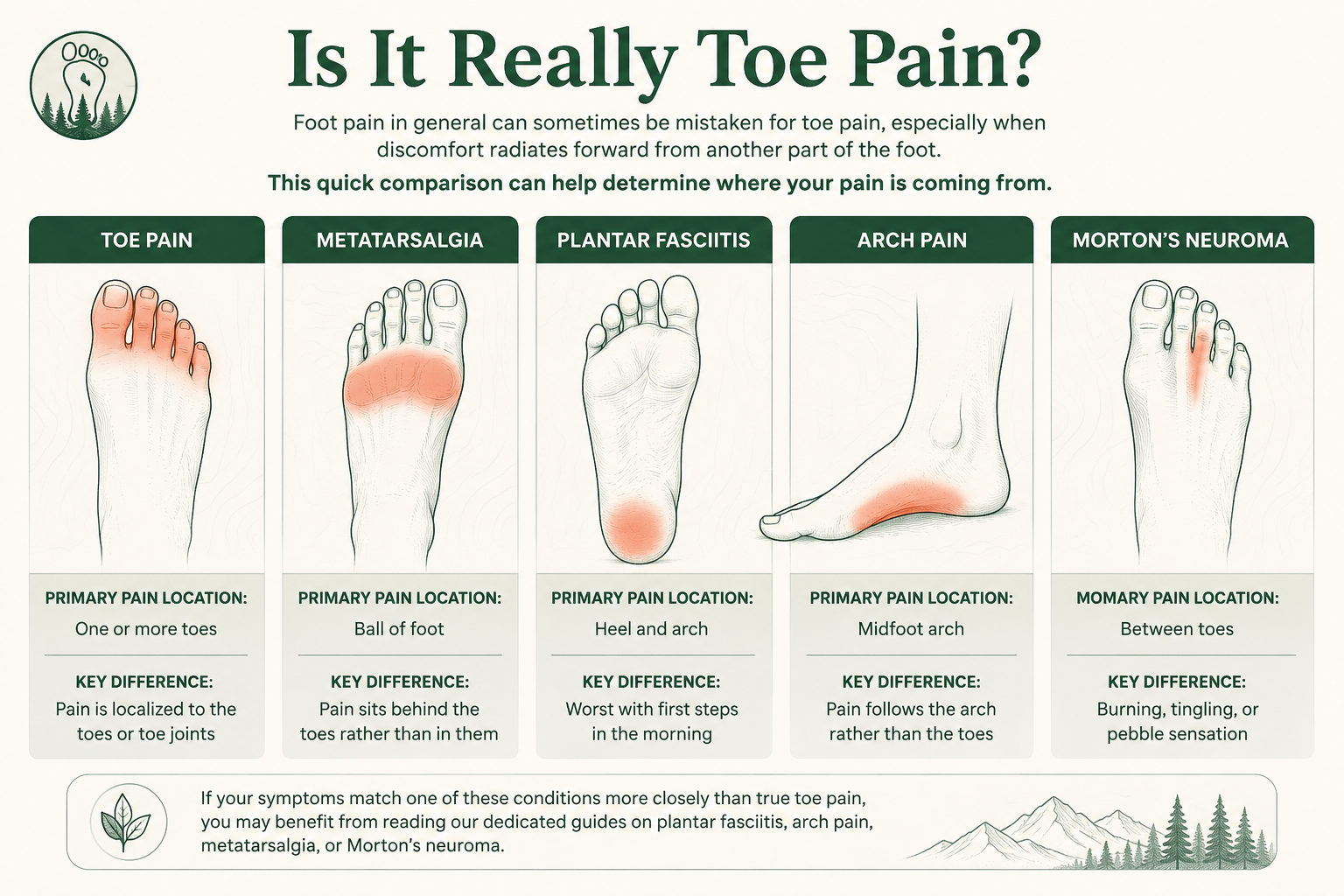
Toe Pain
Metatarsalgia
Plantar Fasciitis
Arch Pain
Morton's Neuroma
If your symptoms match one of these conditions more closely than true toe pain, you may benefit from reading our dedicated guides on plantar fasciitis, arch pain, metatarsalgia, or Morton's neuroma.
If your pain matches one of the other rows more closely than the toes themselves, it may be worth reading our dedicated guides on plantar fasciitis or arch pain instead.
Toe pain rarely shows up the same way for everyone. The type of sensation you're feeling can actually help point toward the underlying cause, which is why it's worth paying attention to the specific quality of the pain, not just its location.
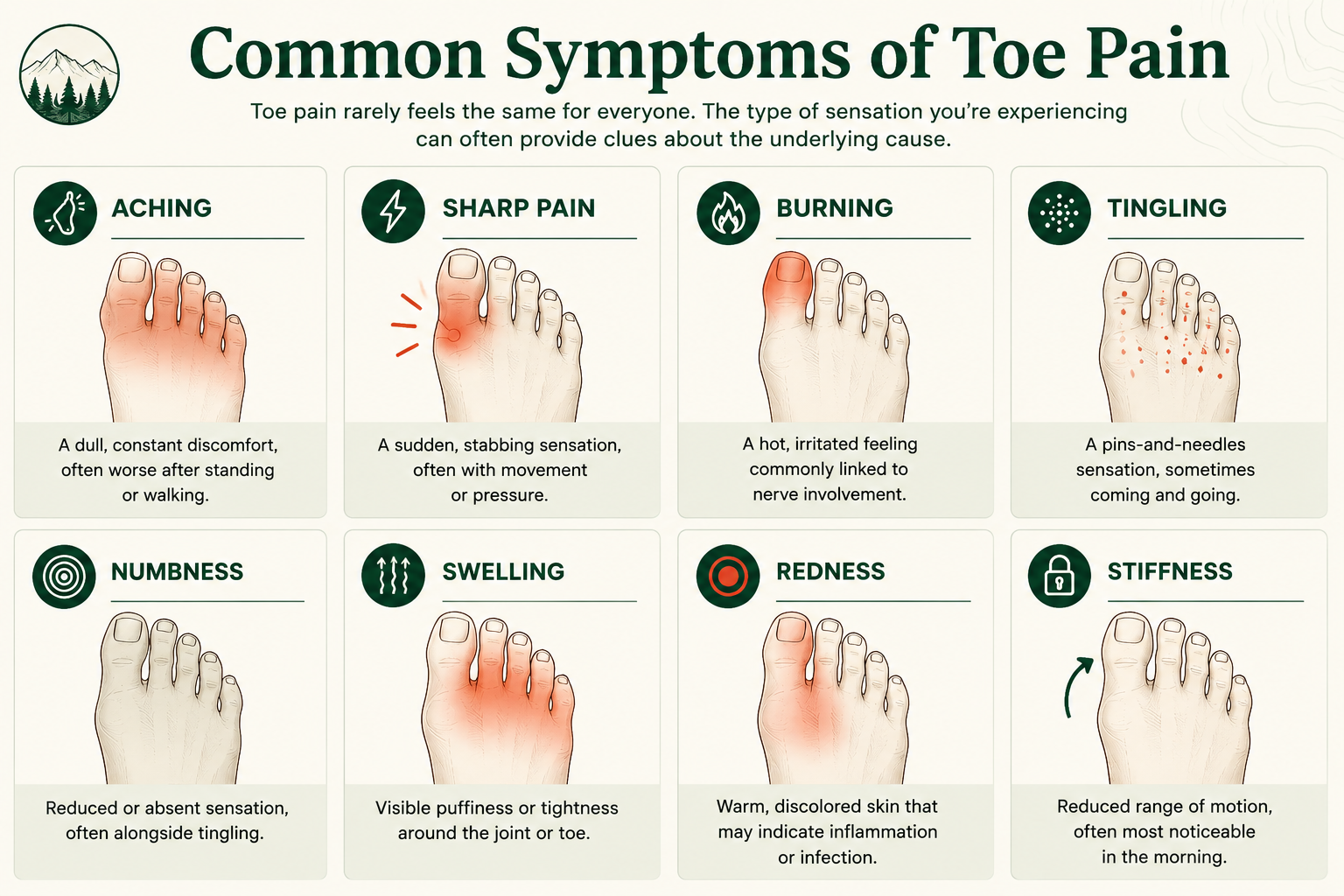
Aching
Sharp Pain
Burning
Tingling
Numbness
Swelling
Redness
Stiffness
If your pain involves more than one of these symptoms at once, such as burning combined with numbness, or swelling combined with redness and warmth, that combination is often more diagnostically useful than any single symptom on its own.
Understanding what's actually inside your toe makes it much easier to understand why pain happens in the first place.
Phalanges are the small bones that make up each toe. Your big toe has two phalanges, while the other four toes each have three. These bones can fracture, develop arthritis, or shift out of alignment.
Metatarsophalangeal (MTP) joints are where your toes meet the rest of your foot, at the base of each toe. These joints handle an enormous amount of load during walking and running, which makes them a frequent site of pain from arthritis, gout, bunions, and turf toe.
Tendons connect muscles to bones and allow your toes to flex and extend. Tendon irritation can cause pain that worsens with specific movements, like curling your toes or pushing off the ground.
Ligaments connect bone to bone and stabilize the toe joints. Ligament damage, such as in turf toe, often causes instability alongside pain.
Nerves run through the spaces between your toes and along the sides of your feet. When compressed or irritated, they can cause burning, tingling, or numbness rather than the typical dull ache associated with joint problems.
Blood vessels supply circulation to the toes. Poor circulation can contribute to slow healing, color changes, and in some cases, pain that worsens with cold temperatures.
Because all of these structures sit so close together in a small space, multiple unrelated conditions can produce strikingly similar symptoms. This is one reason toe pain is often harder to self-diagnose than it seems.
Several different conditions can cause toe pain, and many of them share overlapping symptoms. Below are the most common causes, along with what tends to set each one apart.
Age is a useful, often overlooked factor in narrowing down toe pain. Certain conditions cluster more heavily in some age groups than others.
Children & Teens
Ages 20 to 40
Ages 40 to 60
Ages 60 and Older
These are general patterns rather than firm rules. Any of these conditions can technically occur at any age, but understanding where you fall on this spectrum can help you and your doctor prioritize the most likely explanations first.
A bunion is a bony bump that forms at the base of the big toe, where it meets the foot. Over time, the big toe gradually drifts toward the second toe, which causes the joint at its base to protrude outward. Bunions are common, affecting roughly 23 percent of adults aged 18 to 65 and closer to 36 percent of adults over 65, with women affected more often than men (Nix et al., 2010).
Bunions often cause:
Tight, narrow shoes don't cause bunions outright, but they frequently accelerate symptoms and discomfort once a bunion has started to form. For a deeper look at causes, prevention, and treatment options, see our full guide on bunions.
Arthritis in the toes most commonly shows up as osteoarthritis, the wear-and-tear breakdown of cartilage that cushions the joint. When this occurs specifically in the big toe joint, it's called hallux rigidus, a condition marked by progressive stiffness and reduced range of motion. Research suggests hallux rigidus affects somewhere between 18 and 27 percent of adults over age 50, making it one of the more common arthritic conditions of the foot (Nawata et al., 2021).
Typical signs include:
Unlike an acute injury, arthritis tends to develop slowly and worsen over months or years rather than appearing suddenly. Joint stiffness in the toes can sometimes overlap with other foot conditions, including arch pain and flat feet, since changes in one part of the foot's structure often affect how load is distributed elsewhere.
Gout is a form of inflammatory arthritis caused by a buildup of uric acid crystals in the joints. It has a reputation for targeting the big toe joint specifically, a condition called podagra, which is the first joint affected in roughly half of all gout cases and is eventually involved in about 90 percent of cases over the course of the disease (Roddy, 2011).
Gout flares are usually unmistakable once they start:
Because gout symptoms come on so suddenly and severely, it's one of the few causes of toe pain where most people seek care right away rather than waiting it out.
A hammertoe is a deformity in which one of the smaller toes bends abnormally at the middle joint, creating a claw-like or hammer-like shape. This change in position creates new pressure points against the top of the shoe.
Common symptoms include:
Hammertoes often develop gradually and can worsen if footwear continues to crowd the toes. Choosing shoes with a wide, deep toe box is one of the most effective ways to slow progression. Our guide to best shoes for foot pain covers footwear options designed with this kind of room in mind.
Turf toe is a sprain of the ligaments supporting the big toe joint, caused by hyperextension, when the toe is forced upward beyond its normal range of motion. It's especially common in athletes who play on artificial turf or in sports involving quick stops and pushing off, like football, soccer, and basketball.
Signs of turf toe include:
Mild cases may resolve with rest, while more severe ligament damage can take weeks to heal properly.
Toe fractures usually result from direct trauma, like stubbing your toe on furniture, dropping something heavy on your foot, or twisting it awkwardly during activity.
Typical symptoms include:
A common myth is that you can always tell a fracture apart from a bad bruise just by whether you can still walk. That's not reliable, which is one reason persistent pain after a stubbing injury is worth having checked.
An ingrown toenail occurs when the edge of the nail grows into the surrounding skin instead of straight across, most often affecting the big toe.
This typically causes:
Ingrown toenails are usually straightforward to manage early on, but they can become more painful and infection-prone if left untreated.
Morton's neuroma is a thickening of tissue around one of the nerves leading to the toes, most commonly between the third and fourth toes. It's a nerve-related condition rather than a joint or bone problem, and it occurs roughly eight times more often in women than men, typically between the ages of 30 and 60 (OrthoInfo, AAOS).
People with Morton's neuroma often describe:
Symptoms often worsen with tight or narrow footwear and improve when shoes are removed.
Peripheral neuropathy refers to nerve damage that can cause pain, numbness, or altered sensation, frequently affecting the feet and toes. It has several possible causes, with diabetes being one of the most common.
Neuropathy in the toes often presents as:
Because reduced sensation can mask other injuries, neuropathy deserves particular attention and monitoring. Our full guide on neuropathy and foot health covers this in more depth.
Metatarsalgia refers to pain and inflammation in the ball of the foot, just behind the toes. While it's centered in the metatarsal area rather than the toes themselves, the pain frequently radiates forward into the toes, especially during walking.
Common features include:
Metatarsalgia sometimes develops alongside other overuse conditions in the foot, including plantar fasciitis and heel pain, particularly in people who spend long hours on their feet.
Where your pain shows up can help narrow down likely causes, though it's not a substitute for professional evaluation.

Big Toe Joint
Pain at the base of the big toe is commonly associated with bunions, gout, arthritis (hallux rigidus), and turf toe injuries.
Top of the Toe
Pain on the top of the toe is often linked to hammertoes, corns, or pressure from tight footwear.
Bottom of the Toe or Ball of the Foot
Pain underneath the toes may be caused by metatarsalgia, calluses, or irritation of nearby nerves.
Between the Toes
Burning, tingling, or discomfort between the toes may point to Morton's neuroma, fungal infections, or skin irritation.
Entire Toe
Pain affecting the entire toe is more commonly seen with fractures, infections, or gout flares.
Multiple Toes
Pain involving several toes at once may be related to neuropathy, arthritis, or footwear that places excessive pressure on the forefoot.
This table is meant as a general guide, not a diagnostic tool. Many conditions overlap in how they present, and an accurate diagnosis typically requires a physical exam and, in some cases, imaging.
Beyond location alone, the specific pattern of how symptoms appear and behave is often even more telling.
Sudden Severe Big Toe Pain Overnight
Burning Between the Toes
Bent Toe with Shoe Irritation
Painful Bump at the Big Toe Joint
Morning Stiffness in the Big Toe
Pain After Stubbing a Toe
Walking places unique mechanical demands on the toes that standing still simply doesn't. During the push-off phase of your stride, your toes bend, bear weight, and propel your body forward, all at once.
A few factors explain why this phase tends to aggravate toe pain:
This is also why many people notice their toe pain is mild in the morning, manageable midday, and significantly worse by evening after walking has accumulated throughout the day.
Footwear is rarely the sole cause of an underlying condition, but it's frequently the difference between mild discomfort and significant pain. Several specific footwear issues tend to be repeat offenders.
If you've noticed your toe pain tracks closely with which shoes you wear, footwear is likely playing a meaningful role in your symptoms, even if it isn't the original cause. Choosing shoes built around foot health rather than just style is one of the most practical changes you can make, and it's a topic we cover in depth across our footwear guides.
Diagnosing the cause of toe pain typically starts with a conversation and a physical exam, then moves to imaging if needed.
Treatment for toe pain depends heavily on the underlying cause, but many approaches overlap across conditions, especially in the early stages.
Reducing high-impact activity and giving an irritated joint or injury time to settle down is often the first and most important step, particularly for fresh injuries like turf toe or fractures.
Applying ice for 15 to 20 minutes at a time can help reduce swelling and pain, especially in the first 48 hours after an acute injury or flare-up.
Gentle stretching of the toes and surrounding muscles can help maintain flexibility, particularly for conditions like hallux rigidus where stiffness is a primary concern.
Strengthening the small muscles of the foot can improve stability and reduce strain on the toe joints over time, which may help with conditions like metatarsalgia and hammertoes.
Switching to shoes with more room in the toe box and less pressure on sensitive areas is one of the most accessible and effective changes most people can make.
Custom or over-the-counter orthotics can redistribute pressure away from painful areas, particularly helpful for metatarsalgia, bunions, and Morton's neuroma.
Over-the-counter anti-inflammatory medications can help manage pain and swelling. Gout flares may require specific prescription medications to address uric acid levels directly.
When conservative treatment doesn't resolve symptoms, options range from corticosteroid injections to surgical correction for severe bunions, hammertoes, or chronic neuroma pain. Surgery is typically considered a later step rather than a first response.
While not every cause of toe pain is preventable, particularly genetic or age-related conditions like arthritis, several habits can meaningfully lower your risk or slow progression.
Prevention is rarely about a single change. It's the combination of supportive footwear, reasonable activity habits, and paying attention early when something feels off that tends to make the biggest difference over time.
Many conditions that eventually cause significant toe pain start with subtle symptoms that are easy to brush off. Catching these early often makes treatment simpler and prevents the problem from progressing.
Watch for:
None of these signs are cause for alarm on their own, but addressing them early, often through a footwear change or a brief period of rest, often prevents more significant discomfort later.
Footwear doesn't cure the underlying conditions causing toe pain, but the right features can meaningfully reduce the forces aggravating your symptoms day to day.

Wide Toe Box
Rounded Toe Shape
Flexible Forefoot
Stable Midsole
Rocker Sole
Cushioning
Secure Heel Fit
Most toe pain is manageable with conservative care, but certain signs warrant prompt medical attention rather than a wait-and-see approach.
See a doctor if you experience:
❌ Myth: Toe pain is always caused by tight shoes.
✅ Fact: Many medical and biomechanical conditions can cause toe pain independent of footwear.
❌ Myth: If I can walk on it, it isn't serious.
✅ Fact: Some fractures, arthritis conditions, and tendon injuries still allow walking.
❌ Myth: Bunions are only cosmetic.
✅ Fact: Bunions can affect joint mechanics, comfort, and function, not just appearance.
❌ Myth: All big toe pain is gout.
✅ Fact: Arthritis, bunions, turf toe, and several other conditions can also affect the big toe joint.
❌ Myth: Surgery is always required for chronic toe pain.
✅ Fact: Most causes of toe pain improve with conservative treatment, activity modifications, and appropriate footwear.
Walking puts significant load on the toe joints, especially during push-off. If you have an underlying condition like arthritis, a bunion, or a nerve issue, that mechanical stress often makes symptoms more noticeable than when you're resting.
Sudden, intense big toe pain is a hallmark of gout, but it can also result from turf toe, a fracture, or an acute flare of arthritis. The speed of onset and severity of pain are useful clues for a doctor in narrowing down the cause.
Shoes don't typically cause underlying conditions like arthritis or gout, but tight, narrow, or poorly fitted footwear can aggravate bunions, hammertoes, and nerve-related pain considerably.
Pain accompanied by severe swelling, inability to bear weight, signs of infection, or symptoms lasting more than a few weeks are reasons to see a doctor rather than continue managing it on your own.
Bunions, arthritis, and ingrown toenails are among the most common causes seen in clinical practice, though the most likely cause depends heavily on the pain's location and how it developed.
Yes. Osteoarthritis frequently affects the big toe joint, a condition known as hallux rigidus, causing stiffness and pain that typically worsens gradually over time.
Recovery time varies widely by cause. Minor strains may improve within days to weeks, while fractures and ligament injuries like turf toe can take six to eight weeks or longer. Chronic conditions like arthritis are managed long-term rather than fully resolved.
Yes. Conditions like Morton's neuroma and peripheral neuropathy cause pain through nerve irritation or damage rather than joint or bone issues, often producing burning, tingling, or numbness instead of a typical ache.
Yes. Flat feet can change how weight is distributed across the foot, increasing stress on the forefoot and toe joints. Over time, this altered biomechanics may contribute to bunions, metatarsalgia, and other causes of toe discomfort.
Toe pain has a wide range of possible causes, from structural issues like bunions and hammertoes to nerve conditions, arthritis, and acute injuries. The location of your pain and the specific sensations you're experiencing, whether that's a sharp ache, burning, or numbness, can offer real clues about what's happening beneath the surface.
While many causes of toe pain improve with conservative care, persistent symptoms shouldn't be ignored. The earlier you identify the underlying cause, the easier it is to address the factors contributing to pain and prevent further progression.
Supportive footwear, proper foot mechanics, and early intervention often play a significant role in long-term comfort. If your symptoms aren't improving, consider speaking with a healthcare professional for a proper evaluation.
This article is for educational purposes only and is not a substitute for professional medical advice, diagnosis, or treatment. Always consult a qualified healthcare provider regarding any foot pain or medical condition.